


Your Starter Kit for Slow-Release Liquid NPK Fertilizer Success


In the evolving landscape of precision agriculture, maintaining a competitive edge means adopting the most efficient nutrient delivery systems. Traditional fertilizers often release nutrients too quickly, causing leaching, volatilization, and reduced nutrient uptake by crops. While traditional granular applications still have their place, the industry is rapidly shifting toward specialized liquid formulations. Among these, slow-release liquid NPK fertilizer stands out as a critical tool for modern commercial growers.
For fertilizer manufacturers and agricultural suppliers, understanding the fundamentals of Slow-release liquid NPK fertilizer production is essential for entering one of the fastest-growing segments of the specialty fertilizer market. With advanced liquid fertilizer production system from LANE Heavy Industry, companies can efficiently manufacture high-quality Slow-release liquid NPK fertilizer products that meet the needs of modern farming operations.
What Is Slow-Release Liquid NPK Fertilizer?
Slow-release liquid NPK fertilizer is a liquid nutrient formulation engineered to release essential plant nutrients gradually rather than immediately. The fertilizer contains nitrogen (N), phosphorus (P), and potassium (K) in carefully balanced ratios, often combined with stabilizers or controlled-release technologies that extend nutrient availability.
Unlike conventional liquid fertilizers, Slow-release liquid NPK fertilizer helps maintain a more consistent nutrient supply, allowing crops to absorb nutrients when they are needed most. This improves fertilizer utilization efficiency and supports healthier plant growth throughout the growing season.
Why Farmers Choose Slow-Release Liquid NPK Fertilizer
The increasing adoption of Slow-release liquid NPK fertilizer is driven by several practical benefits:

Improved Nutrient Efficiency: One of the biggest advantages of Slow-release liquid NPK fertilizer is its ability to reduce nutrient losses. Nutrients remain available in the root zone longer, resulting in higher uptake rates and improved fertilizer performance.
Reduced Application Frequency: Because Slow-release liquid NPK fertilizer provides nutrients over an extended period, growers often require fewer fertilizer applications. This lowers labor costs and simplifies nutrient management.
Enhanced Crop Growth: A consistent nutrient supply helps plants avoid periods of deficiency or excess. As a result, Slow-release liquid NPK fertilizer can contribute to stronger root development, improved flowering, and higher yields.
Environmental Benefits: Reducing nutrient runoff and leaching is increasingly important in sustainable agriculture. Slow-release liquid NPK fertilizer helps minimize environmental impacts while maintaining crop productivity.
Essential Components of a Slow-Release Liquid NPK Fertilizer Production Line
Producing premium-quality Slow-release liquid NPK fertilizer requires specialized machinery and precise process control. LANE Heavy Industry offers complete fertilizer manufacturing systems designed to meet industrial production requirements.
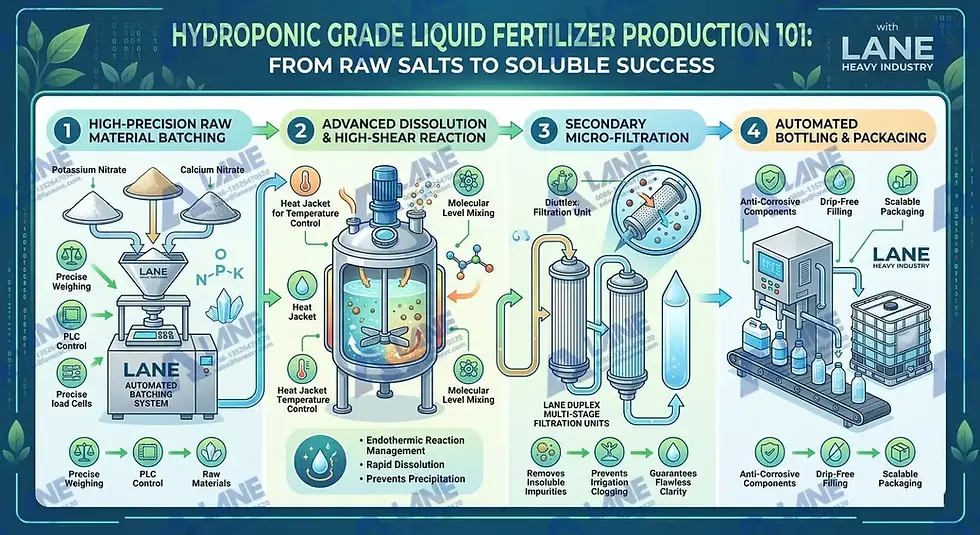
Raw Material Storage and Feeding System: The production process begins with the storage and accurate dosing of nitrogen, phosphorus, potassium, and additive materials. Automated feeding systems ensure consistent formulations for every batch of Slow-release liquid NPK fertilizer.
Dissolution and Mixing Equipment: Raw materials are dissolved and blended in high-efficiency mixing tanks. Proper mixing ensures that all nutrients are evenly distributed throughout the Slow-release liquid NPK fertilizer solution.
Reaction System: The reaction stage is one of the most critical parts of manufacturing Slow-release liquid NPK fertilizer. Specialized reaction kettles maintain precise temperature, pressure, and pH conditions to create stable nutrient complexes and controlled-release characteristics.
Filtration and Purification Units: To guarantee product quality, the solution passes through filtration systems that remove impurities and undissolved particles. These units help maintain the stability and clarity of the final Slow-release liquid NPK fertilizer product.
Aging and Storage Tanks: Following filtration, the fertilizer is transferred to aging tanks where chemical stabilization occurs. This step enhances the shelf life and effectiveness of Slow-release liquid NPK fertilizer.
Filling and Packaging Systems: Automated filling machines package the finished product into bottles, drums, or bulk containers for commercial distribution.
Why Choose LANE Heavy Industry for Fertilizer Production Equipment?
LANE Heavy Industry specializes in complete fertilizer production solutions for manufacturers worldwide. Whether producing conventional fertilizers or advanced Slow-release liquid NPK fertilizer, the company provides customized systems designed for efficiency and reliability.
Key advantages include:
Automated production control
High mixing efficiency
Stable reaction technology
Energy-saving operation
Flexible production capacities
Customized plant design
Comprehensive technical support
These advantages help fertilizer producers achieve consistent quality while reducing operational costs.

Quality Control Essentials
Quality control is non-negotiable for Slow-release liquid NPK fertilizer. Every batch must be tested for:
Nutrient content (N, P, K levels)
pH and density
Viscosity and stability
Compatibility with irrigation equipment
Shelf-life performance
A stable formula prevents returns, protects your brand, and builds customer trust. Documenting QC results also helps you troubleshoot formulation issues and optimize production efficiency.
Application Benefits for Growers
Growers adopt Slow-release liquid NPK fertilizer because it:
Provides uniform nutrient supply
Reduces leaching and runoff
Improves uptake efficiency
Requires fewer application cycles
Integrates easily with fertigation
Supports consistent crop performance
These benefits make your product attractive to commercial growers, greenhouse operators, and precision farming systems.
FAQ
What is the main advantage of Slow-release liquid NPK fertilizer?
It provides steady nutrient release, reducing waste and improving uptake efficiency compared to fast-acting liquids.
Can it be used in fertigation systems?
Yes, most formulations are designed for fertigation, but solubility and filtration must be controlled to prevent clogging.
What machinery do I need to produce it?
You need storage tanks, dosing systems, mixing reactors, homogenizers, pumps, filtration units, control panels, and filling machines. LANE Heavy Industry can supply this complete package.
How long does nutrient release take?
Release timing depends on formulation design, but typical slow-release liquids provide nutrition over 2–6 weeks.
Is Slow-release liquid NPK fertilizer more expensive?
It often has higher per-liter costs than standard liquids, but lower application frequency and improved efficiency can reduce total cost per acre.
Email: sales@lanesvc.com
Contact number: +86 13526470520
Whatsapp: +86 13526470520

Comments