


Maximizing Yield: Choosing the Right Microbial Stabilizers for Commercial Bio Mineral Liquid Fertilizer Production

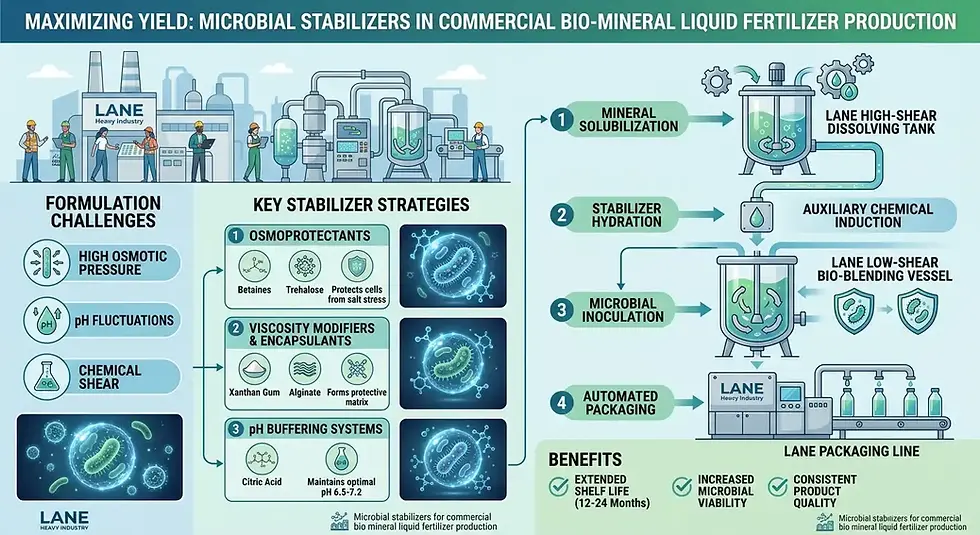
Achieving maximum agricultural output requires a delicate balance of fast-acting mineral nutrition and long-term soil biology. While liquid bio-mineral fertilizers represent a breakthrough in crop yield optimization, mixing living microbial inoculants with dense mineral salts creates an aggressive chemical ecosystem that routinely destroys cell walls. To prevent this, commercial agricultural input brands must select specialized microbial stabilizers for commercial bio mineral liquid fertilizer production to induce metabolic dormancy and protect fragile cells during storage.
Producing stable and effective product requires more than just mixing nutrients and microorganisms. The key to high-performance fertilizer lies in combination of advance automated machinery and microbial stabilizers for commercial bio mineral liquid fertilizer production. LANE Heavy Industry has manufactured a production line that can create liquid fertilizer with beneficial microorganisms, extend shelf life, and ensure consistent field performance.
Why Microbial Stabilizers Are Critical for Yield Maximization
The effectiveness of liquid bio mineral fertilizers depends heavily on microbial survival. Without proper stabilization, microbial populations decline rapidly during storage and transportation.
This is why microbial stabilizers for commercial bio mineral liquid fertilizer production are essential in modern fertilizer manufacturing.
They help:
Maintain microbial viability
Prevent nutrient imbalance
Improve nutrient uptake efficiency in soil
Extend shelf life of the product
Ensure consistent crop yield results
When microbial activity is preserved, plants benefit from improved nitrogen fixation, phosphorus solubilization, and root development.

Key Functions of Microbial Stabilizers for Commercial Production
1. Protecting Microbial Cells
The main role of microbial stabilizers for commercial bio mineral liquid fertilizer production is to protect bacteria and fungi from environmental stress such as heat, pH changes, and osmotic pressure.
2. Enhancing Shelf Life
Stabilizers allow liquid fertilizers to remain effective for 12–24 months, depending on formulation and storage conditions.
3. Improving Nutrient Compatibility
In bio mineral fertilizers, high salt concentrations can harm microbes. Stabilizers reduce toxicity and maintain balance between minerals and microorganisms.
4. Increasing Field Efficiency
Well-preserved microbes colonize plant roots more effectively, improving nutrient absorption and ultimately increasing yield.
Key Categories of Microbial Stabilizers
To maximize yield, manufacturers must choose stabilizers based on the specific strain and mineral matrix. Common categories include:
1. Protective Carbohydrates and Polyols
Sugars (e.g., sucrose, glucose) and polyols (e.g., glycerol, mannitol) act as osmoprotectants. They balance the internal pressure of microbial cells against the high salt concentration of bio mineral liquids. This category is essential for formulations microbial stabilizers for commercial bio mineral liquid fertilizer production that rely on high-conductivity nutrient packs.
2. Natural Gums and Polymers
Guar gum, xanthan gum, and alginate derivatives improve suspension stability. They reduce settling and prevent cell clumping, ensuring uniform dosing. Gums also create a physical barrier that protects cells from oxidative stress.
3. Protein-Based Protectants
Caseinates, yeast extracts, and gelatin provide buffering capacity. They help maintain pH stability and supply nitrogen sources that support microbial dormancy and rapid revival upon application.
4. Buffering and Antioxidant Systems
pH buffers (e.g., phosphates, citrates) maintain the solution within a strain-friendly range (typically 6.0–7.5 for most bacteria). Antioxidants like ascorbic acid or sodium metabisulfite prevent oxidative damage during storage.
Integrating Stabilizers with LANE Heavy Industry Machinery
The effectiveness of microbial stabilizers for commercial bio mineral liquid fertilizer production is heavily influenced by processing equipment. High shear, heat, and contamination can negate the benefits of expensive stabilizers.
Your choice of machinery from LANE Heavy Industry is critical to preserving viability. LANE’s specialized fertilizer production lines are designed for low-shear, temperature-controlled processing:
Reactor Tanks: LANE’s corrosion-resistant, jacketed reactors allow precise temperature control during the mixing of stabilizers and mineral solutions, preventing thermal shock to microbes.
Mixing Systems: The low-shear agitators in LANE mixers ensure that stabilizers are homogenized without damaging microbial cell walls. This is vital when dealing with delicate strains like Bacillus or Pseudomonas.
Filtration & Filling: LANE’s inline filtration removes particulates without clogging, while their aseptic filling lines minimize contamination risks, ensuring the stabilizer package remains effective until the product reaches the end-user.
Technical Summary of Bio-Mineral Formulation Parameters
Formulation Component | Target Function | Recommended Processing Equipment |
Chelated Minerals (NPK + Trace) | Primary Crop Nutrition | LANE High-Shear Dissolving Tank |
Osmoprotectants (Trehalose/Betaine) | Intracellular Osmotic Balancing | LANE Auxiliary Chemical Induction System |
Viscosity Hydrocolloids (Xanthan/CMC) | Suspension & Mineral Isolation | LANE Powder-Liquid Blending Loop |
Living Inoculants (PGPR/Bacillus spp.) | Biological Activity & Yield Boost | LANE Low-Shear Bio-Blending Vessel |

Formulation Strategy for Maximum Yield
A successful formulation follows a strict sequence:
Dissolve Minerals First: Create the base nutrient solution (NPK, Ca, Mg, etc.).
Add Stabilizers: Incorporate carbohydrates, gums, and buffers. Ensure complete dissolution.
Cool the Batch: Adjust temperature to <30°C (strain-specific).
Inoculate Microbes: Add microbial strains last to minimize exposure to heat/shear.
Gentle Mixing: Use LANE’s low-shear pumps and mixers to ensure uniformity without cell damage.
This sequence ensures that microbial stabilizers for commercial bio mineral liquid fertilizer production function as a protective matrix rather than just a
FAQ
Q1: What is the most common stabilizer for liquid biofertilizers?
Glycerol and xanthan gum are widely used for osmoprotection and suspension stability.
Q2: Can stabilizers affect nutrient availability?
Generally, no. Properly selected stabilizers are inert regarding nutrient uptake but improve physical stability.
Q3: When should microbes be added during production?
Always add microbes after the mineral/stabilizer solution has cooled (<30°C) to prevent thermal death.
Q4: How does LANE machinery help stabilizer performance?
LANE’s low-shear mixers and temperature-controlled reactors prevent physical and thermal damage to the stabilizer-microbe complex.
Email: sales@lanesvc.com
Contact number: +86 13526470520
Whatsapp: +86 13526470520


Comments