


Slow-Release Liquid Nitrogen Fertilizer Manufacturing Process


Modern agriculture focuses on nutrient efficiency and environmental sustainability. This has led to rapid innovation in the fertilizer industry. Among these technologies slow-release liquid nitrogen fertilizer has become a preferred solution for growers worldwide. Unlike commercial technologies, slow-release liquid nitrogen fertilizer is designed to provide a steady supply of nitrogen over an extended period. It helps crop absorb nutrients more efficiently over a period of time.
However, manufacturing efficient fertilizer requires industrial grade machine that can handle the production of slow release fertilizer. Its production requires a carefully controlled manufacturing process supported by advanced industrial equipment such as blending, reaction, and automation systems provided by LANE Heavy Industry. Our Liquid fertilizer production line is manufactured with energy saving technologies.
What Is Slow-Release Liquid Nitrogen Fertilizer?
Slow-release liquid nitrogen fertilizer is a liquid nutrient formulation that gradually makes nitrogen available to plants over time. This controlled-release mechanism improves nitrogen use efficiency and reduces the frequency of fertilizer applications.
The formulation typically combines nitrogen sources with stabilizers, inhibitors, or specialty additives that slow the conversion of nitrogen into forms susceptible to environmental loss. As a result, slow-release liquid nitrogen fertilizer supports healthier crop growth while minimizing nutrient waste.
Overview of the manufacturing process
The core steps in producing slow-release liquid nitrogen fertilizer typically include:
Raw material preparation and storage
Metering and batching of nitrogen sources and additives
Chemical reaction or complexation (if required by the formulation)
High-efficiency blending and homogenization
Filtration and impurity removal
Storage and final packaging
Lane Heavy Industry provides equipment such as liquid fertilizer production lines, blending systems, stirred reactors, and chemical fertilizer machinery that can be integrated into this process flow.

The Core Stages of the Manufacturing Process
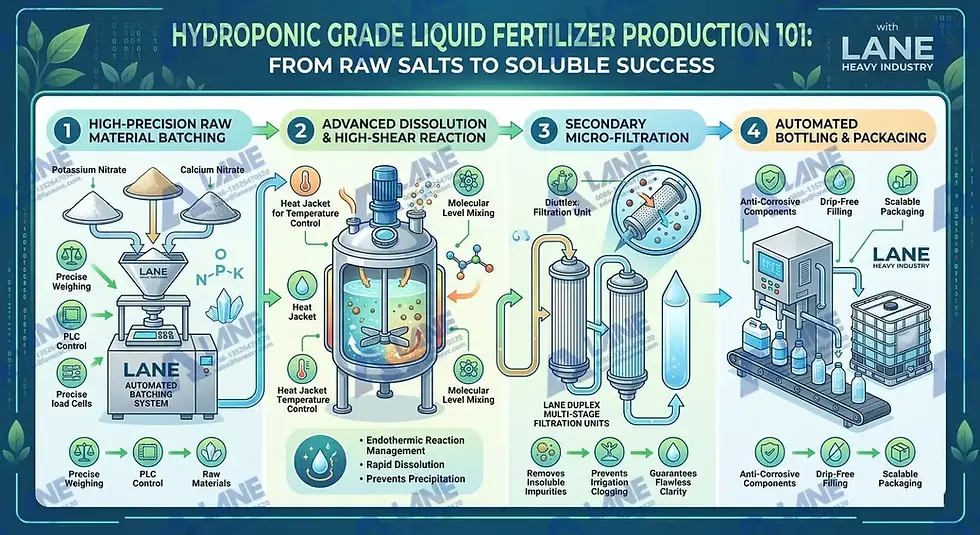
The industrial production of a premium liquid nitrogen product requires a continuous, highly automated workflow. Below is the step-by-step breakdown of how LANE Heavy Industry’s machinery executes this complex chemical and physical transformation.
1. Automated Raw Material Feeding & Dosing
The manufacturing process begins with the precise measurement of raw inputs—typically high-purity solid urea granules, formaldehyde or triazone modifiers, anhydrous ammonia, and deionized water. LANE Heavy Industry integrates automated batching systems equipped with high-precision weight sensors and pneumatic feeding valves. This ensures the exact stoichiometric ratios required for a stable slow-release liquid nitrogen fertilizer batch are introduced into the system without manual error or dust contamination.
2. Controlled Chemical Synthesis & Polymerization
Once the raw ingredients are introduced into the main reaction loop, they enter the LANE Macromolecule Mixing Reactor. This stage is where the actual chemical backbone of slow-release liquid nitrogen fertilizer is formed.
Through a controlled condensation reaction, the urea molecules cross-link with aldehydes to form complex, long-chain carbon-nitrogen polymers (such as urea-triazone or methylene urea). This reaction is highly sensitive to temperature and pH variations.
LANE reactors are engineered with specialized heating/cooling jackets and high-torque, multi-directional agitation paddles. Without precise temperature tracking and high-shear agitation, the slow-release liquid nitrogen fertilizer solution may fail to polymerize uniformly, resulting in unreacted crystalline precipitation or premature "salt-out" during winter storage.
3. Homogenization and Additive Blending
After the primary nitrogen polymer matrix is fully synthesized, the fluid is transferred to the LANE Additive Mixing Tank. At this point, the raw polymer must be modified with specific functional ingredients to make it field-ready.
Operators introduce stabilizers, surfactants, anti-foaming agents, and essential micronutrients (such as zinc, boron, or iron chelate). LANE's dual-impeller blending system ensures that these heavy micronutrients are perfectly suspended and homogenized throughout the fluid. This stage is critical for transforming raw polymers into a commercial-grade slow-release liquid nitrogen fertilizer that delivers consistent nutrition across every single acre of application.
4. Duplex Filtration & Quality Control
Even tiny micro-aggregates or unreacted solid particles can ruin an entire batch or damage end-user field machinery. Therefore, the fluid passes through a high-precision continuous filtration loop.
LANE Heavy Industry installs a heavy-duty Duplex Strainer System directly into the discharge line. This dual-filter configuration allows the liquid to be continuously screened down to micro-levels. If one filter element becomes filled with debris, the PLC system seamlessly diverts the liquid flow to the secondary parallel filter, allowing operators to clean the first mesh screen without pausing the continuous manufacturing sequence. This ensures the final slow-release liquid nitrogen fertilizer will not clog commercial drip-irrigation emitters or tractor spray nozzles.

5. Automated Packaging & Volumetric Filling
The final stage of the manufacturing process is automated packaging. The stable, cooled fluid moves into LANE’s high-speed volumetric filling machine. Equipped with anti-corrosive stainless steel contact parts and anti-drip pneumatic nozzles, the system fills containers of various sizes—ranging from 20L commercial jugs to 1000L IBC totes—with extreme volumetric accuracy, ready for immediate global logistics.
Advantages of using Lane Heavy Industry machinery
Using Lane Heavy Industry machinery for slow-release liquid nitrogen fertilizer production offers several advantages:
Integrated liquid fertilizer production lines for turnkey solutions
Reliable stirred reactors for controlled reaction and mixing
High-efficiency blending systems for uniform product quality
Corrosion-resistant construction for chemically active formulations
Scalable design from pilot to industrial production
This makes Lane a practical supplier for manufacturers aiming to build a modern, efficient plant for slow-release liquid nitrogen fertilizer.
FAQ
1. What is slow-release liquid nitrogen fertilizer?
It is a liquid nitrogen fertilizer that releases nitrogen gradually, improving plant uptake and reducing nitrogen loss.
2. Why is the manufacturing process important?
Because the process determines the release rate, stability, and uniformity of slow-release liquid nitrogen fertilizer.
3. Can Lane Heavy Industry supply equipment for this process?
Yes. Lane provides liquid fertilizer production lines, blending systems, stirred reactors, and related fertilizer machinery suitable for this application.
Email: sales@lanesvc.com
Contact number: +86 13526470520
Whatsapp: +86 13526470520

Comments