


Hydroponic Grade Liquid Fertilizer Production 101: From Raw Salts to Soluble Success

The indoor farming sector is expanding with vertical farms and greenhouse producing high yields of leafy greens, herbs, and fruiting vegetables year-round. In soil-less environments, plant rely on precision liquid fertilizer to deliver essential elements. Because of this, standard agricultural fertilizers are completely inadequate. Commercial growers require pristine, highly specialized nutrients, making hydroponic grade liquid fertilizer production one of the fastest-growing and highest-margin segments in the modern agrochemical industry.
Producing these specialized fertilizers requires advanced equipment, strict quality control, and carefully selected raw materials. With modern liquid fertilizer machinery from LANE Heavy Industry, manufacturers can establish efficient and automated facilities dedicated to hydroponic grade liquid fertilizer production.
What Is Hydroponic Grade Liquid Fertilizer?
Hydroponic grade liquid fertilizers are concentrated nutrient solutions specifically designed for soil-free cultivation systems. They contain essential macronutrients such as nitrogen, phosphorus, and potassium, as well as secondary nutrients and trace elements needed for healthy plant growth.
The goal of hydroponic grade liquid fertilizer production is to create a product that dissolves completely, maintains nutrient availability, and performs reliably in hydroponic systems. Since hydroponic crops receive all their nutrition directly from the nutrient solution, fertilizer quality directly affects plant health and productivity.

Starting with High-Purity Raw Salts
Every successful hydroponic grade liquid fertilizer production process begins with high-quality raw materials. The most commonly used nutrient salts include:
Calcium nitrate
Potassium nitrate
Mono potassium phosphate (MKP)
Magnesium sulfate
Potassium sulfate
Chelated micronutrients
Trace element blends
These materials must meet strict purity standards. Low-quality salts may contain impurities that cause precipitation, clog irrigation systems, or interfere with nutrient uptake.
The use of premium raw materials ensures that the final product produced through hydroponic grade liquid fertilizer production meets the requirements of commercial hydroponic growers.
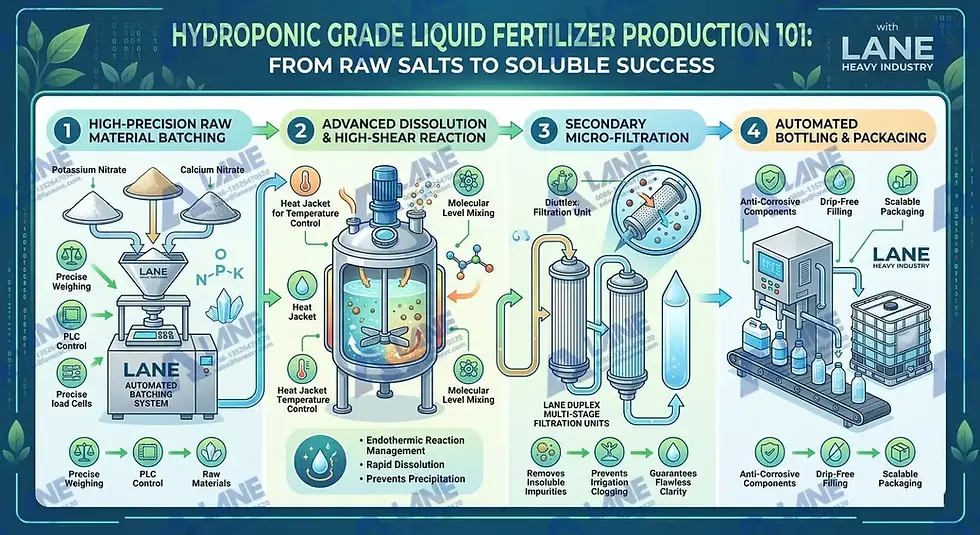
Step 1: Accurate Raw Material Dosing
Precision is critical in fertilizer manufacturing. Before mixing begins, raw materials are accurately weighed and measured according to the desired formula.
LANE Heavy Industry provides automated feeding and dosing systems that improve formulation accuracy while reducing labor requirements. Automated dosing eliminates human error and ensures consistency throughout the hydroponic grade liquid fertilizer production process.
This stage is especially important because even small deviations in nutrient ratios can affect crop performance.
Step 2: Dissolution and Mixing
Once the raw salts have been measured, they are transferred into stainless-steel mixing tanks. Water is added gradually while agitators continuously mix the solution.
The purpose of this stage is to achieve complete dissolution of all nutrient components. Proper mixing ensures uniform nutrient distribution and prevents localized concentrations that may lead to instability.
Advanced mixing tanks from LANE Heavy Industry are specifically designed for hydroponic grade liquid fertilizer production, offering excellent mixing efficiency and corrosion resistance.
Complete dissolution is one of the most important objectives in hydroponic grade liquid fertilizer production, as undissolved particles can cause serious operational issues in hydroponic systems.
Step 3: Filtration and Purification
After mixing, the nutrient solution passes through filtration equipment to remove any remaining insoluble particles.
Hydroponic growers require perfectly clear nutrient solutions because even tiny particles can clog drip emitters, fertigation systems, and irrigation lines. Therefore, filtration is an essential component of professional hydroponic grade liquid fertilizer production.
LANE Heavy Industry offers filtration systems capable of producing highly refined nutrient solutions suitable for modern hydroponic applications.
Step 4: Quality Control and Testing
Quality assurance is critical for commercial fertilizer manufacturing. Every batch produced during hydroponic grade liquid fertilizer production must be tested to verify nutrient content, pH levels, and solution stability.
Laboratory analysis helps manufacturers confirm that the product meets formulation specifications and industry standards.
Typical quality control parameters include:
Nutrient concentration
Electrical conductivity (EC)
pH value
Solubility
Storage stability
Strict testing procedures ensure growers receive a reliable product that performs consistently in the field.
Step 5: Storage and Packaging
Once quality testing is complete, the finished fertilizer is transferred to storage tanks before packaging.
Depending on customer requirements, products may be packaged in:
Small retail bottles
Commercial containers
Drums
Intermediate bulk containers (IBCs)
Bulk transportation tanks
Automated filling and packaging systems from LANE Heavy Industry help streamline the final stage of hydroponic grade liquid fertilizer production, improving efficiency while maintaining product quality.

Key Requirements for Soluble Success
To achieve success in hydroponic grade liquid fertilizer production, manufacturers must meet several critical requirements.
First, all nutrients must be completely water soluble. Any undissolved material can cause equipment blockages and nutrient delivery problems.
Second, formulations must remain chemically stable during storage and application. The fertilizer should resist precipitation, crystallization, and nutrient degradation.
Third, nutrient concentrations must be highly accurate. Hydroponic growers rely on precise EC and pH management to maximize crop performance.
Finally, the production process must be consistent and repeatable. Automation helps manufacturers achieve these goals while reducing production costs.
FAQ
What is hydroponic grade liquid fertilizer production?
Hydroponic grade liquid fertilizer production is the process of manufacturing fully soluble, high-purity nutrient solutions specifically designed for hydroponic systems.
Why is solubility critical in hydroponic fertilizers?
Solubility ensures that nutrients remain available to plants and prevents clogging of irrigation systems.
What machinery is required for production?
Key equipment includes dissolution tanks, dosing systems, filtration units, and automated control systems, such as those provided by LANE Heavy Industry.
Can the same fertilizer be used for all crops?
No, hydroponic grade liquid fertilizer production must be tailored to specific crops and growth stages.
Email: sales@lanesvc.com
Contact number: +86 13526470520
Whatsapp: +86 13526470520


Comments