


The Complete Guide to All-natural organic liquid fertilizer for beans: From Commercial Manufacturing to Garden Application


Table of Contents
Introduction
Understanding All-natural organic liquid fertilizer for beans
Commercial Manufacturing with LANE Heavy Industry
Key Equipment in the Production Line
The Manufacturing Process Step by Step
Quality Control and Standards
Garden Application Techniques for Bean Growers
Application Schedule and Dosage
Conclusion
Frequently Asked Questions (FAQ)
1. Introduction
Beans are one of the most popular vegetables in the world. But they require specific nutrient balance to reach their full potential. Beans, as nitrogen-fixing legumes, respond exceptionally well to organic liquid amendments. Using an all-natural organic liquid fertilizer for beans ensures that these heavy feeders get a rapid, bio-available boost without the risk of chemical salts damaging the delicate soil microbiome.
This guide explores how Liquid fertilizer machinery from LANE Heavy Industry transform organic raw materials into professional liquid fertilizer for beans and other vegetables.
2. Understanding All-natural organic liquid fertilizer for beans
All-natural organic liquid fertilizer for beans is fundamentally different from synthetic liquid fertilizers. It is created from from plant-based materials, compost extracts, and beneficial microorganisms. These liquid formulations provide beans with readily available nutrients while improving soil structure and microbial activity.
Research on Phaseolus vulgaris (common bean) shows that organic liquid fertilizers enhance root development, with studies showing root length increased of up to 46% compared to normal tree.
3. Commercial Manufacturing with LANE Heavy Industry
Henan LANE Heavy Industry Machinery Technology Co., Ltd. leads the field in liquid fertilizer production technology. As an ISO 9001-certified manufacturer, LANE provides comprehensive solutions for producing all-natural organic liquid fertilizer for beans.
The company's integrated approach combines research, development, production, and after-sales support, ensuring commercial producers receive end-to-end service. With CE certification and a 5-year warranty on equipment, LANE's production lines represent the gold standard in the industry.
LANE recently completed a customized project for a Southeast Asian client processing soybean dreg into liquid fertilizer, demonstrating the versatility of their systems for bean-specific formulations.

4. Key Equipment in the Production Line
A complete LANE production line for all-natural organic liquid fertilizer for beans includes the following essential components:
Equipment | Function | Specifications |
Crusher | Size reduction of raw materials | 1-20 ton/hour capacity |
Anaerobic breakdown with specific bacteria | 10m³ volume, temperature-controlled | |
Enzyme Digestion Tank | Protein decomposition into amino acids | 5m³ volume, corrosion-resistant |
Nutrient blending and formulation | Automatic measuring system | |
Solid particle removal | Multi-layer filtration | |
Storage Tanks | Product holding with quality preservation | Stainless steel, 6mm thickness |
Automatic Filling Machine | Container filling for distribution | 2 tons/hour capacity |
All equipment features industrial-grade stainless steel construction (6mm thickness) for durability and easy maintenance.
5. The Manufacturing Process Step by Step
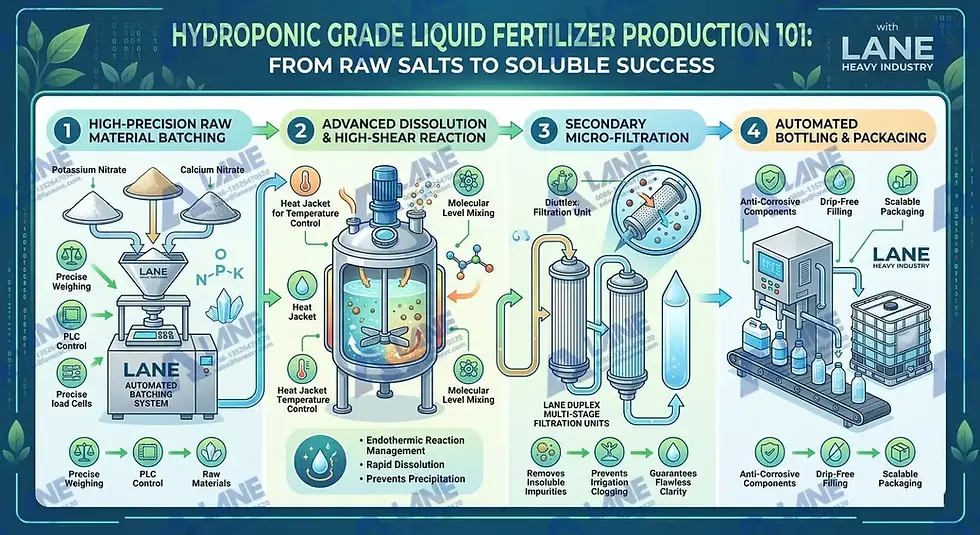
Producing high-quality all-natural organic liquid fertilizer for beans follows a carefully designed process:
Stage 1: Raw Material Preparation
Organic materials like soybean dregs, legume residues, or composted plant matter are crushed and sieved to remove impurities and ensure uniform particle size.
Stage 2: Fermentation
Pre-treated materials enter temperature-controlled fermentation tanks (25-35°C) with specific bacterial cultures. Anaerobic fermentation breaks down complex organic compounds over 30 days.
Stage 3: Enzymatic Digestion
Macromolecular proteins undergo further decomposition in enzyme digestion tanks, breaking down into amino acids and oligopeptides readily absorbed by bean plants.
Stage 4: Nutrient Blending
The base liquid moves to mixing reactors where additional nutrients are precisely added through automatic measuring systems, allowing formulation adjustments for specific bean varieties.
Stage 5: Filtration
Dual filtration systems remove remaining solid particles, ensuring the final all-natural organic liquid fertilizer for beans is pure and suitable for drip irrigation without clogging emitters.
Stage 6: Storage and Packaging
Finished product transfers to stainless steel storage tanks before automatic filling machines package it for market distribution.
6. Quality Control and Standards
LANE's production lines incorporate multiple quality control points ensuring every batch of all-natural organic liquid fertilizer for beans meets specifications:
Nutrient analysis: Testing for nitrogen (particularly amino acids), phosphorus, potassium, and secondary nutrients
Microbiological testing: Beneficial microorganism counts and pathogen absence verification
Physical properties: pH (typically 6.5-7.5), density, and particle size monitoring
Real-time monitoring: PLC control systems tracking all production parameters
The equipment holds ISO and CE certifications, with rigorous factory testing before shipment.

7. Garden Application Techniques for Bean Growers
Even premium all-natural organic liquid fertilizer for beans requires proper application for optimal results. Home gardeners and small-scale growers have several effective options:
Foliar Application
Spraying diluted fertilizer directly on bean leaves provides rapid nutrient uptake. Use a fine mist sprayer during cool morning or evening hours to maximize absorption and prevent leaf burn. Dilution rates typically range from 1-2.5 liters of concentrate per 500-1000 liters of water per hectare.
Soil Drenching
Apply diluted fertilizer directly to the soil around bean plants, allowing roots to absorb nutrients through irrigation. For garden-scale application, mix 10-20 ml of concentrate per liter of water and apply at the base of plants.
Drip Irrigation Integration
For gardeners with drip systems, all-natural organic liquid fertilizer for beans can be injected through irrigation lines. Always run clean water for 30 minutes after application to prevent emitter clogging.
Seed Treatment
Soaking bean seeds in diluted fertilizer (1:4 ratio with water) for 30 minutes before planting enhances germination and provides early seedling nutrition.
8. Application Schedule and Dosage
Research and field experience have established optimal application schedules for beans:
Growth Stage | Application Method | Dosage (per hectare) | Frequency |
Pre-planting | Seed treatment | 1:4 dilution | Once |
Vegetative (15-20cm height) | Foliar or soil | 1.5-2 L/500-1000 L water | 1-2 applications |
Pre-flowering | Foliar | 2-2.5 L/500-1000 L water | 1 application |
Pod development | Foliar or soil | 1.5-2 L/500-1000 L water | 2-3 applications, 15-20 day intervals |
Studies on mung beans demonstrate that liquid organic fertilizer at 10 L/ha combined with appropriate foliar applications increased branch number by 68.7% and leaf number by 62.85% compared to untreated controls.
For garden-scale production, a general guideline is 2-3 applications during the growing season: during vegetative growth, before flowering, and during pod development.
9. Conclusion
All-natural organic liquid fertilizer for beans is the ideal choice for anyone looking to grow healthy, high-yield bean crops while maintaining eco-friendly gardening practices. LANE Heavy Industry's liquid fertilizer production system enables commercial manufacturers to produce consistent, high-quality liquid fertilizers that meet the needs of bean crops. For growers, following evidence-based application practices ensures maximum return on investment while supporting soil health and environmental sustainability.
10. Frequently Asked Questions (FAQ)
Q: What raw materials work best for producing all-natural organic liquid fertilizer for beans?
A: Protein-rich materials like soybean dregs, legume residues, and composted plant matter are excellent choices. LANE's production lines can be customized based on locally available raw materials.
Q: How often should I apply all-natural organic liquid fertilizer for beans to my garden crop?
A: Research recommends 2-3 applications during the growing season: during vegetative growth (when plants reach 15-20cm), before flowering, and during pod development, with 15-20 day intervals.
Q: Can I use all-natural organic liquid fertilizer for beans in my drip irrigation system?
A: Yes, but ensure proper filtration. LANE's production lines include dual filtration systems that remove particles capable of clogging emitters. Always run clean water for 30 minutes after application.
Q: What dilution rate should I use for foliar application on beans?
A: For garden-scale foliar application, dilute according to product instructions—typically 1-2.5 L of concentrate per 500-1000 L of water per hectare. Test on a small area first.
Q: How long does the manufacturing process take for all-natural organic liquid fertilizer for beans?
A: The complete process, including fermentation, typically takes approximately 30 days from raw material to finished product.
Q: Does LANE Heavy Industry provide installation and training for their production lines?
A: Yes. LANE provides comprehensive service including equipment positioning, piping connection, electrical installation, trial operation, and operator training. Remote monitoring and technical support are also available.
Q: What quality certifications does LANE equipment hold?
A: LANE's production lines are ISO and CE certified, with a 5-year warranty after shipment.
Q: Can I produce all-natural organic liquid fertilizer for beans at home?
A: Small-scale production is possible using fermentation methods, but commercial quality and consistency require professional equipment like LANE's production lines.

Email: sales@lanesvc.com
Contact number: +86 13526470520
Whatsapp: +86 13526470520

Comments