


Nitrogen-Rich Liquid Fertilizer Production for Vegetables at Commercial Scale


Table of Contents
Introduction
Understanding Nitrogen-Rich Liquid Fertilizers
Importance of Nitrogen-Rich Liquid Fertilizer Production for Vegetables
LANE Heavy Industry Machinery for Fertilizer Production
Step-by-Step Production Process
Quality Control and Efficiency
Advantages of Commercial-Scale Production
Environmental and Economic Benefits
FAQ
1. Introduction
Vegetable farming is a demanding sector that requires precise nutrient management to achieve optimal growth and yield. Nitrogen is the most critical nutrient for vegetable growth. it supports lush leaf development and strong stem formation. To meet the demand for farmers, commercial-scale nitrogen-rich liquid fertilizer production for vegetables is essential. Unlike solid fertilizers, liquid formulations offer faster absorption, higher nutrient utilization (up to 80%), and is compatible with modern irrigation systems.
For commercial vegetable growers, efficient and scalable Nitrogen-rich liquid fertilizer production for vegetables helps them cut costs while ensuring consistent nutrient supply. LANE Heavy Industry, a leading manufacturer of agricultural machinery, has developed a specialized commercial-scale liquid production line tailored explicitly for Nitrogen-rich liquid fertilizer.
2. Understanding Nitrogen-Rich Liquid Fertilizers
Nitrogen-rich liquid fertilizers are nutrient solutions specifically formulated to provide essential nitrogen directly to plants. Liquid fertilizers can be quickly absorbed by plants and it can be distributed uniformly. This is particularly beneficial for leafy vegetables that require constant nitrogen supply for optimal growth.
The main benefits of nitrogen-rich liquid fertilizers include:
Faster nutrient uptake
Reduced soil compaction
Easy integration with irrigation systems
Improved plant vigor and yield
The commercial-scale production of such fertilizers demands precision machinery to maintain nutrient balance and product quality.
3. Importance of Nitrogen-Rich Liquid Fertilizer Production for Vegetables
Nitrogen is a key driver of photosynthesis, chlorophyll production, and overall plant metabolism. For vegetables, a continuous supply of nitrogen ensures lush foliage, rapid growth, and high yield. By investing in nitrogen-rich liquid fertilizer production for vegetables at a commercial scale, growers can:
Maximize crop productivity
Reduce nutrient losses
Standardize fertilizer quality for large-scale distribution
This type of production also helps meet the increasing market demand for fresh vegetables with consistent nutritional content.

4. LANE Heavy Industry Machinery for Fertilizer Production
LANE Heavy Industry specializes in designing and manufacturing advanced fertilizer production machinery tailored for commercial operations. Their equipment for nitrogen-rich liquid fertilizer production for vegetables includes:
Mixing Tanks: Ensure homogenous nutrient solutions
Storage Tanks: Maintain product stability
Pumps and Piping Systems: For precise flow control
Automated Control Panels: Monitor production parameters for quality assurance
Filtration Units: Remove impurities and prevent clogging in irrigation systems
These machines are designed to handle large-scale operations while reducing labor costs and maintaining consistent fertilizer quality.
5. Step-by-Step Production Process
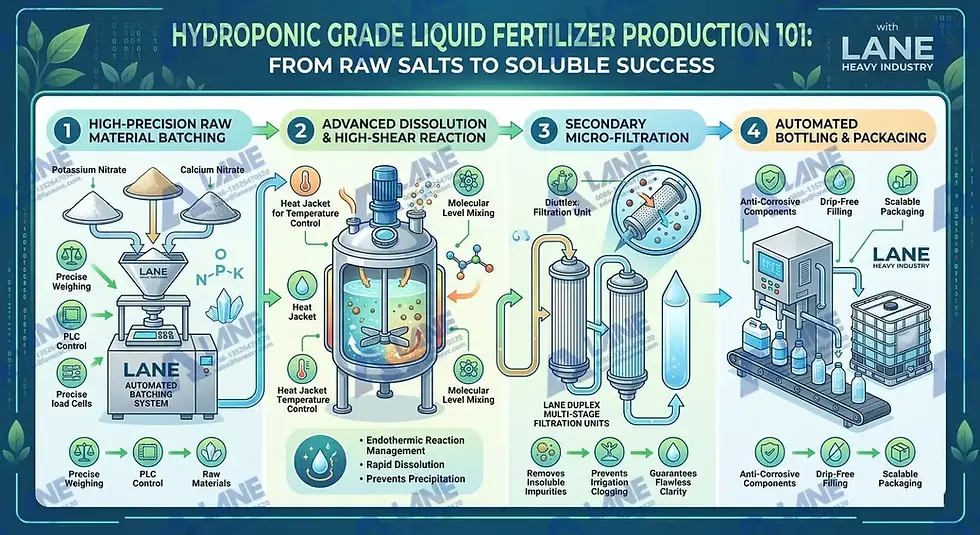
The commercial-scale nitrogen-rich liquid fertilizer production for vegetables involves several critical steps:
Raw Material Preparation: Ammonium nitrate, urea, and other nitrogen sources are accurately measured.
Mixing: The ingredients are blended with water in specialized mixing tanks to create a homogenous solution.
Filtration: The solution passes through filtration systems to eliminate undissolved particles.
Quality Testing: pH, nitrogen content, and nutrient ratios are monitored to ensure compliance with standards.
Storage: The liquid fertilizer is stored in controlled tanks to maintain stability.
Packaging and Distribution: Fertilizer is packaged in bulk or smaller units for transportation to farms.
This streamlined process ensures efficiency, high output, and reduced operational downtime, making LANE Heavy Industry machinery ideal for commercial production.
6. Quality Control and Efficiency
Consistent product quality is critical in nitrogen-rich liquid fertilizer production for vegetables. LANE Heavy Industry’s equipment incorporates automated monitoring systems that check:
Nitrogen concentration
Solution viscosity
Temperature and pH levels
By maintaining tight control over these parameters, producers can guarantee that each batch meets commercial standards. Efficiency is also improved through energy-saving mixing techniques and precise material handling systems.
7. Advantages of Commercial-Scale Production
Investing in commercial nitrogen-rich liquid fertilizer production for vegetables offers multiple advantages:
High throughput with minimal labor
Uniform nutrient distribution for crops
Reduced wastage and operational costs
Ability to supply large-scale farms and cooperatives
Enhanced profitability due to high-quality, market-ready fertilizer
LANE Heavy Industry machinery ensures scalability without compromising product quality, making it an ideal choice for modern agricultural enterprises.

8. Environmental and Economic Benefits
Nitrogen-rich liquid fertilizer production for vegetables also contributes to sustainability:
Reduces excessive nitrogen runoff compared to granular fertilizers
Improves nutrient absorption efficiency in crops
Minimizes environmental pollution
Offers cost-effective solutions for commercial vegetable farming
By integrating efficient production technology, growers can support both productivity and environmental responsibility.
9. FAQ
Q1: Why is nitrogen important for vegetables?
A1: Nitrogen is vital for leaf development, photosynthesis, and overall plant growth, directly impacting vegetable yield and quality.
Q2: How does liquid fertilizer compare to granular fertilizer?
A2: Liquid fertilizers are absorbed faster, distribute more evenly, and integrate easily with irrigation systems, making them ideal for vegetables.
Q3: Can LANE Heavy Industry machinery handle large-scale operations?
A3: Yes, their commercial-grade equipment is designed for high-volume, efficient production with minimal labor input.
Q4: Is nitrogen-rich liquid fertilizer safe for all vegetables?
A4: Yes, when applied according to recommended dosages, it is safe and highly effective for a wide range of vegetable crops.
Q5: How often should liquid fertilizer be applied to vegetables?
A5: Application frequency depends on crop type and growth stage, but commercial production allows for precise formulation to meet specific crop needs.

Email: sales@lanesvc.com
Contact number: +86 13526470520
Whatsapp: +86 13526470520

Comments