


Meeting the Unprecedented Demand for Liquid Fertilizer in Asia Pacific: Challenges and Opportunities
- Efat Elahi
- Apr 29
- 5 min read


Asia Pacific (APAC) region is the worlds most populated region and the demand for liquid fertilizer in Asia Pacific has grown at an extraordinary pace over the past decade. This region contains nearly 60% of worlds population. The pressure for food security in this area has become higher. Traditional granular fertilization methods have become inefficient in the face of modern environmental and economic constraints. This has led to a skyrocketing demand for liquid fertilizer in Asia Pacific, a trend that is reshaping how crops are nourished from the fields of Punjab to the rice terraces of Vietnam.
From China and India to Southeast Asian countries such as Vietnam, Thailand, Indonesia, and Malaysia, agricultural producers are actively seeking more efficient nutrient delivery systems. For companies planning to enter or expand in this market, investing in advanced liquid fertilizer production line from lane has become strategic advantage. LANE Heavy Industry Machinery provides complete liquid fertilizer production line solutions tailored to industrial-scale manufacturers.
Why Is the Demand for Liquid Fertilizer Growing in Asia Pacific?
The rise of the demand for liquid fertilizer in Asia Pacific can be explained by several factors.
1. Precision Agriculture Expansion
Modern farms increasingly rely on fertigation, drip irrigation, and foliar spraying systems. Liquid fertilizers integrate seamlessly into these systems, allowing precise nutrient control and minimizing waste.
Benefits include:
Faster nutrient absorption
Reduced fertilizer loss
Better crop uniformity
Lower labor costs
As smart farming technologies spread, the demand for liquid fertilizer in Asia Pacific continues to rise.
2. High-Value Crop Production
Asia Pacific is a major producer of: Fruits, Vegetables, Tea, Coffee, Rice, Oil palm, Greenhouse crops. These crops often require controlled nutrient programs, making liquid fertilizers more effective than traditional solid formulations. The growth of export-oriented agriculture significantly strengthens the demand for liquid fertilizer in Asia Pacific.
3. Environmental Regulations
Governments across the region are tightening fertilizer regulations to reduce runoff, eutrophication, and soil degradation.
Liquid fertilizers offer:
Higher nutrient use efficiency
Lower over-application risk
Reduced environmental contamination
This regulatory trend further supports the demand for liquid fertilizer in Asia Pacific.
Major Challenges Facing Liquid Fertilizer Producers
Although market opportunities are strong, manufacturers face multiple production challenges.
Raw Material Compatibility
Liquid fertilizers require stable nutrient solubility. Poor formulation can cause:
Crystallization
Sedimentation
Layer separation
Storage instability
Manufacturers must ensure precise raw material handling and mixing.
Production Consistency
Maintaining stable product concentration across batches is critical.
Challenges include:
Inaccurate dosing
Temperature fluctuations
Improper mixing speed
pH instability
These issues directly affect product quality and customer satisfaction.
Packaging and Storage Requirements
Unlike granular fertilizers, liquid products require:
Corrosion-resistant storage tanks
Leak-proof packaging systems
Accurate filling equipment
Safe transportation infrastructure
As the demand for liquid fertilizer in Asia Pacific expands, packaging efficiency becomes increasingly important.
LANE Heavy Industry Liquid Fertilizer Production Line Solution
To help manufacturers capitalize on the growing demand for liquid fertilizer in Asia Pacific, LANE Heavy Industry Machinery offers complete liquid fertilizer production systems.

Core Equipment Includes:
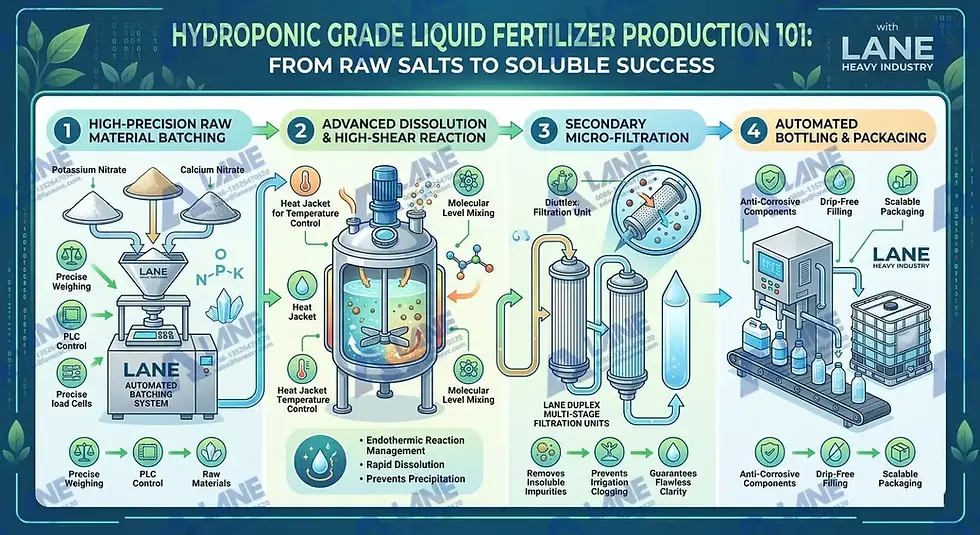
1. Raw Material Feeding System
This system accurately meters:
Nitrogen sources
Phosphorus compounds
Potassium salts
Trace elements
Organic additives
Automated feeding improves formula consistency.
2. Dissolving and Mixing Tanks
High-efficiency mixing systems ensure:
Full dissolution of raw materials with liquid
Uniform nutrient blending
Stable liquid suspension
LANE uses corrosion-resistant stainless-steel tanks for durability.
3. Heating System
Some materials require controlled heating for better dissolution.
Benefits:
Improved solubility
Faster production cycles
Reduced crystallization risk
Filtration removes impurities and insoluble particles.
Advantages:
Better product clarity
Reduced nozzle blockage in fertigation systems
Longer shelf life
5. Storage Tanks
Finished products are stored in industrial stainless-steel tanks designed for:
Corrosion resistance
Temperature control
Safe chemical storage

6. Automatic Filling and Packaging Machine
LANE provides automated filling solutions for: 1L bottles, 5L containers, 20L drums, 200L barrels, and IBC tanks. This packaging flexibility supports various market channels.
Advantages of Choosing LANE Heavy Industry
As the demand for liquid fertilizer in Asia Pacific continues growing, production efficiency becomes essential.
LANE offers several advantages:
Customized Capacity Options
Production capacities available:
1 TPH
5 TPH
10 TPH
20 TPH
50 TPH
Manufacturers can scale according to market demand.
Formula Flexibility
Suitable for producing:
NPK liquid fertilizer
Humic acid liquid fertilizer
Amino acid fertilizer
Calcium nitrate solutions
Micronutrient fertilizers
Organic liquid fertilizers
This flexibility allows manufacturers to respond quickly to evolving market needs.
Automation and Labor Reduction
Automated systems reduce:
Manual dosing errors
Labor costs
Production downtime
Automation is critical for meeting rising demand for liquid fertilizer in Asia Pacific.
International Project Experience
LANE equipment is exported to more than 200 countries and regions, providing clients with:
Installation support
Technical training
Formula guidance
After-sales service
Market Opportunities in Asia Pacific
The future of the demand for liquid fertilizer in Asia Pacific remains highly promising.
Emerging High-Growth Markets
Strong demand growth is expected in:
India
Indonesia
Vietnam
Philippines
Thailand
Bangladesh
These countries are modernizing agricultural infrastructure rapidly.
Greenhouse Agriculture Growth
Greenhouse farming is expanding significantly in:
China
Japan
South Korea
Australia
Liquid fertilizers are essential for controlled-environment agriculture.
Organic and Specialty Fertilizers
Consumer demand for organic food increases the need for:
Seaweed fertilizers
Fish emulsion
Amino acid fertilizers
Bio-liquid fertilizers
This trend strengthens long-term demand for liquid fertilizer in Asia Pacific.
Investment Outlook
For investors, the current market represents a strategic entry window.
Reasons include:
Rapid agricultural modernization
Government support for sustainable farming
Rising fertilizer efficiency standards
Expanding export agriculture
Companies investing early in advanced liquid fertilizer production lines can gain substantial market share.
Frequently Asked Questions (FAQ)
Q1: What are the biggest challenges in manufacturing liquid fertilizer in Asia Pacific?
The primary challenges include sourcing consistent and affordable raw materials (especially imported phosphates and potash), managing high logistics costs for liquid transport, ensuring batch-to-batch consistency to prevent crop damage, and complying with increasingly strict environmental regulations on emissions and effluents.
Q2: How can LANE’s production lines help lower raw material costs?
LANE designs equipment that processes locally available organic waste (such as soybean dregs, animal manure, and crop residues) into high-quality bio-liquid fertilizers. This reduces dependence on expensive imported synthetic inputs and converts waste-management problems into cost-effective nutrient sources.
Q3: Are LANE’s liquid fertilizer lines suitable for organic and bio-based fertilizers?
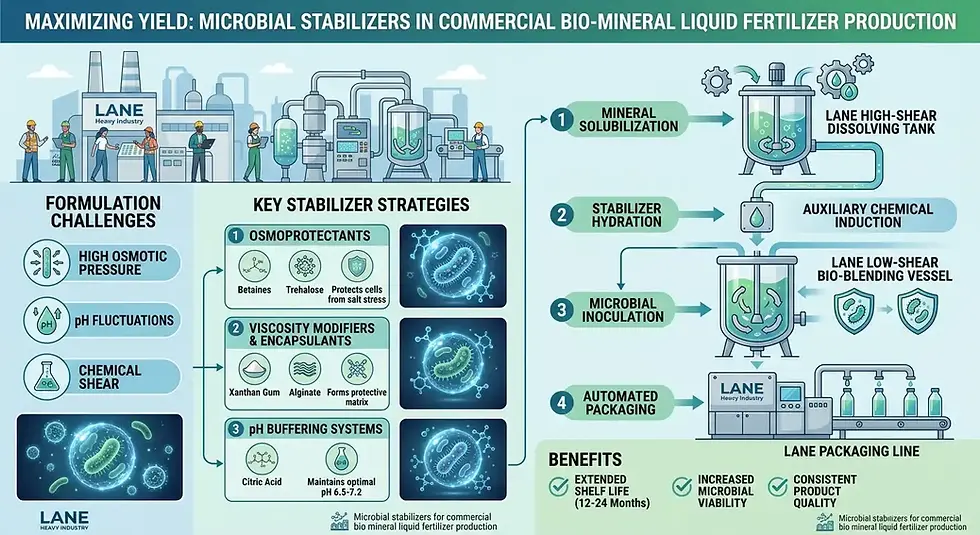
Yes, absolutely. LANE’s bio-liquid fertilizer production lines integrate fermentation tanks, enzymatic hydrolysis units, and organic-specific filtration, making them ideal for producing organic and bio-based liquid fertilizers that meet both conventional and organic certification standards.
Q4: Can small and medium enterprises (SMEs) afford and operate these machines?
LANE offers modular designs with capacities starting as low as 0.5 tons per hour. The full PLC automation simplifies operation, requiring minimal specialized labor, and the turnkey service includes on-site training. This makes it highly accessible for SMEs and farmer cooperatives looking to start local production.

Email: sales@lanesvc.com
Contact number: +86 13526470520
Whatsapp: +86 13526470520

Comments