


A Step by Step Liquid Fertilizer Production Process for Agribusiness


Table of Contents
Introduction
Understanding Liquid Fertilizer
Importance of a Step by Step Liquid Fertilizer Production Process
Step 1: Raw Material Selection
Step 2: Formulation and Mixing
Step 3: Reaction and Processing
Step 4: Filtration and Purification
Step 5: Storage and Stabilization
Step 6: Packaging and Distribution
Advantages of Using LANE Heavy Industry Machinery
Frequently Asked Questions (FAQ)
Conclusion
1. Introduction
Liquid fertilizers are now an inseparable part of the modern agriculture due to its efficiency and nutrient availability. This fertilizer offers faster nutrient absorption, precise application, and improved crop yields compared to traditional solid fertilizers. To maximize the efficiency, farmers and manufacturers rely on advanced machinery. For agribusinesses looking to streamline production and ensure consistent quality, following a clear step by step liquid fertilizer production process is essential.
LANE Heavy Industry, a leading manufacturer of fertilizer machinery, provides a complete, efficient liquid fertilizer production line tailored to agribusiness needs, making the step by step liquid fertilizer production process accessible and cost-effective.
2. Understanding Liquid Fertilizer
Liquid fertilizers are water-soluble fertilizers containing essential nutrients for plants. They can be applied directly to soil or sprayed on plant foliage. Compared to solid fertilizers, liquids ensure faster nutrient absorption, reduce labor costs, and improve crop productivity.
Implementing a structured step by step liquid fertilizer production process ensures consistency in nutrient composition, product quality, and operational efficiency.
3. Importance of a Step by Step Liquid Fertilizer Production Process
A well-defined production process is critical to:
Ensure uniform nutrient content.
Reduce production errors and waste.
Optimize the use of raw materials.
Minimize operational costs and downtime.
LANE Heavy Industry’s machinery provides automation and precision, allowing agribusinesses to follow a step by step liquid fertilizer production process efficiently.

4. Step 1: Raw Material Selection
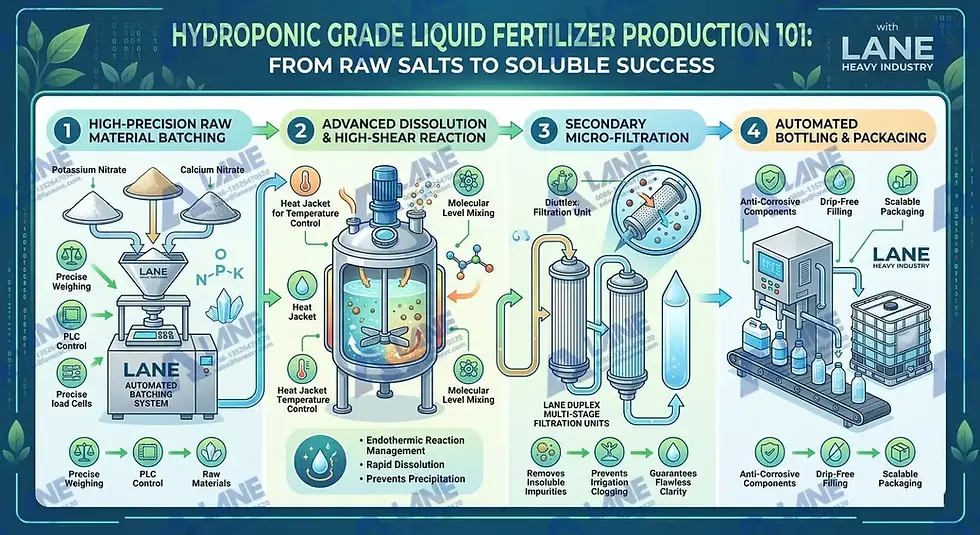
The first step in a step by step liquid fertilizer production process is choosing high-quality raw materials. Common ingredients include:
Nitrogen sources: Urea, Ammonium Nitrate
Phosphorus sources: Phosphoric acid, Superphosphate
Potassium sources: Potassium chloride, Potassium sulfate
Micronutrients: Zinc, Iron, Magnesium
Using premium raw materials ensures better solubility, stability, and plant uptake. LANE Heavy Industry’s feeding and dosing systems accurately measure ingredients for consistent results.
5. Step 2: Formulation and Mixing
Once raw materials are selected, the next stage is formulation. The step by step liquid fertilizer production process requires precise mixing to achieve the desired nutrient ratios.
Batching: LANE machinery allows automated batching for accurate measurements.
Mixing: High-efficiency agitator mixers dissolves raw material with liquid and ensures homogenous liquid solutions.
Temperature Control: Some formulations require controlled heating for complete dissolution.
Correct formulation and mixing guarantee product quality, essential for agribusiness success.
6. Step 3: Reaction and Processing
Certain fertilizers, especially NPK liquid fertilizers, require chemical reactions to stabilize nutrients. In this stage:
LANE Reactors mix raw materials under controlled conditions.
pH levels are adjusted to maintain stability.
Additives, such as anti-foaming agents, can be incorporated.
Following this step in the step by step liquid fertilizer production process ensures that the final product is nutrient-rich and free from impurities. LANE Heavy Industry’s reactors are designed for safety, efficiency, and continuous operation.
7. Step 4: Filtration and Purification
After the reaction process, impurities must be removed to ensure a clear, high-quality product.
Filtration systems: Remove insoluble particles.
Purification: Helps extend shelf life and improve absorption efficiency.
LANE Heavy Industry provides advanced filtration solutions integrated into the production line, supporting a smooth step by step liquid fertilizer production process.
8. Step 5: Storage and Stabilization
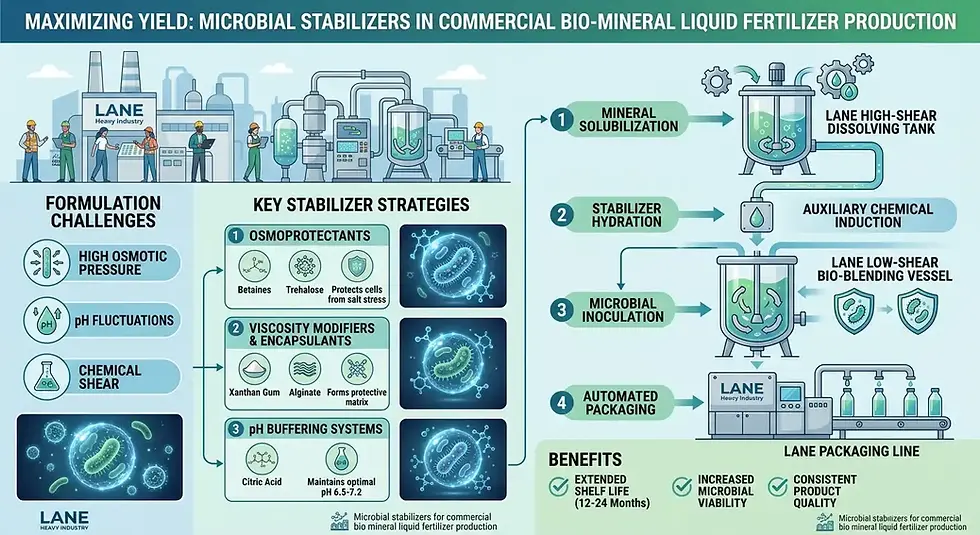
Once purified, liquid fertilizers must be stabilized to prevent precipitation and maintain quality during storage.
Stabilizers prevent nutrient degradation.
Temperature control tanks maintain ideal storage conditions.
pH balancing ensures longer shelf life.
Proper storage is a critical step in the step by step liquid fertilizer production process, reducing wastage and ensuring the product reaches the end user in optimum condition.
9. Step 6: Packaging and Distribution
The final step in a step by step liquid fertilizer production process is packaging. LANE Heavy Industry offers automated bottling and packaging systems to:
Fill containers efficiently.
Seal and label products accurately.
Prepare shipments for distribution.
This step ensures the product maintains its integrity during transportation and reaches customers safely.

10. Advantages of Using LANE Heavy Industry Machinery
LANE Heavy Industry machinery provides several benefits in implementing a step by step liquid fertilizer production process:
High automation and precision.
Reduced operational costs and labor requirements.
Consistent product quality.
Scalability for large-scale production.
Compliance with international safety and environmental standards.
By investing in advanced machinery, agribusinesses can increase profitability and efficiency.
11. Frequently Asked Questions (FAQ)
Q1: How long does a complete step by step liquid fertilizer production process take?
A: Depending on scale, it can take from a few hours to a full day for batch production, while continuous production lines reduce time significantly.
Q2: Can LANE machinery handle different fertilizer types?
A: Yes, LANE Heavy Industry machines are versatile, suitable for NPK, single nutrient, and micronutrient liquid fertilizers.
Q3: Is automation necessary for a step by step liquid fertilizer production process?
A: While small-scale production can be manual, automation ensures consistency, higher output, and lower labor costs.
Q4: What safety measures are included in the production line?
A: LANE machinery includes automated monitoring, pressure control, temperature regulation, and emergency shut-off systems.
12. Conclusion
Following a structured step by step liquid fertilizer production process is crucial for agribusinesses to produce high-quality, consistent fertilizer. From raw material selection to packaging, each stage contributes to efficiency, consistency, and profitability. For agribusinesses looking to maximize efficiency, reduce waste, and improve product quality, following this detailed step by step liquid fertilizer production process with LANE Heavy Industry machinery is the ideal solution. LANE’s reliable equipment, agribusinesses can enhance crop yields, reduce waste, and gain a competitive edge in the agricultural industry.

Email: sales@lanesvc.com
Contact number: +86 13526470520
Whatsapp: +86 13526470520

Comments