


A Step-by-Step Guide to Setting Up Your Own Liquid Fertilizer Production System for Greenhouses

Greenhouse farming relies on precise nutrition to maximize crop yield and quality. A dedicated Liquid Fertilizer Production System for Greenhouse can provide control, efficiency, and sustainability to the greenhouse operator. Unlike traditional solid fertilizers, liquid fertilizers are quickly absorbed by greenhouse crops, reduce nutrient waste, and allow for flexible nutrient adjustment based on crop growth stages. Setting up your own Liquid Fertilizer Production System for Greenhouse reduces long-term costs, gives complete recipe control, and minimized packaging waste.
LANE Heavy Industry, a trusted manufacturer of agricultural machinery creates customized liquid fertilizer production System for Greenhouse. The machines are designed for durability and precision in agricultural environments.

Table of Contents
Planning and Design: Assessing Your Needs
Core Component Breakdown: LANE Machinery Spotlight
Step 1: Site Preparation and Tank Installation
Step 2: Installing the Mixing and Reaction Station
Step 3: Integrating Filtration and pH/EC Control
Step 4: Automation and Integration with Fertigation
System Calibration and Safety Protocols
Conclusion: The Value of On-Site Production
Frequently Asked Questions (FAQ)
1. Planning and Design: Assessing Your Needs
Before ordering equipment, define the scale of your Liquid Fertilizer Production System for Greenhouse. Calculate your daily nutrient solution consumption based on crop type and greenhouse square footage. This determines the tank volumes, mixer capacity, and pump specifications needed. Decide if you’ll produce simple nutrient solutions or more complex organic-based liquors. A well-planned design is the foundation of an efficient Liquid Fertilizer Production System for Greenhouse.
2. Core Component Breakdown: LANE Machinery Spotlight
A reliable system is built on industrial-grade components. LANE Heavy Industry offers a product line perfectly suited for building a professional Liquid Fertilizer Production System for Greenhouse:
Heavy-Duty Mixing Tanks: Corrosion-resistant, baffled tanks with varying capacity.
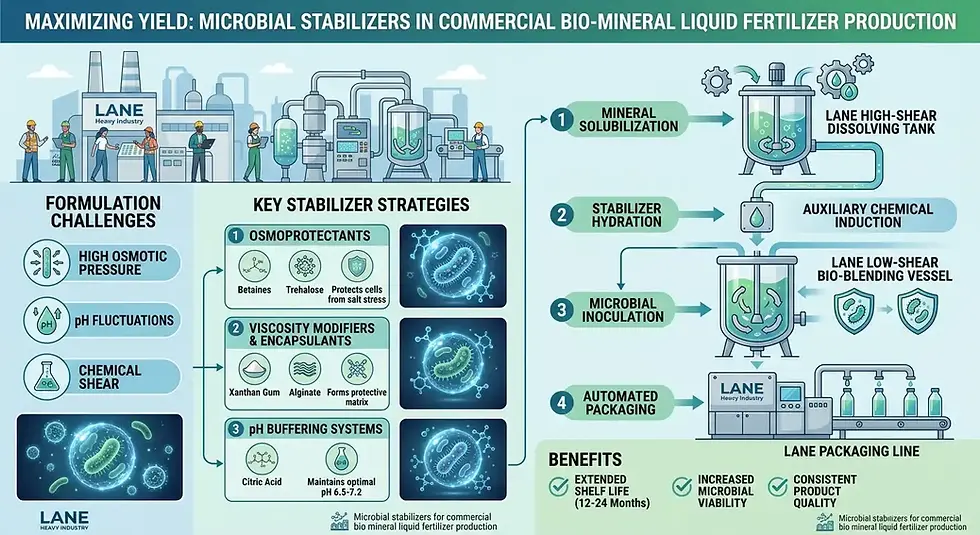
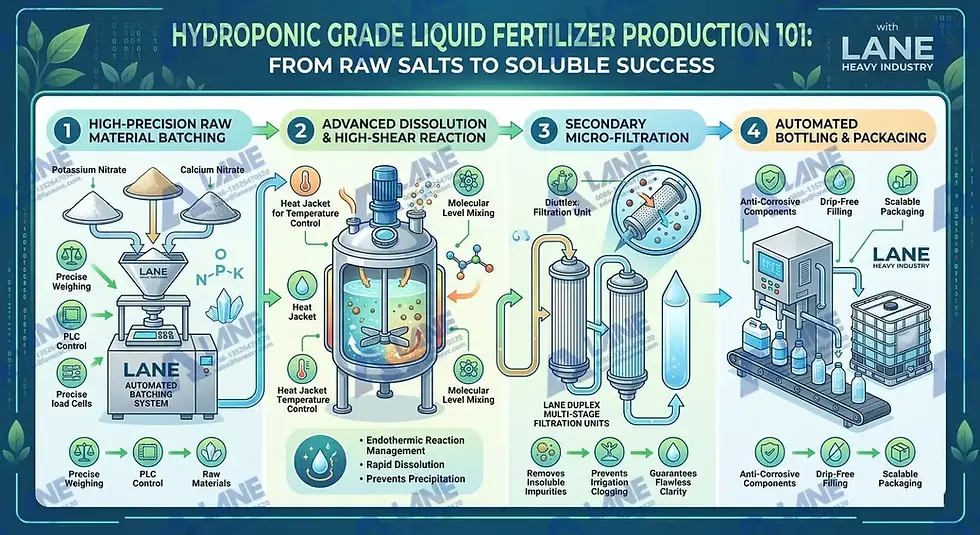
High-Shear Mixer Emulsifiers: For homogenizing raw materials like potassium nitrate, calcium salts, and organic concentrates.
Reaction Vessels: For processes requiring controlled temperature and agitation for chelation or hydrolysis.
Filtration Systems: Multi-bag or cartridge filters to remove particulates and ensure clean, clog-free fertilizer.
Automated Dosing & Control Panels: For precise injection of acids, micronutrients, and pH adjustment agents.

3. Step 1: Site Preparation and Tank Installation
Choose a dedicated, level, and ventilated room or area within your greenhouse utility zone. Install primary storage tanks for your raw water and stock solutions of macronutrients (N, P, K, Ca, Mg). Install LANE’s main production mixing tank centrally. Ensure all tank platforms are stable and that you have easy access for raw material delivery and loading. Proper infrastructure is critical for a smooth-running Liquid Fertilizer Production System for Greenhouse.
4. Step 2: Installing the Mixing and Reaction Station
LANE high-shear mixer is the heart of your Liquid Fertilizer Production System for Greenhouse, ensuring complete dissolution and uniformity. Connect it to a variable frequency drive (VFD) for controlled mixing speeds. If you are producing specialized fertilizers, connect the LANE reaction vessel in line, ensuring proper thermal control plumbing.
5. Step 3: Integrating Filtration and pH/EC Control
Post-mixing, the liquid should be routed through a LANE filtration unit. This protects your downstream greenhouse irrigation lines and emitters from blockage. The filtered solution then moves to a balancing tank where integrated pH and EC (Electrical Conductivity) probes continuously monitor the solution. Connect automated dosers, controlled by the system panel, to inject minute amounts of acid/alkali or nutrient concentrates to hit your precise targets.
6. Step 4: Automation and Integration with Fertigation
The true power of a modern Liquid Fertilizer Production System for Greenhouse lies in automation. Connect the LANE control panel to your main greenhouse environmental computer or irrigation controller. The system can be programmed to automatically produce batches based on reservoir levels, or to directly inject the finished concentrate into the irrigation mainline at a set ratio. This creates a closed-loop, precision fertigation workflow.
7. System Calibration and Safety Protocols
Calibrate all sensors (pH, EC, flow meters) weekly. Establish strict Standard Operating Procedures (SOPs) for raw material handling, batch recording, and system cleaning to prevent nutrient cross-contamination. Always wear appropriate PPE when handling concentrated salts and acids. A well-maintained Liquid Fertilizer Production System for Greenhouse is both safe and consistently accurate.
8. Conclusion: The Value of On-Site Production
Setting up your own Liquid Fertilizer Production System for Greenhouse is a smart investment for any greenhouse grower. It offers cost savings, nutrient control, and sustainability. Investing a tailored Liquid Fertilizer Production System for Greenhouse with LANE Heavy Industry machinery transforms your nutrient management from a recurring cost into a controlled, efficient process. A well-designed Liquid Fertilizer Production System for Greenhouse not only improves crop health and yield but also reduces your environmental footprint by using renewable resources

Frequently Asked Questions (FAQ)
Q1: What is the main benefit of building my own Liquid Fertilizer Production System for Greenhouse?
A: The primary benefit is long-term cost control and independence. By purchasing raw materials in bulk and producing on-demand, you eliminate the premium paid for pre-mixed, branded bottled nutrients, yielding a high ROI while ensuring recipe consistency.
Q2: Is LANE Heavy Industry machinery suitable for a small to mid-size greenhouse?
A: Absolutely. LANE offers scalable components. A small operation might start with a single 500-gallon mixing tank, a compact mixer, and a basic controller, which is still a fully functional Liquid Fertilizer Production System for Greenhouse. The system can be expanded as your operation grows.
Q3: How complex is the daily operation of this system?
A: Once programmed and calibrated, the system is largely automated. Daily tasks typically involve checking raw material levels, verifying sensor readings, and logging batch data. The automation significantly reduces manual labor compared to handling hundreds of bottles or bags.
Q4: Can this system produce organic liquid fertilizers?
A: Yes, with the right configuration. The high-shear mixers and reaction vessels from LANE are excellent for hydrolyzing organic materials like fish emulsions, seaweed extracts, or creating compost teas. Proper filtration is key for organic-based Liquid Fertilizer Production System for Greenhouse setups.
Q5: What kind of maintenance does the LANE machinery require?
A: Maintenance is straightforward: regular inspection of mixer seals, cleaning of filtration elements, and calibration of probes. LANE equipment is built for industrial environments, offering durability and easy access to serviceable parts.

Email: sales@lanesvc.com
Contact number: +86 13526470520
Whatsapp: +86 13526470520

Comments