


A Step-by-Step Guide to Plant-Based Liquid Fertilizer Production


Plant based liquid fertilizer production has emerged as a key player in this green revolution as agricultural industry is increasingly turning to eco-friendly farming. It offers natural, chemical-free alternative to traditional synthetic fertilizers. It is created from renewable plant sources like crop residues, fruit peels, algae, and herbal waste. This fertilizer enriches soil health, boosts crop yield, and minimizes environmental impact.
For business and farmers looking for eco-friendly solution for synthetic fertilizer, LANE Heavy Industry’s liquid fertilizer production line provides a seamless, efficient, and scalable way to master plant based liquid fertilizer production. This guide breaks down the entire plant based liquid fertilizer production process step by step, highlighting how LANE’s specialized machinery simplifies each stage to ensure high-quality, consistent results.
Step 1: Raw Material Collection and Preparation
The foundation of quality plant based liquid fertilizer production lies in proper raw material selection and preparation. Common plant-based feedstocks include:
Soybean dregs and oilseed cakes (rich in protein and fiber)
Agricultural residues (crop stalks, leaves)
Plant processing byproducts (fruit peels, vegetable waste)
Dedicated biomass (seaweed, alfalfa, comfrey)
Before processing, raw materials must be inspected and prepared. LANE's equipment line begins with a crusher that processes up to 1 ton per hour, ensuring uniform particle size (typically 0.01–5mm diameter) for optimal extraction. This preliminary crushing significantly enhances the efficiency of subsequent plant based liquid fertilizer production stages by increasing surface area for microbial action and chemical reactions.
Step 2: Fermentation and Biological Conversion
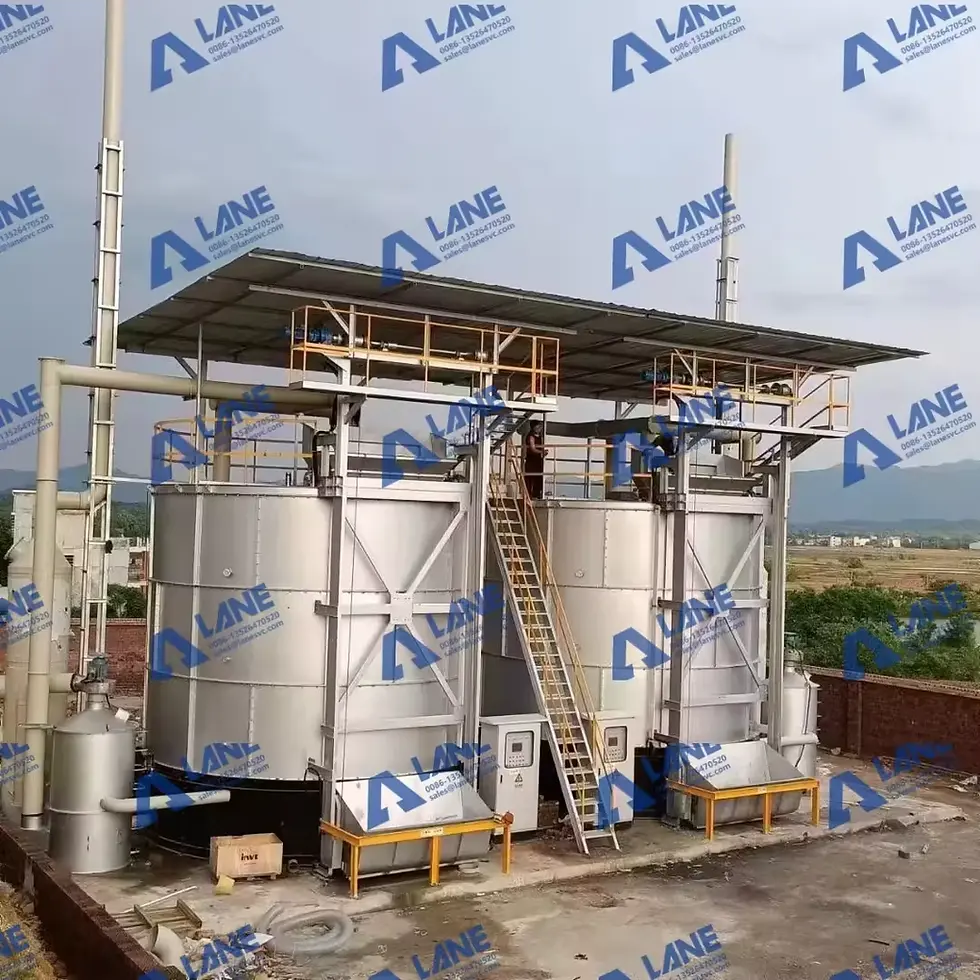
The heart of plant based liquid fertilizer production is the fermentation stage, where complex organic compounds are broken down into plant-available nutrients. LANE's stainless steel fermentation tanks, available in volumes up to 15 cubic meters, provide the ideal environment for this process.
Key features of LANE fermentation systems include:
Temperature control systems for optimal microbial activity
Integrated stirring mechanisms for uniform processing
Corrosion-resistant construction for longevity
During fermentation, specific bacterial cultures are added to the plant material along with water (typical ratios range from 1:2 to 1:15 material-to-water). The anaerobic fermentation process typically requires 4–90 days depending on feedstock characteristics and desired end-product specifications. For enhanced efficiency, LANE's systems can incorporate enzymatic digestion stages that further break down macromolecular compounds using specialized enzyme tanks.
Step 3: Nutrient Enhancement and Formulation
After primary fermentation, the base liquid requires fortification to meet specific crop nutrient requirements. This stage of plant based liquid fertilizer production involves precise formulation adjustments.
LANE's blending tanks feature automatic measuring systems that ensure accurate addition of:
Nitrogen, phosphorus, and potassium supplements
Secondary nutrients and micronutrients
Organic additives for enhanced performance
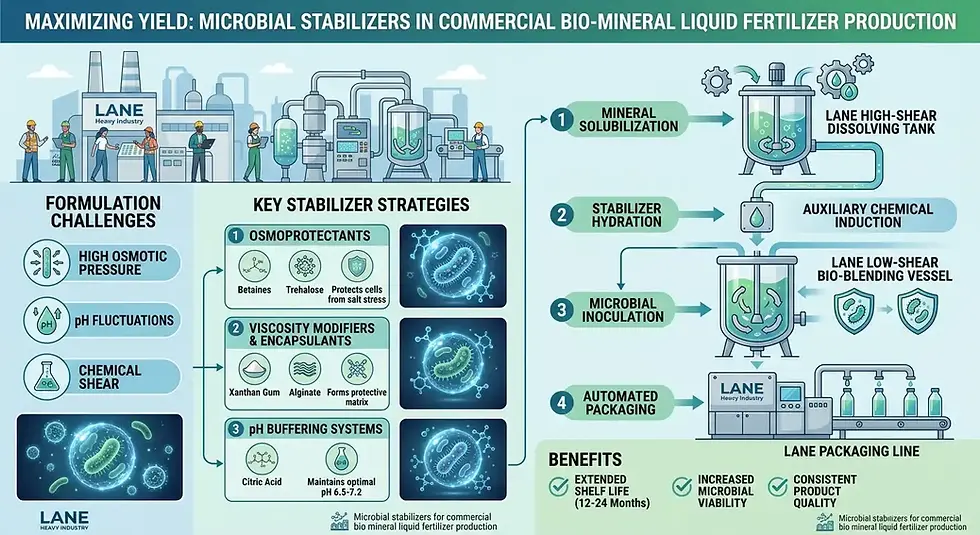
pH regulators and stabilizers
For emulsified foliar fertilizer production, LANE's specialized lines incorporate high-shear mixing technology that creates stable emulsions for improved plant absorption. The emulsification process ensures even distribution of nutrients and better adherence to leaf surfaces when applied.
Step 4: Filtration and Purification
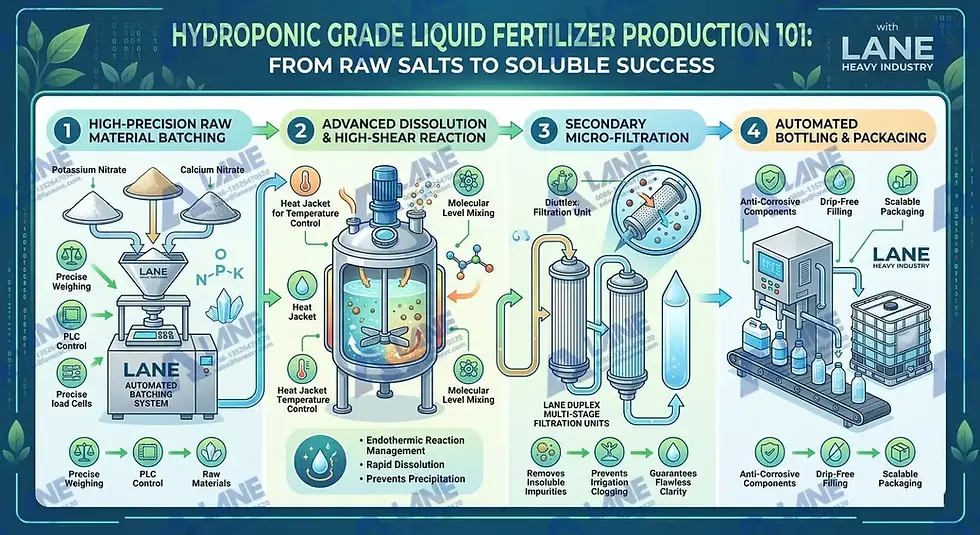
Quality plant based liquid fertilizer production requires thorough filtration to remove solid particles and impurities. LANE's multi-layer filtration systems employ duplex strainers and advanced filtering technology to achieve optimal product clarity.
The filtration process:
Removes undigested plant fibers and suspended solids
Ensures consistent product quality across batches
Prevents clogging in application equipment
Extends product shelf life
Depending on production requirements, filtration systems can be configured with various micron ratings to achieve desired final product specifications.

Step 5: Storage and Quality Control
Once filtered, the liquid fertilizer moves to storage tanks where final quality checks are performed. LANE's storage solutions feature:
Industrial-grade stainless steel construction (6mm thickness)
Temperature and pressure monitoring capabilities
Integrated sampling ports for quality testing
Quality control in plant based liquid fertilizer production involves verifying nutrient concentrations, pH levels, and microbial stability before product release. LANE's automated systems enable real-time monitoring throughout the production process, ensuring consistent quality that meets regulatory standards and customer expectations.
Step 6: Automated Packaging
The final stage of plant based liquid fertilizer production is efficient packaging for distribution. LANE's automatic filling lines, with capacities ranging from 2–19 tons per hour depending on system configuration, provide:
Precise volume measurement
Contamination-free filling
Flexible container options (from small bottles to bulk containers)
Integration with labeling and palletizing systems
Why Choose LANE Heavy Industry for Your Production Line
LANE Heavy Industry Machinery Technology Co., Ltd. stands at the forefront of fertilizer equipment manufacturing with several distinguishing advantages:
Comprehensive solutions: From single machines to complete turnkey production lines
Customization capabilities: Equipment tailored to specific raw materials and production goals
Quality assurance: ISO and CE certifications with 5-year warranties
Global support: Remote video guidance, on-site installation, and operator training
Proven track record: Successful installations across South America, Africa, and Asia
Frequently Asked Questions (FAQ)
Q1: What raw materials can be used for plant based liquid fertilizer production?
Common feedstocks include soybean dregs, oilseed cakes, agricultural residues, fruit and vegetable processing waste, and dedicated biomass like seaweed or alfalfa.
Q2: What is the typical production capacity of LANE's liquid fertilizer lines?
LANE offers solutions ranging from 1–20 tons per hour, with systems customizable to specific production requirements. Small-scale lines start at 1–3 tons per hour, while industrial installations can achieve significantly higher outputs.
Q3: How long does the fermentation process take?
Fermentation typically requires 4–90 days depending on feedstock type, desired nutrient profile, and environmental conditions. LANE's temperature-controlled tanks optimize this timeline for maximum efficiency.
Q4: Can I produce different fertilizer formulations with the same equipment?
Yes, LANE's production lines are designed for flexibility. The blending systems allow precise adjustment of nutrient ratios, enabling production of various NPK formulations, organic fertilizers, and specialty products from the same equipment.
Q5: What quality certifications does LANE equipment hold?
All LANE machinery carries ISO and CE certifications, with warranty periods extending five years after shipment date.
Q6: Do you provide installation and training support?
Yes, LANE offers comprehensive support including remote video guidance, on-site installation instruction, worker training, and field testing of production lines.
Q7: What is the minimum investment for a small-scale production line?
Basic equipment for small-scale plant based liquid fertilizer production starts around $13,500 for semi-automated lines, with complete systems available at various price points depending on capacity and automation level.
Q8: Can I use agricultural waste materials in production?
Absolutely. LANE specializes in converting agricultural byproducts into valuable fertilizers. Recent projects include processing soybean dregs in Vietnam and developing bio-liquid fertilizer solutions for African agricultural operations.

Email: sales@lanesvc.com
Contact number: +86 13526470520
Whatsapp: +86 13526470520

Comments