


Using Liquid Ammonia for Phosphate Fertilizer: A Complete Production Guide


phosphate is one of the three major macronutrients for crops. In modern industrial agriculture, phosphate fertilizers form the backbone of global crop nutrition strategies. Among the many innovations in fertilizer manufacturing, the use of liquid ammonia for phosphate fertilizer production has emerged as a highly efficient and cost-effective solution. By reacting anhydrous liquid ammonia directly with concentrated phosphoric acid, manufacturing plants can produce premium-grade Monoammonium Phosphate (MAP) and Diammonium Phosphate (DAP), as well as complex NPK granules with exceptional nutrient distribution.
Liquid ammonia for phosphate fertilizer has become a strong cost-reduction lever in ammonium phosphate production. For fertilizer manufacturers seeking higher profitability and stable production, adopting advanced phosphate fertilizer production lines from LANE Heavy Industry can significantly improve operational efficiency. We provide complete turnkey fertilizer production systems designed for modern agricultural demands, including phosphate fertilizer granulation lines, ammonia reaction systems, drying systems, cooling equipment, and automatic packaging solutions.
Chemical Fundamentals & Thermodynamic Synergy
The core objective when using liquid ammonia for phosphate fertilizer synthesis is the controlled neutralization of orthophosphoric acid (H3PO4). Anhydrous liquid ammonia (NH3), kept under pressure, flashes into a highly reactive gaseous state when metered into the reaction zone, driving rapid exothermic neutralization. Depending on the targeted molar ratio of Nitrogen to Phosphorus (N:P), the reactions progress as follows:
For MAP production (Molar Ratio ≈ 1.0):
NH3 (liq/gas) + H3PO4 (aq) → NH4H2PO4 + Heat
For DAP production (Molar Ratio ≈ 1.7 – 2.0):
2NH3 (liq/gas) + H3PO4 (aq) → (NH4)2HPO4 + Heat
The immense heat released during these reactions serves a valuable structural purpose in the production loop: it drives off a massive percentage of the process water as steam. This autogenous water evaporation dramatically reduces the thermal energy required in downstream drying units, decreasing overall fuel costs. Proper management requires balancing moisture levels and temperature within the granulator bed to maintain a precise "slurry-like" plastic state that favors high-efficiency particle enlargement.
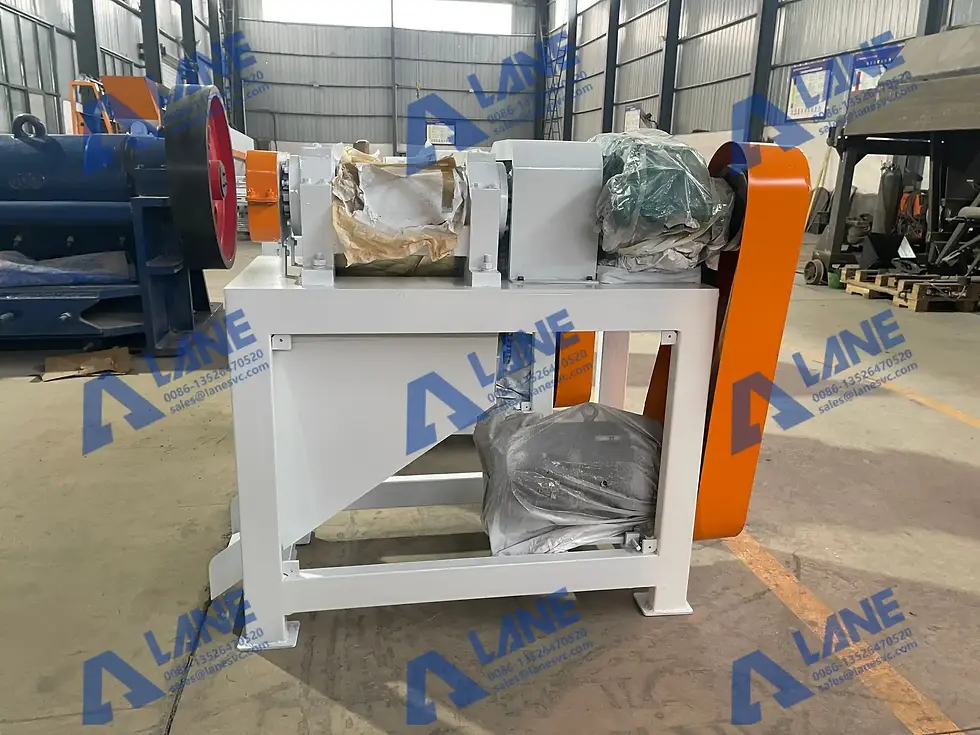
Step-by-Step Production Process via LANE Heavy Industry Machinery
The complete LANE Heavy Industry production line transitions the raw chemical reactants into uniform, high-density, anti-caking commercial fertilizer granules through a continuous, closed-loop circuit.
Production Stage | Core Equipment (LANE Machinery) | Key Technical Objective |
1. Pre-Neutralization | Tubular Pipe Reactor / Pre-neutralizer Vessel | Controlled chemical reaction of liquid ammonia and acid to form a hot, pumpable ammonium phosphate slurry. |
2. Ammoniation Granulation | Advanced Rotary Drum Granulator | Spraying hot slurry onto a rolling bed of recycled fines while adding sub-bed ammonia to finalize the molar ratio. |
3. Thermal Drying | Rotary Drum Dryer | Counter-current or co-current heat transfer to reduce granule moisture contents to below 1.5%. |
4. Thermal Stabilization | Rotary Drum Cooler | Rapidly lowering granule temperature to ambient levels to lock in structural integrity and prevent caking. |
5. Mechanical Classification | High-Frequency Vibrating Screening Machine | Separating off-spec fractions (oversize and fines) from the premium, marketable product. |
6. Particle Crushing | Heavy-Duty Chain Crusher / Cage Crusher | Milling oversized granules down to a fine powder for immediate return to the granulator circuit. |
7. Conditioning & Polishing | Rotary Drum Coating Machine | Applying a micro-thin layer of anti-caking oil and protective powder for long-term storage stability. |
8. Environmental Protection | Venturi Scrubbers & Cyclonic Dust Collectors | Capturing vaporized ammonia and particulates, recycling them directly back into the chemical loop. |
Detailed Phase Walkthrough:
Slurry Preparation and Pipe Reactor Synthesis: Liquid ammonia is pressurized and introduced alongside phosphoric acid into a specialized LANE tubular pipe reactor positioned directly inside the hood of the granulator, or into an external pre-neutralizer. The intense mixing generates a boiling ammonium phosphate slurry at temperatures exceeding 115°C to 130°C.
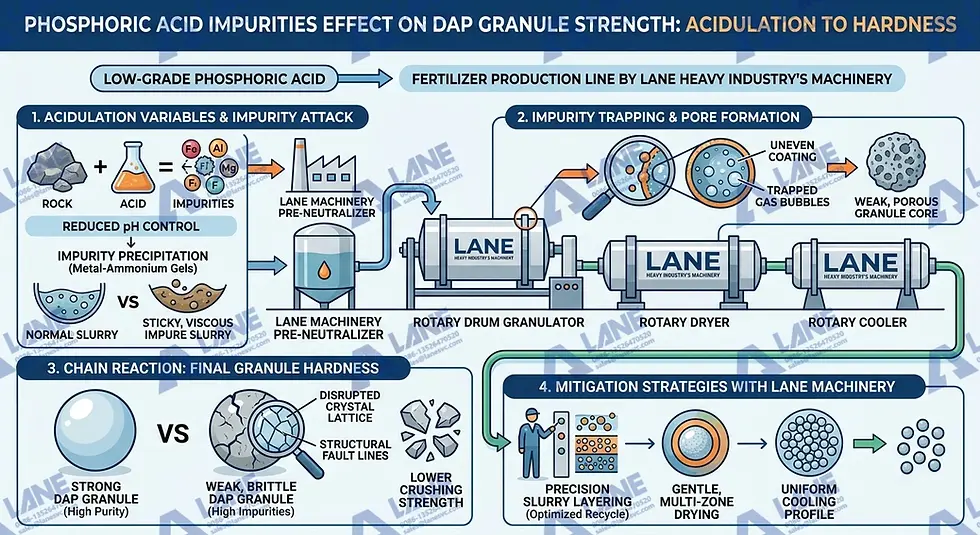
The Granulation Loop: The core of the operation takes place inside the LANE Rotary Drum Granulator. The hot slurry is distributed uniformly via a multi-hole spray sparger onto a falling curtain of recycled fines. Crucially, an underlying gas distribution sparger injects additional gaseous ammonia right beneath the rolling bed of material. This dual-injection system allows precise fine-tuning of the N:P molar ratio mid-granulation, promoting chemical binding, increasing granule hardness, and optimizing particle sphericity.
Drying, Cooling, and Sorting: Damp green granules discharge from the drum and enter the Rotary Dryer, where a controlled air stream removes remaining moisture without thermally degrading the ammonium molecules. The dried particles are immediately transferred to the Rotary Cooler. Cooling is essential; it crystallizes the internal mineral bridges within each granule, increasing crushing strength. The Vibrating Screen separates the product: undersized fines pass back to the granulator instantly, oversized granules are routed through a Heavy-Duty Chain Crusher to be broken down, and the on-spec fraction moves forward to the Coating Machine for surface glazing.

Production advantages
Liquid ammonia improves cost performance in several ways:
It supports precise dosing, which reduces raw material loss and improves the acid-to-ammonia ratio
More stable reaction lowers the chance of scaling and maintenance interruptions, which are major hidden costs in phosphate fertilizer plants.
better slurry consistency leads to better granulation and at a higher granulation rate.
Because of these our DAP and MAP production line can cut operating costs by 20% and achieve a 95% granulation rate, showing the economic value of an integrated design. While those results depend on plant scale and operating conditions, they highlight how equipment selection and process control affect profitability.
Frequently Asked Questions (FAQ)
Q1: Why choose liquid ammonia over gaseous ammonia or solid urea for phosphate fertilizer production?
A: Liquid ammonia provides a highly concentrated, cost-effective source of nitrogen that reacts completely with phosphoric acid. Unlike urea, which requires separate thermal melting and can increase product hygroscopicity, the liquid ammonia reaction generates significant autogenous heat. This heat evaporates process water naturally, vastly reducing the coal or natural gas consumption required by the downstream rotary dryer.
Q2: How does LANE Heavy Industry’s Rotary Drum Granulator optimize liquid ammonia integration?
A: LANE Heavy Industry's granulators feature customized internal acid-resistant alloy spargers and an advanced sub-bed gaseous ammoniation pipe design. This configuration guarantees complete contact between the ammonia gas and the acidic bed material, achieving exceptional neutralization efficiency, minimizing ammonia slippage into the exhaust system, and producing exceptionally hard, spherical granules.
Q3: Can this same production line be used for multi-nutrient NPK fertilizers?
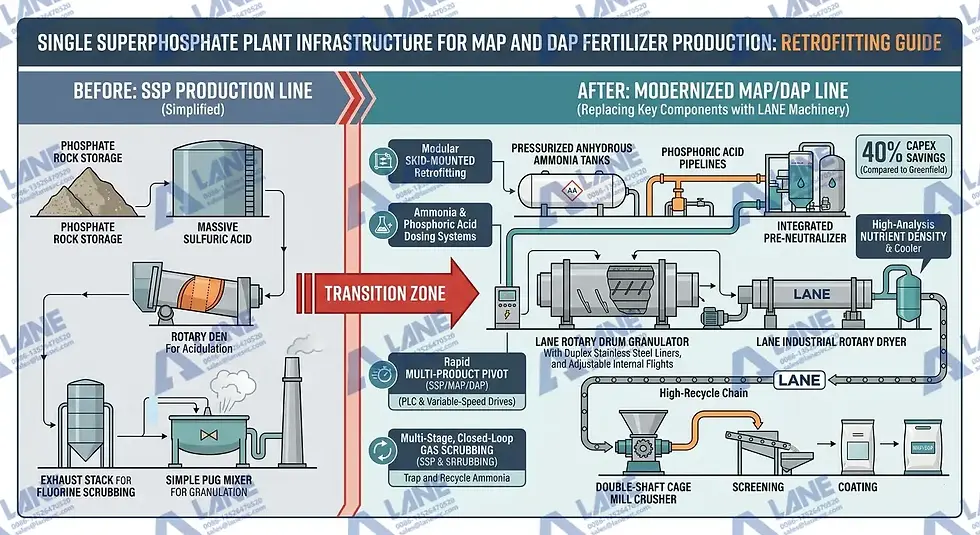
A: Yes. The LANE Heavy Industry fertilizer production line is highly versatile. By introducing solid potassium sources (such as Muriate of Potash or Sulfate of Potash) and secondary micronutrients into the solid feeding system along with the recycled fines, the ammonium phosphate slurry acts as an ideal chemical binder to create premium, homogeneous NPK compound fertilizers.
Email: sales@lanesvc.com
Contact number: +86 13526470520
Whatsapp: +86 13526470520

Comments