


Modular NPK and Phosphate Fertilizer Plant: Cost-Effective Fertilizer Production Line

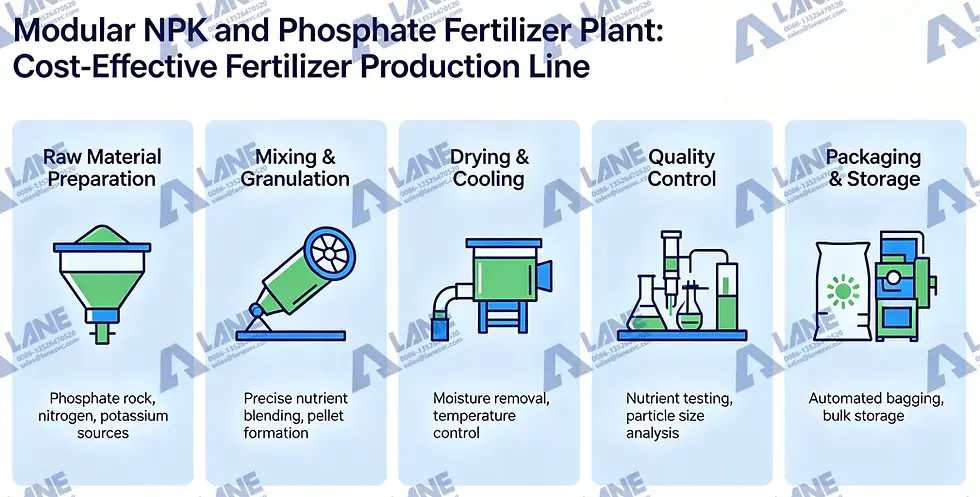
The demand for efficient and affordable fertilizer production continuous to grow as agriculture industry expands. Fertilizer manufacturers are now looking for flexible production systems that can reduce operational costs while maintaining high output quality. The primary challenge of the fertilizer producer is balancing initial capital investment with long-term operational efficiency. A Modular NPK and Phosphate Fertilizer Plant has become one of the most practical solutions for achieving cost-effective fertilizer manufacturing.
This NPK phosphate production line is designed for flexibility, scalability, and efficient resource utilization. Modular fertilizer plants allow manufacturers to produce various NPK and phosphate fertilizers with lower investment risks and faster installation times. As a professional fertilizer equipment manufacturer, LANE Heavy Industry provides complete turnkey fertilizer production solutions for global customers
What Is a Modular NPK and Phosphate Fertilizer Plant?
A Modular NPK and Phosphate Fertilizer Plant is an integrated fertilizer production system composed of independent processing modules. Each module performs a specific production function such as crushing, batching, granulation, drying, cooling, screening, or packaging.
Compared with traditional fertilizer factories, modular systems provide greater flexibility because production capacity can be expanded gradually. This allows fertilizer manufacturers to start with a smaller investment and later increase production according to market demand.
The plant is widely used for producing:
NPK compound fertilizer
DAP fertilizer
MAP fertilizer
SSP fertilizer
TSP fertilizer
Granular phosphate fertilizer
Why Choose a Modular Fertilizer Production Line?
A Modular NPK and Phosphate Fertilizer Plant offers several economic and technical advantages that make it attractive for fertilizer investors and manufacturers.

Lower Initial Investment
Traditional fertilizer plants often require large construction projects and expensive infrastructure. Modular fertilizer systems use prefabricated equipment and compact layouts that significantly reduce construction costs.
Manufacturers can also install production modules in phases, which helps reduce financial pressure during the early stages of the project.
Faster Installation Time
One major advantage of a Modular NPK and Phosphate Fertilizer Plant is the short installation period. Since the equipment is pre-designed and modularized, on-site assembly becomes faster and easier.
LANE Heavy Industry provides professional installation guidance and commissioning support, helping customers begin production quickly.
Flexible Production Capacity
The modular structure allows fertilizer producers to increase production capacity by adding new equipment modules without rebuilding the entire factory.
Common production capacities include:
10,000 tons/year
30,000 tons/year
50,000 tons/year
100,000 tons/year
This flexibility makes the system suitable for both small and large fertilizer manufacturers.
Anatomy of the Modular Production Sequence
LANE Heavy Industry’s cost-effective fertilizer production line is divided into synchronized operational blocks designed to handle complex chemical slurrification (such as MAP or DAP) as well as compound NPK dry-to-granular processing:
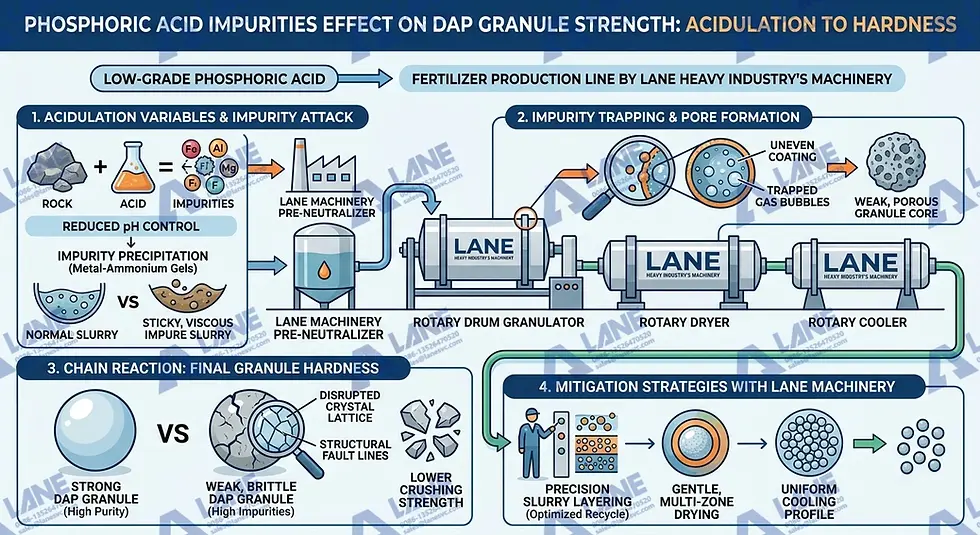
Advanced Ammoniation & Granulation: For phosphate fertilizers like MAP and DAP, LANE Heavy Industry utilizes advanced Pipe Reactor Technology positioned within a heavy-duty Rotary Drum Ammoniator-Granulator. Liquid phosphoric acid and anhydrous ammonia react exothermically inside the pipe. The intense heat generated natively evaporates large volumes of water from the chemical slurry, drastically lowering the fuel consumption required by downstream drying equipment.
Thermal Moisture Management: Fresh granules are directed into a synchronized counter-current Rotary Dryer and Rotary Cooler loop. Custom-engineered internal lifting flights cascade the granules smoothly across the path of the heated airflow. This maximizes heat transfer efficiency and dries the product down to a core moisture content of <1.5%, entirely eliminating warehouse caking.
The High-Yield Recycle Loop: To prevent material waste, a multi-deck high-frequency vibrating screen isolates granules within the premium 2.0 to 4.0 mm range. Oversized particles are routed into high-speed chain crushers, while undersized fines are swept directly back to the granulation drum to act as seed nuclei for the next batch. This tight closed-loop system maintains a 95% granule uniformity rate, maximizing the volume of salable product generated per hour.

Strategic Financial Advantages of LANE Machinery
Premium Anti-Corrosive Integrity: Phosphate processing creates highly aggressive chemical environments. To protect your asset, LANE Heavy Industry fabricates all core reaction zones, slurry pipelines, and drum liners from industrial-grade SUS304 or SUS316L stainless steel, preventing corrosion-related failures and extending plant lifespan.
Agile Market Switching: Rather than being locked into a single product, LANE’s modular automation architecture allows operators to adjust process parameters seamlessly. You can toggle from high-nitrogen NPK blends to pure phosphate fertilizers (MAP/DAP) via software-assisted modifications, allowing you to adapt immediately to changing market prices.
Zero-Waste Environmental Controls: Integrated multi-stage Venturi scrubbers and cyclone dust collectors capture ammonia slip, fluorine gases, and chemical particulates. These captured compounds are recycled straight back into the primary reaction loop, eliminating wastewater discharge while recovering valuable raw materials.
Conclusion
In a competitive market, the producer with the lowest per ton wins. Fertilizer producers who are seeking cost optimization and efficient production, LANE’s Modular NPK and Phosphate Fertilizer Plant is an ideal choice. The modular design reduces installation costs, shortens construction time, and allows future production expansion. It integrates cost-saving advantages in investment, operation and expansion, helping enterprises reduce costs while ensuring product quality, and achieving sustainable development in the competitive. With advanced fertilizer machinery, intelligent automation systems, and complete turnkey services, LANE Heavy Industry provides reliable solutions for modern fertilizer manufacturing.
Frequently Asked Questions (FAQ)
1. How much can I save with a modular plant compared to a conventional one?
Clients typically see a 20-30% reduction in capital expenditure due to minimized civil works and shorter project timelines. Operationally, energy-efficient machinery can reduce power and fuel consumption by 15% or more, as demonstrated in LANE’s retrofit projects.
2. What is the typical ROI for a modular NPK and phosphate fertilizer plant?
While dependent on local raw material and product prices, the combination of lower Capex, faster commissioning (5-8 months), and reduced operational costs often yields a payback period of 2 to 4 years, significantly faster than traditional plants.
3. Can the plant be expanded later without major new investment?
Yes. The modular design is specifically engineered for scalability. You can start with a smaller capacity and integrate additional pre-engineered modules for granulation, drying, or packaging as your market grows, preserving future capital.
Email: sales@lanesvc.com
Contact number: +86 13526470520
Whatsapp: +86 13526470520


Comments