


Phosphoric Acid Impurities Effect on DAP Granule Strength — From Acidulation Variables to Final Granule Hardness

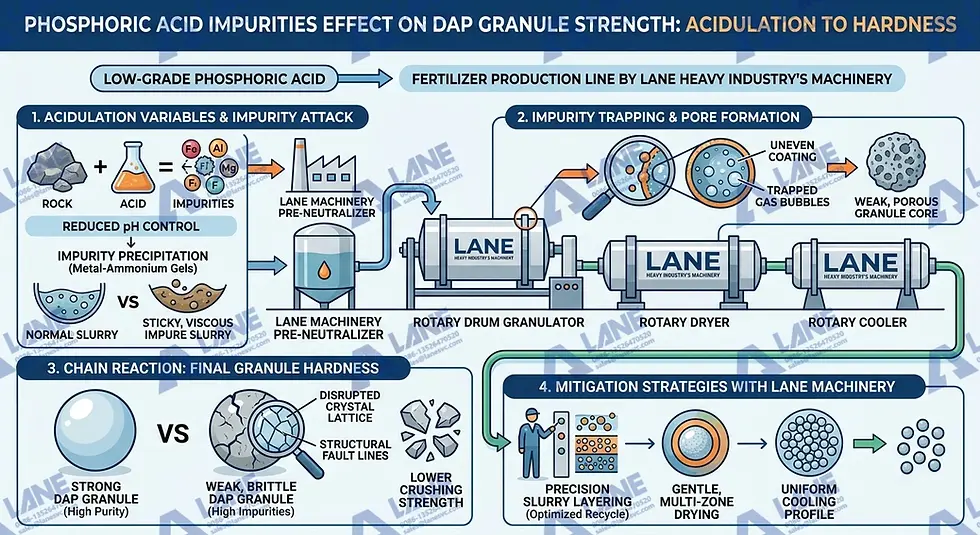
Diammonium phosphate (DAP) fertilizer is one of the world's most widely used phosphate fertilizers. It has excellent nutrient concentration, excellent storage stability, and strong market demand. however, manufacturing this fertilizer is a complex process. If your plant's granulation loop is calibrated perfectly but your final product is still failing routine crushing tests, the problem isn't your mechanical settings—it's a chemical saboteur. The phosphoric acid impurities effect on DAP granule strength acts as an invisible enemy that begins during early acidulation variables and carries all the way through to the final cooling drum.
Dissolved iron, aluminum, and fluorine hijack the ammonization process. This turn what should be a smooth slurry into a thick, porous sludge that prevents tight crystal interlocking. Overcoming this hidden flaw requires understanding of the production process and mechanical excellence. LANE Heavy Industry have manufactured production line for DAP fertilizer. Our reactors can neutralize the damage to secure maximum final granule hardness.
Understanding Acidulation in DAP Production
DAP production begins with the neutralization of phosphoric acid using ammonia. During this acidulation process, ammonium phosphate slurry is generated and fed into the granulation system.
The quality of this slurry determines:
Granulation efficiency
Particle growth rate
Crystal development
Final granule hardness
The phosphoric acid impurities effect on DAP granule strength often starts during acidulation, where impurities interfere with reaction chemistry and influence the physical properties of the slurry.

Common phosphoric acid impurities include:
Iron (Fe)
Aluminum (Al)
Calcium (Ca)
Magnesium (Mg)
Fluoride (F)
Sulfates (SO₄)
Organic contaminants
Each impurity contributes differently to the phosphoric acid impurities effect on DAP granule strength, depending on concentration and operating conditions.
The Chain Reaction: Impact on Final Granule Hardness
Once the compromised slurry enters the granulation phase, the internal architecture of the DAP granule is compromised. Pure DAP relies on a tightly woven, interlocking crystal lattice to achieve high crushing strength.
However, the phosphoric acid impurities effect on DAP granule strength shatters this lattice symmetry. Fluorine and magnesium complexes embed themselves into the growing crystals, creating structural fault lines. When the granules are subjected to the weight of a storage pile or the vibration of commercial transport, they fracture along these chemical fault lines, disintegrating into problematic dust.
3. Mitigating the Threat with LANE Heavy Industry's Machinery
While chemical impurities present a major hurdle, the right mechanical hardware can act as an effective shield. A robust fertilizer production line engineered by LANE Heavy Industry's Machinery is specifically designed to manage volatile slurry conditions and protect final granule hardness.
Precision Slurry Layering in the Rotary Granulator
The high-torque rotary drum granulator from LANE Heavy Industry's Machinery features fully adjustable flight configurations and flexible liquid distribution sprays. When dealing with the high-viscosity sludge caused by the phosphoric acid impurities effect on DAP granule strength, operators can increase the internal recycling ratio of dry material.
By rolling the sticky, impure slurry over a larger volume of dry seed particles in thin, successive layers, the machine forcefully packs the material, squeezing out trapped air pockets and eliminating internal voids.
Controlled Thermal Curing in the Rotary Dryer
Thermal shock is the enemy of an impure granule. Metallic impurity complexes carry bound water molecules that expand when heated. If exposed to a sudden blast of high temperature, this water flashes into steam, leaving behind a web of micro-cracks that worsens the phosphoric acid impurities effect on DAP granule strength.
The advanced rotary drying systems built by LANE Heavy Industry's Machinery utilize segmented, multi-zone heating profiles. By gently drawing out moisture at a controlled pace, the system prevents steam-induced fracturing, effectively preserving a high baseline granule hardness.
High-efficiency filtration modules integrated upstream of the pre neutralizer to remove calcium and suspended solids

4. Key Takeaways for Plant Operators
To consistently defeat the phosphoric acid impurities effect on DAP granule strength, a dual chemical and mechanical strategy is essential:
Optimize the Mole Ratio: Maintain a strict nitrogen-to-phosphorus ratio in your pre-neutralizer to control when and how metal impurities drop out of solution.
Leverage Mechanical Layering: Use the heavy-duty recycling capabilities of your fertilizer production line to compress sticky slurries into dense, multi-layered pellets.
Gentle Drying and Cooling: Rely on the precision thermal zones of LANE Heavy Industry's Machinery dryers and counter-current coolers to lock in crystal integrity without causing stress fractures.
FAQ
Q1: What impurity most critically affects DAP granule strength?
Calcium is the major source of grade deficiency and weakens granule structure, driving the phosphoric acid impurities effect on DAP granule strength.
Q2: How does the F:Fe₂O₃ ratio influence hardness?
Ratios >2.3:1 form coarse crystals that enhance strength; ratios <2.0:1 produce fine crystals that weaken granules, intensifying the phosphoric acid impurities effect on DAP granule strength.
Q3: Can purification remove impurities effectively?
Yes, purification achieves 30% iron, 31% aluminum, and 18% magnesium removal, eliminating the phosphoric acid impurities effect on DAP granule strength.
Q4: What N:P ratio prevents nitrogen deficiency?
N:P must exceed 1.4:1 to avoid MAP formation and nitrogen deficiency, which otherwise worsen the phosphoric acid impurities effect on DAP granule strength.

Email: sales@lanesvc.com
Contact number: +86 13526470520
Whatsapp: +86 13526470520


Comments