


Single Superphosphate Plant Infrastructure for MAP and DAP Fertilizer Production: Everything You Need to Know

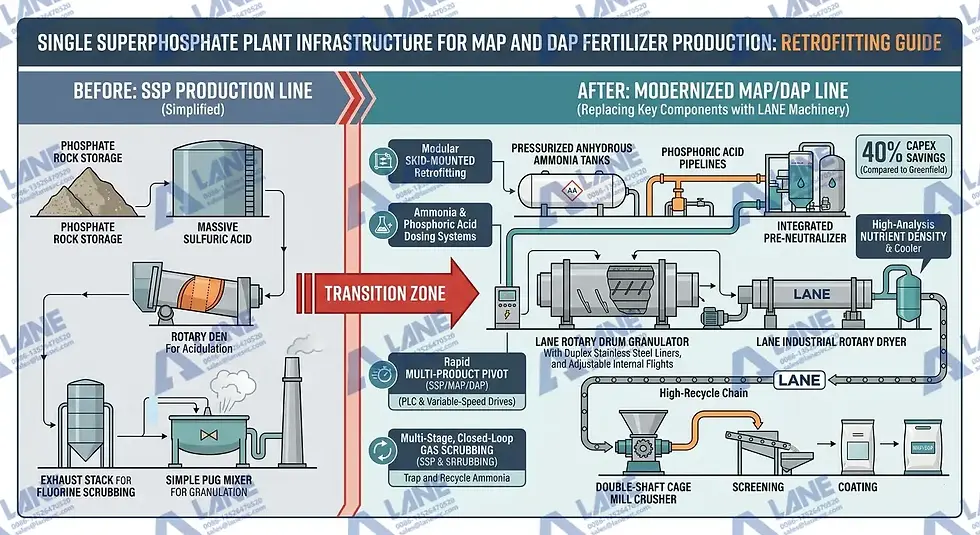
For heavy industrial enterprises, equipment longevity determines long-term profitability. Tearing down an operational factory to build a new is a costly, time-consuming venture that often delays time to market by years. As demand increases, many producers are exploring how to upgrade existing facilities instead of building new plants. The most sustainable alternative is industrial retrofitting. Upgrading your single superphosphate plant infrastructure for MAP and DAP fertilizer production allows you to leverage over 50 % of your existing capital assets. This including massive civil foundations, raw material storage sheds, electrical grid ties, and packaging terminals.
Partnering with LANE Heavy Industry to replace obsolete acidulation lines with a high capacity, heavy duty replaceable system production line preserves your foundational investment while immediately elevating your facility to high-analysis chemical output. This article explains everything you need to know about process conversion, equipment integration, and industrial upgrading using modern solutions from Henan LANE Heavy Industry Machinery Technology Co., Ltd.
Understanding SSP vs MAP/DAP Production Systems
To understand single superphosphate plant infrastructure for MAP and DAP fertilizer production, it is important to compare the two processes:
SSP production: phosphate rock + sulfuric acid
MAP/DAP production: phosphoric acid + ammonia
This means SSP plants are acidulation-based, while MAP/DAP plants are ammoniation-based systems. Despite this difference, many mechanical systems in SSP plants can still be reused or upgraded.

What Can Be Reused in SSP Plant Infrastructure
A major advantage of upgrading single superphosphate plant infrastructure for MAP and DAP fertilizer production is the ability to reuse existing assets.
Reusable systems include:
Raw material crushing and grinding units
Conveying and feeding systems
Granulation and drying equipment (with modifications)
Screening and packaging lines
Storage warehouses and logistics infrastructure
Dust collection and environmental systems
These components significantly reduce investment costs during conversion projects.
What Must Be Upgraded or Replaced
While mechanical systems can be reused, chemical processing systems require major changes.
Key upgrades include:
Sulfuric acid system → replaced with phosphoric acid storage
Den reactor → replaced with ammoniation granulation system
Introduction of ammonia storage and safety systems
Installation of corrosion-resistant materials
Upgraded gas scrubbing and emission control systems
These modifications are essential for transforming single superphosphate plant infrastructure for MAP and DAP fertilizer production into a modern compound fertilizer facility.
Process Flow Transformation
The production flow must be redesigned entirely.
Traditional SSP process:
Phosphate rock → acid reaction → curing → drying → screening → packaging
MAP/DAP process:
Phosphoric acid → ammonia neutralization → granulation → drying → cooling → coating → packaging
This transformation is the core of upgrading single superphosphate plant infrastructure for MAP and DAP fertilizer production.
Key Equipment from LANE Heavy Industry
A successful upgrade of single superphosphate plant infrastructure for MAP and DAP fertilizer production depends on integrating specialized equipment. LANE Heavy Industry provides a complete fertilizer production line designed for this transformation.
Phosphoric Acid Storage and Feeding: Unlike SSP plants, MAP/DAP production requires phosphoric acid systems. LANE offers corrosion-resistant storage tanks and precision feeding units that ensure stable acid flow, which is critical for consistent reactions in single superphosphate plant infrastructure for MAP and DAP fertilizer production.
Ammonia Storage and Injection System: Ammonia handling is a key addition. LANE machinery includes pressurized tanks, vaporization systems, and automated control units. These ensure safe and efficient ammonia delivery, a crucial step in upgrading single superphosphate plant infrastructure for MAP and DAP fertilizer production.
Pipe Reactor System: The pipe reactor is central to MAP/DAP production. LANE’s pipe reactors enable rapid and efficient mixing of ammonia and phosphoric acid, producing a uniform slurry. This system replaces traditional SSP reactors when converting single superphosphate plant infrastructure for MAP and DAP fertilizer production.
Rotary Drum Granulator: Granulation plays a vital role in product quality. LANE rotary drum granulators provide excellent particle uniformity, adjustable retention time, and high granulation efficiency. These features significantly enhance single superphosphate plant infrastructure for MAP and DAP fertilizer production.
Drying and Cooling Systems: LANE’s rotary dryers and coolers are designed to handle MAP/DAP moisture characteristics. They ensure optimal drying, prevent caking, and improve storage stability, making them essential for upgraded single superphosphate plant infrastructure for MAP and DAP fertilizer production.
Screening and Recycling Systems: Efficient screening systems improve product consistency. LANE provides vibrating screens and recycling loops that return off-size particles to the process, increasing yield in single superphosphate plant infrastructure for MAP and DAP fertilizer production.
Dust Collection and Environmental Systems: Environmental compliance is critical. LANE offers dust collectors, cyclones, and wet scrubbers that reduce emissions and ensure safe operation of single superphosphate plant infrastructure for MAP and DAP fertilizer production.

Engineering Challenges in Conversion
Upgrading SSP plants is technically complex.
Key challenges include:
Compatibility between old and new systems
Ammonia handling safety requirements
Corrosion resistance issues
Production downtime during retrofit
Process control integration
Proper engineering planning is critical for success.
Economic Benefits of Upgrading
Despite technical challenges, upgrading single superphosphate plant infrastructure for MAP and DAP fertilizer production offers strong economic advantages:
30–60% lower investment cost compared to new plants
Faster project implementation
Reuse of existing infrastructure
Reduced permitting and civil construction costs
Improved product diversification
FAQ
1. Is it possible to fully convert SSP plants to MAP/DAP production?
Yes, most SSP plants can be upgraded, provided the infrastructure supports new process requirements.
2. What is the most important equipment in the upgrade?
The pipe reactor and ammonia system are critical components in single superphosphate plant infrastructure for MAP and DAP fertilizer production.
3. How long does the upgrade take?
Typically, between 6 to 12 months depending on plant size and complexity.
4. Does upgrading improve environmental performance?
Yes, modern systems from LANE significantly reduce emissions and improve environmental compliance.
Email: sales@lanesvc.com
Contact number: +86 13526470520
Whatsapp: +86 13526470520


Comments