


Low Capacity DAP Plant: Flexible Production for Small and Medium Farms


Small and medium scale farmers all over the world is seeking more efficient and cost-effective ways to secure high-quality fertilizers. Diammonium Phosphate (DAP) is one of the most popular compound fertilizers because of its high phosphorus and nitrogen content. farmers and agribusiness can start producing DAP fertilizer with low capacity DAP plant to secure high-quality fertilizers at low cost. This production line offers flexible production, lower investment requirements, and scalable operation for businesses targeting regional agricultural markets.
A low capacity DAP plant is a compact production line that is designed to match the production needs of local regions, cooperatives, and family‑owned farms. With advanced DAP fertilizer production solutions from LANE Heavy Industry Machinery Technology Co., Ltd., small and medium producers can manufacture quality DAP fertilizer while minimizing risk and maximizing operational efficiency.
The Pivot to Localized Production: What is a Low Capacity DAP Plant?
A low capacity DAP plant operates within an output range of 1 to 10 tons per hour (TPH), delivering roughly 5,000 to 30,000 tons of premium granulated fertilizer per year based on seasonal shifts. Unlike massive petrochemical-scale plants that depend on unyielding, continuous chemical processes, a low-capacity line is built on a modular blueprint.
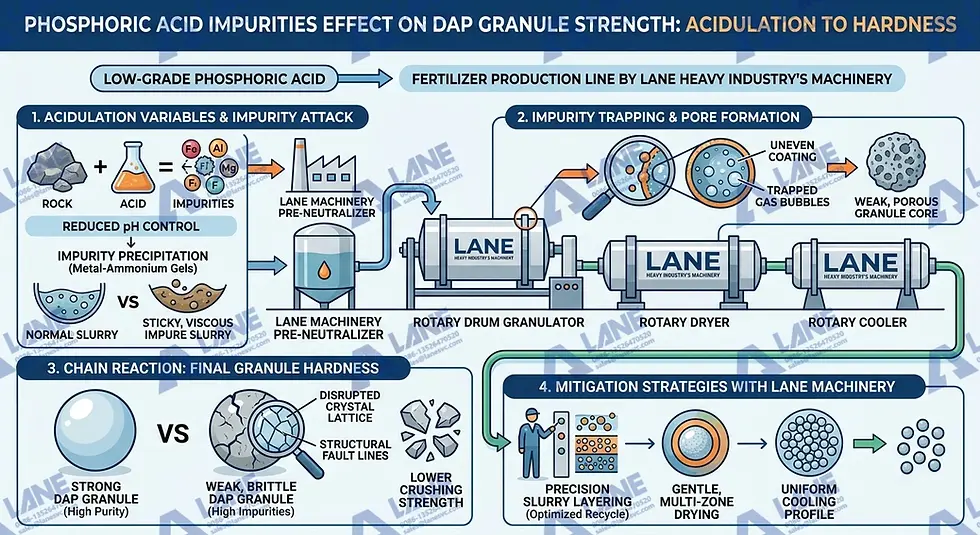
LANE Heavy Industry has pioneered this downscaled engineering, ensuring that a smaller throughput does not mean a compromise in quality. By integrating precise batching scales, high-shear mixing, and advanced granulation techniques, these plants produce DAP granules (typically 18-46-0 NP grade) with the exact same nutrient uniformity, high crushing strength, and dust-free handling characteristics found in global commodity shipments.
How a Low Capacity DAP Plant Works with LANE Heavy Industry Machinery

LANE Heavy Industry constructs its small-to-medium fertilizer plants with a heavy emphasis on automation, compact real-estate layout, and extreme corrosion resistance. A standard low-capacity layout consists of several integrated technological stages:
Precision Batching & Crushing: Automated belt weighers feed raw materials into a heavy-duty cage or hammer crusher. This step ensures that all solid inputs are reduced to a fine, uniform powder, providing the perfect physical foundation for stable granulation.
Controlled Slurry Reaction: Phosphoric acid and ammonia are introduced into a specialized, rubber-lined neutralization reactor tank. The controlled, exothermic chemical reaction creates a balanced DAP slurry.
Advanced Granulation (The Rotary Drum): The slurry is sprayed onto a tumbling bed of recycled core particles inside LANE’s optimized rotary drum granulator. The rolling action builds dense, highly spherical, uniform granules.
Drying and Cooling Loops: Granules enter a co-current rotary dryer to strip away excess moisture without scorching heat, followed by a counter-current rotary cooler that stabilizes the crystal structure and prevents caking during transport.
Precision Screening & Recycling: Industrial Rotary screeners separate the exact commercial grade (typically 2–4mm). Oversized granules are immediately crushed and returned to the system, while undersized particles serve as core seeds for the next batch, ensuring a zero-waste loop.
Comparative Advantage: Low Capacity vs. Mega Industrial Setups
Strategic Metric | LANE Low Capacity Plant (1-10 TPH) | Traditional Mega Factory (30+ TPH) |
Initial Investment | Low capital risk; accessible for private agri-groups. | Multi-million dollar; requires massive external financing. |
Site Requirements | Fits inside modest, standard industrial warehouses. | Requires expansive heavy-industrial zones and port access. |
Labor Requirement | High automation; easily managed by 3–5 operators per shift. | Massive engineering, maintenance, and administrative crews. |
Product Customization | Turnkey adjustment for micro-batches and custom NPKs. | High rigidity; formulation changes cause massive downtime. |

Cost performance for small‑scale operators
A low capacity DAP plant is not intended to beat the unit‑cost efficiency of the world’s largest phosphate complexes; instead, it aims to offer financially sustainable production at a community or regional level. Fixed costs (land, utilities, and basic infrastructure) are lower in absolute terms, and the plant avoids the heavy overhead associated with large industrial plants.
At the same time, the plant can still benefit from reasonably stable operating costs. Because DAP is a high‑analysis phosphate fertilizer, even moderate volumes can generate meaningful revenue when sold to a concentrated base of nearby farms. For cooperatives or farmer‑owned enterprises, this means they can capture part of the value chain that would otherwise go to distant manufacturers and distributors.
When a low capacity DAP plant makes sense
A low capacity DAP plant is most suitable in the following situations:
You serve a defined geographic cluster of small and medium farms that cannot rely on uncertain or expensive long‑distance supply.
Your capital budget is limited, but you want to produce a branded, high‑quality fertilizer locally.
You expect to grow gradually, so you need a plant whose design can be expanded step‑by‑step rather than fully built at once.
You seek tighter integration between fertilizer supply and local agronomic practices (e.g., soil testing, crop‑specific blends).
In all these cases, a compact plant built around LANE’s DAP fertilizer production line can act as a nucleus for regional agricultural development, improving both fertilizer access and farm profitability.
FAQ
Q1: What does “low capacity DAP plant” mean?
A low capacity DAP plant is a fertilizer facility designed to produce DAP at a smaller output level, suitable for local or regional markets rather than national export‑oriented supply.
Q2: Why is a low capacity DAP plant attractive for small farms?
It reduces dependence on distant suppliers, lowers transport and middleman costs, and improves supply reliability for farmers during critical planting periods.
Q3: Can LANE Heavy Industry supply a complete low capacity DAP production line?
Yes; LANE’s DAP fertilizer production line covers the full process chain—ammoniation, granulation, drying, cooling, screening, coating, and packaging—which can be scaled down for smaller plants.
Q4: Is a low capacity plant suitable for future expansion?
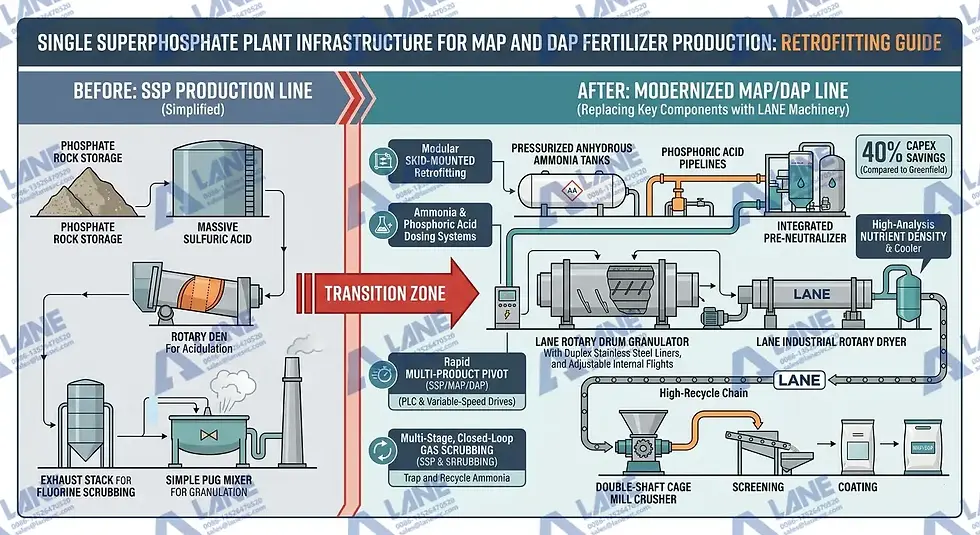
Yes. These plants are often designed to be modular, allowing additional capacity to be added by upgrading or duplicating key equipment blocks as demand grows.

Email: sales@lanesvc.com
Contact number: +86 13526470520
Whatsapp: +86 13526470520

Comments