


The Complete Beginner's Guide to Liquid Fertilizer Production Line Investment

Table of Contents
Introduction: What is a Liquid Fertilizer Production Line?
Why Consider This Investment? Key Benefits
The Core Components: What’s in a LANE Production Line?
Understanding the Costs: A Realistic Investment Breakdown
The Roadmap: 5 Steps to Launch Your Production
Why Partner with LANE Heavy Industry as a Beginner?
Frequently Asked Questions (FAQ)

1. Introduction: What is a Liquid Fertilizer Production Line?
Liquid fertilizer has become popular among farmers because of its high absorption and fast result. It is more efficient and eco-friendlier alternative to traditional solid fertilizers. Liquid fertilizer production line investment has become a promising venture for investors seeking long-term returns in the agricultural sector. Liquid fertilizer production line is some interconnected machines and tanks that transforms raw nutrient materials like nitrogen, phosphorus, potassium, and micronutrients into a finished, market ready product.
If you are a farmer, agricultural entrepreneur, or investor, then a liquid fertilizer production line investment presents a golden opportunity. For a beginner, understanding this process is the firsts step toward recognizing its potential. This guide will cover the key aspects from market analysis to equipment selection, with a focus on LANE Heavy Industry’s machinery.
2. Why Consider This Investment? Key Benefits
Liquid fertilizer production line investment moves you from being a buyer to a producer of inputs is a strategic leap. Here’s why this investment is compelling.
Cost Control & Independence: Liquid fertilizer production line shields your operation from market price volatility for commercial fertilizers.
Customization: You can create specific blends tailored to your soil's exact needs or to target high-value niche crops.
New Revenue Stream: You can sell surplus production to neighboring farms, nurseries, or cooperatives.
Operational Efficiency: Liquid fertilizers work seamlessly with modern irrigation and precision application systems.
3. The Core Components: What’s in a LANE Production Line?
A standard turnkey line from LANE is designed for efficiency and quality. As a beginner, familiarizing yourself with these key parts is essential:
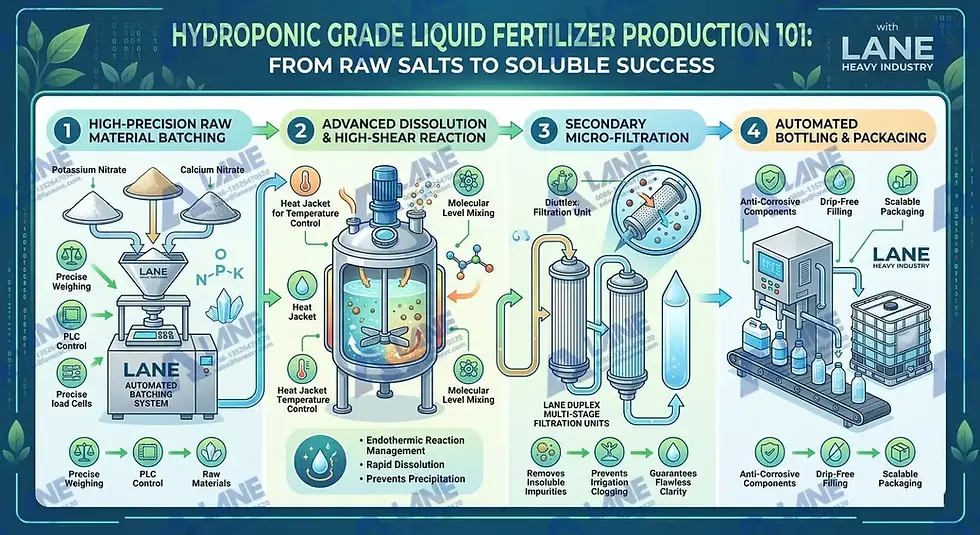
Batching System: These are the precision scales and conveyors that measure raw materials accurately.
Reaction Vessels: Heavy-duty, heated stainless steel tanks where raw materials are dissolved and chemically reacted.
High-Shear Mixer/Homogenizer: This critical component ensures a smooth, stable product where solids won’t settle.
Filtration System: It removes impurities to prevent clogging in application equipment.
PLC Control Panel: The "brain" of the operation, allowing for automated control, recipe storage, and consistent batch quality.
Storage & Packaging: Includes holding tanks and, for commercial sales, options for filling into IBC totes, drums, or bottles.

4. Understanding the Costs: A Realistic Investment Breakdown
Your liquid fertilizer production line investment is not a single number but a sum of parts. Here’s a simplified beginner’s breakdown:
Cost Component | Description | Approximate Range (USD) |
By | The LANE production line equipment (semi-automatic to automatic). | $50,000 - $200,000+ |
Installation & Commissioning | Professional setup, calibration, and testing. | $5,000 - $25,000 |
Facility Preparation | Space, reinforced flooring, utilities (water, 3-phase power). | Variable |
Initial Raw Material Inventory | First purchase of base nutrients and additives. | $10,000 - $30,000 |
Certification & Licensing | Meeting local agricultural and safety standards. | Variable |
Note: A small-scale, semi-automatic line for on-farm use starts at a lower entry point, while large-scale commercial lines require a higher initial investment.
5. The Roadmap: 5 Steps to Launch Your Production
Liquid fertilizer production line investment is a huge uptake that require significant preparations. You should asses the following question before creating a Liquid fertilizer production line.
Define Your Scope: Start by asking: "Am I producing for myself, or also for sale?" This determines your needed capacity.
Develop a Business & Financial Model: Project your costs, potential savings, and revenue. This model is crucial for securing financing if needed.
Consult with an Expert Manufacturer: Engage with LANE Heavy Industry. Share your goals and let us recommend a line configuration that matches your budget and output targets.
Prepare Your Site: Ensure your facility has the necessary space, power, water, and drainage as specified in the machinery layout.
Install, Train, & Produce: LANE engineers oversee installation, provides comprehensive operator training, and supports your first production runs.
6. Why Partner with LANE Heavy Industry as a Beginner?
Starting a new Liquid fertilizer production line requires reliable partners. LANE is an ideal choice for beginners because:
Beginner-Friendly Engineering: Our lines are built for operational simplicity and durability; it reduces the technical barrier to entry.
Comprehensive Training: We don’t just sell machines; we ensure your team can operate them confidently.
End-to-End Support: From design to after-sales service and spare parts, We provide the support network a new producer needs.
Proven Durability: Investing in corrosion-resistant, industrial-grade machinery from the start prevents costly breakdowns and downtime

7. Frequently Asked Questions (FAQ)
Q: I have a small farm. Is this investment too large for me?
A: Not necessarily. Liquid fertilizer production line investment is scalable. LANE offers compact lines perfect for on-farm production to meet your own needs, which can be the most cost-effective starting point.
Q: What technical skills do I need to operate the line?
A: You don’t need a chemistry degree. LANE’s control systems are user-friendly, and their training equips operators with the knowledge to run batching, mixing, and packaging processes safely and efficiently.
Q: How much space do I need for a production line?
A: A small to medium-scale line can often be housed in a warehouse or large shed space of approximately 1,000 to 2,500 square feet, including storage for raw and finished materials.
Q: Can I get help with the formula and production process?
A: Yes. Reputable manufacturers like LANE Heavy Industry often provide basic starter formulations and process guidelines, helping you produce high-quality fertilizer from your first batch.
Q: What is the typical payback period on this investment?
A: For operations selling product, a well-planned investment can see a return within 2 to 4 years. For farms using the output primarily for self-supply, the payback is realized through continuous input cost savings, often within 3-5 years depending on acreage and original input costs.
Q: Does LANE help with maintenance?
A: Absolutely. They provide detailed maintenance manuals and schedules, and their support team is available to help troubleshoot and supply genuine spare parts to keep your line running smoothly.

Email: sales@lanesvc.com
Contact number: +86 13526470520
Whatsapp: +86 13526470520

Comments