


The Financial Blueprint: Assessing the Profitability of a Liquid Fertilizer Production Plant
- Efat Elahi
- Jan 31
- 5 min read

Table of Contents
Introduction
A Market Primed for Growth
The Financial Blueprint: Costs, Revenue, and Projections
The Production Core: Efficiency Through Technology
Strategic Factors Influencing Profitability
Conclusion
Frequently Asked Questions (FAQ)

1. Introduction
Entering fertilizer sector presents a significant opportunity. As global agriculture shifts toward precision and sustainability, the demand for fertilizers is also increasing. Recent liquid fertilizer plant profitability analysis shows that liquid fertilizers are the most demanding fertilizer solution for farming because of its higher nutrient absorption rates 60%-75% vs. 30%-40% for traditional solid fertilizers. For investors and entrepreneurs, who wants to enter the fertilizer business, a rigorous liquid fertilizer plant profitability analysis is critical to unlocking this sector’s potential. This liquid fertilizer plant profitability analysis provides a detailed financial blueprint, examining the costs, revenue streams, and critical investment decisions.
2. A Market Primed for Growth
according to recent liquid fertilizer plant profitability analysis, the liquid fertilizers market is experiencing robust expansion, projected to grow from $9.76 billion in 2025 to $14.58 billion by 2029, at a strong compound annual growth rate (CAGR) of 10.6%. This growth is fueled by several key trends:
Precision Agriculture Adoption: The widespread use of drip irrigation and fertigation systems, which are inherently compatible with liquid formulations, is a major driver.
Demand for Balanced Nutrition: There is a rapid shift towards comprehensive crop nutrition programs where liquids excel due to their ease of blending and application.
Government Support: Subsidies for fertigation solutions and sustainable farming practices in regions like Asia-Pacific are lowering adoption barriers for farmers.
Rise of High-Value Crops: The horticulture segment (fruits, vegetables) is the fastest-growing user of liquid fertilizers, driven by the pursuit of premium crop quality and yield.

3. The Financial Blueprint: Costs, Revenue, and Projections
A realistic financial model is the cornerstone of assessing profitability. The investment can be broken down into capital (CapEx) and operational (OpEx) expenditures.
Capital Expenditure (CapEx): Initial Investment
This is the one-time cost to establish the plant. A 2021 techno-economic study for a plant processing organic waste estimated the total investment for conventional extraction technology at under €1.5 million (approx. $1.6 million), while more advanced microwave-assisted technology exceeded €3.5 million (approx. $3.8 million). A 1 TPH LANE production line Machinery Costs around 160,000US$. Key components include:
Land & Site Development: Costs for acquisition, preparation, and construction.
Machinery & Plant Setup: The production line (e.g., reactors, mixing tanks, filling systems) is typically the largest cost center.
Storage & Handling: Corrosion-resistant storage tanks (fiberglass, stainless steel) are essential but add 20-40% to equipment costs compared to granular fertilizer infrastructure.
Operational Expenditure (OpEx): Ongoing Costs
These are the recurring costs of running the plant, which directly impact the gross margin:
Raw Materials: Primary cost driver. For organic fertilizer, this includes waste streams like manure, plant residues, or food processing by-products.
Utilities: Water, electricity, and fuel for processing.
Labor: Wages for operational, technical, and managerial staff.
Packaging & Logistics: Bottles, drums, IBCs, and transportation.
Revenue Streams & Profitability Metrics
Primary revenue comes from selling bulk or packaged liquid fertilizer. A key strategy to enhance profitability is developing by-product revenue streams, such as selling processed organic matter as animal feed or mulch. Key financial metrics to track include:
Gross Margin: Sale price per unit minus direct production cost (raw materials, utilities, direct labor).
Payback Period: The time required to recoup the initial CapEx investment.
Net Present Value (NPV) & Internal Rate of Return (IRR): The core indicators of long-term project viability and profitability, calculated from detailed cash flow projections.
Table: Key Financial Metrics for a Liquid Fertilizer Plant
Metric | Description | Industry Benchmark / Note |
Estimated Minimum Investment | Capital required for plant setup | ~$1.6M for conventional tech. LANE technology is cheaper 1 tph is 160,000US$ |
Major Cost Driver | Largest ongoing expense | Raw material procurement |
Critical Infrastructure Cost | Essential but expensive equipment | Storage tanks add 20-40% to equipment cost |
Key Revenue Enhancer | Strategy to improve margins | Sale of by-products (e.g., animal feed) |
4. The Production Core: Efficiency Through Technology
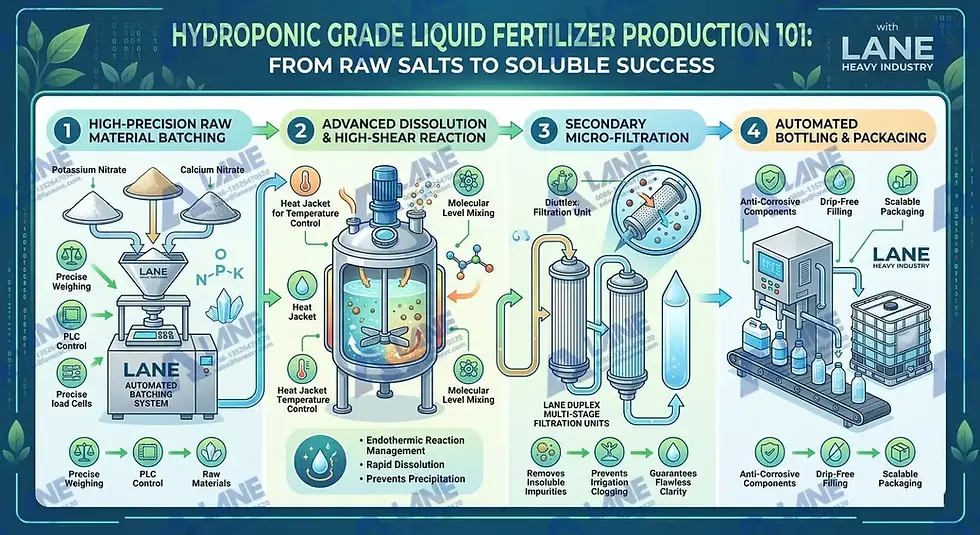
The choice of production technology is a critical investment that dictates product quality, consistency, and long-term operating costs. For a plant aiming for high profitability, investing in a reliable and efficient production line from a manufacturer like LANE Heavy Industry is strategic. Such a line typically integrates:
Pre-processing: Crushers and mixers to prepare raw materials.
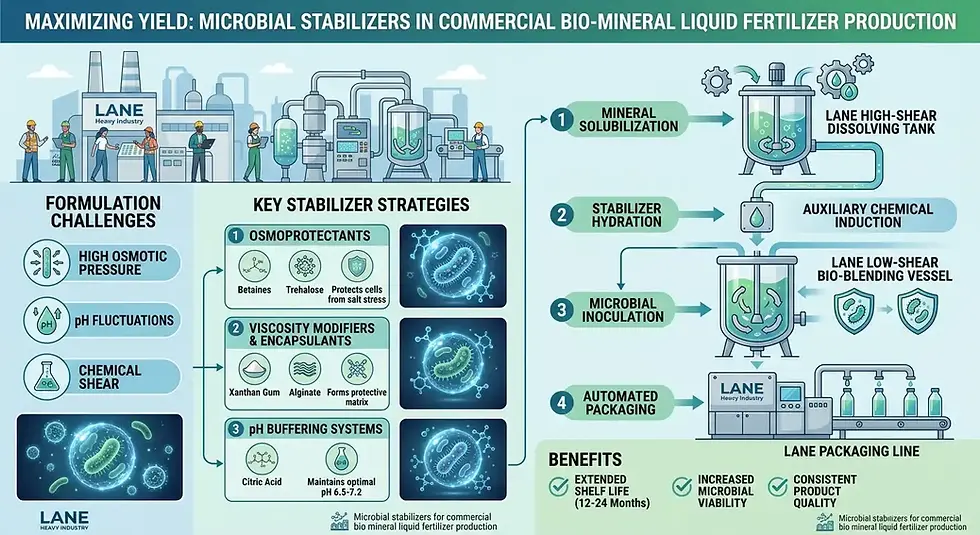
Reaction Tank & Fermentation Tanks: Where the chemical or biological conversion to fertilizer occurs.
Filtration & Clarification Systems: For product purity.
Automated Filling & Packaging: For efficiency and labor savings.
A well-designed, automated line minimizes labor costs, reduces product variation, and maximizes output—directly improving the unit economics and payback period of the plant.
5. Strategic Factors Influencing liquid fertilizer plant profitability analysis
Beyond the machinery, several strategic decisions impact the bottom line:
Source Low-Cost Inputs: Securing reliable, inexpensive organic waste streams is a primary competitive advantage for organic fertilizer producers.
Target Premium Markets: While field crops use volume, the highest margins are in horticulture and protected agriculture (greenhouses), where precision nutrition is highly valued.
Mitigate Key Risks: Address challenges like nutrient volatilization in warm climates and ensure robust, corrosion-resistant storage solutions to prevent environmental hazards and product loss.

6. Conclusion
A thorough liquid fertilizer plant profitability analysis confirms the sector’s strong potential. profitable liquid fertilizer plant is built on a foundation of strong market demand and meticulous financial planning. The liquid fertilizer plant profitability analysis reveals that success hinges on securing a detailed and conservative financial model that accounts for all CapEx and OpEx; investing in reliable, efficient production technology to ensure quality and control costs; and executing a smart business strategy focused on optimal raw material sourcing and high-margin market segments. LANE Heavy Industry’s production lines optimize efficiency, reduces costs, and enables flexibility.
7. Frequently Asked Questions (FAQ)
1. What is the typical payback period for a liquid fertilizer plant?
While it varies based on scale, technology, and market access, industry project reports suggest a well-managed plant can expect a payback period on the initial capital investment within 5 to 7 years, contingent on achieving projected capacity utilization and sales targets.
2. What are the single biggest cost factors in running the plant?
Raw materials consistently represent the largest portion of ongoing operating costs (OpEx). For the initial setup, the production machinery and specialized storage infrastructure (corrosion-resistant tanks) constitute the major capital outlays.
3. Is organic or synthetic liquid fertilizer more profitable?
Both segments are growing. Organic liquid fertilizers cater to the rapidly expanding sustainable and organic food market, which can command premium prices. Synthetic fertilizers serve large-scale conventional agriculture. Profitability depends more on production efficiency, input cost control, and target market selection than on the type alone.
4. What are the main operational challenges?
Key challenges include managing the corrosive nature of many fertilizers, which requires expensive storage solutions; minimizing nutrient losses (e.g., through volatilization) to maintain product efficacy; and securing a consistent, cost-effective supply of raw materials, especially for organic production.

Email: sales@lanesvc.com
Contact number: +86 13526470520
Whatsapp: +86 13526470520

Comments