


From Raw Materials to Finished Product: A Step-by-Step Look at NPK Liquid Fertilizer Manufacturing

NPK Liquid Fertilizer is a versatile, high-efficiency agricultural input that delivers nitrogen (N), phosphorus (P), and potassium (K) directly to roots or foliage in an easily absorbable form. These three nutrients are the essential for plant growth. Producing high-quality NPK liquid fertilizer requires industrial grade precision machine that can transform basic chemical raw materials into a stable, homogeneous, and plant-ready nutrient solution.
Unlike solid fertilizers, it offers faster nutrient uptake, reduces waste, and is compatible with modern irrigation systems. This makes it a top choice for commercial farmers and gardeners alike. Behind every batch of high-quality NPK Liquid Fertilizer lies a precise manufacturing process. LANE Heavy Industries liquid fertilizer production line is made for precision.

Table of Contents
The Foundation: Sourcing and Handling Raw Materials
The Heart of the Process: Formulation and Reaction
Achieving Perfection: Mixing, Homogenization, and Filtration
The Final Stages: Storage, Packaging, and Quality Assurance
Conclusion: The Value of an Integrated Production Line
1. The Foundation: Sourcing and Handling Raw Materials
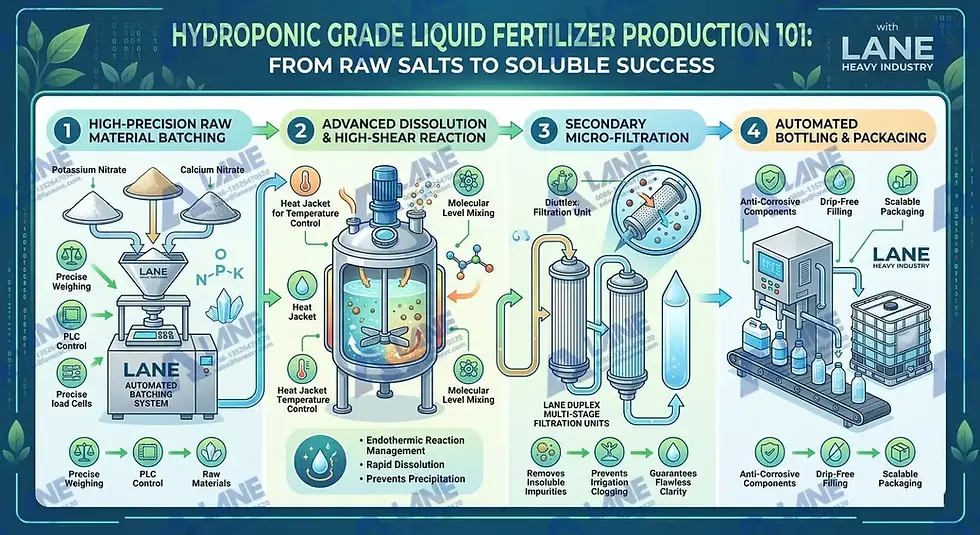
Every superior batch of NPK liquid fertilizer begins with the precise sourcing and handling of its core components. The primary raw materials are water-soluble sources of Nitrogen (N), Phosphorus (P), and Potassium (K), such as urea, ammonium phosphates, and potassium chloride or nitrate. Secondary and micronutrients (like iron, zinc, or boron) are added as soluble salts or chelates.
The first step in a modern plant involves the automated or semi-automated transfer of these raw materials to the initial processing area. A well-designed production line from LANE Heavy Industry would start with storage silos or hoppers and precise weighing and dosing systems. Accurate dosing is non-negotiable; even minor deviations can alter the final NPK ratio, affecting both crop performance and product compliance with labeled guarantees.
2. The Heart of the Process: Formulation and Reaction
Once measured, the raw materials are introduced into the core reaction vessel. This is typically a heated and agitated reactor kettle, a central component in LANE's production lines. Here, the chemical transformation occurs.
Dissolution and Reaction: Water (often demineralized to prevent unwanted precipitation) and the solid or liquid raw materials are combined under controlled temperature and agitation. Heat is applied to accelerate dissolution and facilitate any necessary chemical reactions, such as the hydrolysis of polyphosphates or the formation of stable nutrient complexes.
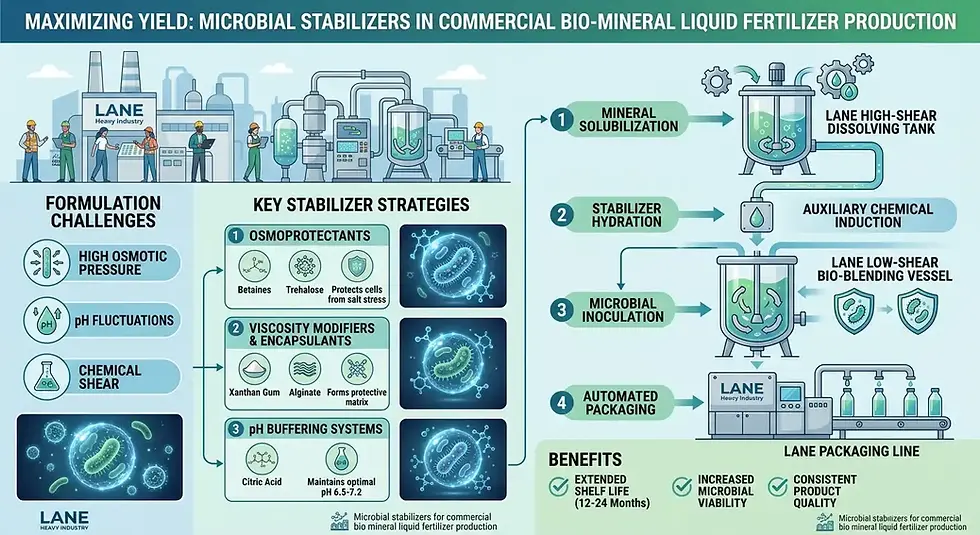
pH Control: This stage is critical. The pH of the solution must be carefully monitored and adjusted using acids or bases. Proper pH control ensures all nutrients remain in a soluble, plant-available form and prevents the formation of insoluble precipitates that could clog application equipment or fall out of solution in the tank.

3. Achieving Perfection: Mixing, Homogenization, and Filtration
After the initial reaction, the solution moves to a high-shear mixing or homogenization stage. While the reactor provides primary agitation, a dedicated high-speed homogenizer ensures the product is perfectly uniform, breaking down any remaining globules or crystals to create a stable, non-separating emulsion or solution.
The mixture then passes through a filtration system. This step removes any undissolved impurities, incidental contaminants, or potential precipitate particles. This is essential for protecting downstream equipment—like pumps and fillers—from wear and clogging, and for guaranteeing a crystal-clear, professional-grade final product.
4. The Final Stages: Storage, Packaging, and Quality Assurance
The now-finished NPK liquid fertilizer is pumped into large-scale storage tanks. These tanks are often equipped with slow-speed agitators to maintain homogeneity during temporary storage before packaging. The entire production line, including these tanks, is typically constructed from corrosion-resistant materials like stainless steel to ensure product purity and longevity.
Finally, the liquid is transferred to the automated packaging line, where it is filled into bottles, jugs, drums, or IBC totes. Crucially, quality control checks are performed at multiple stages—from raw material inspection to final batch testing—to verify NPK concentration, pH, density, and stability.
5. Conclusion: The Value of an Integrated Production Line
The production of high-quality NPK Liquid Fertilizer requires precision, efficiency, and reliable machinery. journey from raw materials to packaged NPK liquid fertilizer is a continuous, integrated process. Each stage is dependent on the precise execution of the previous stage. By leveraging LANE’s advanced equipment, manufacturers can meet the growing demand for NPK Liquid Fertilizer and support sustainable agriculture. As the agricultural industry evolves, LANE Heavy Industry continues to innovate its machinery, solidifying its position as a trusted partner in NPK Liquid Fertilizer production worldwide.

Frequently Asked Questions (FAQ)
Q1: What is the typical production capacity of a standard NPK liquid fertilizer line?
Capacity can vary based on the scale of the operation. For instance, supplier information indicates that standard lines from manufacturers like LANE Heavy Industry can offer a range, such as 1 to 30 tons of output per hour, allowing businesses to select a system that matches their market needs.
Q2: How important is the choice of raw materials?
It is critical. The purity, solubility, and compatibility of the raw materials directly determine the stability, clarity, and nutrient availability of the final fertilizer product. Low-quality inputs can lead to clogging, precipitation, and inconsistent NPK ratios.
Q3: Can one production line make different NPK formulations?
Yes, but with proper procedures. A well-designed line is versatile. To switch formulations, the system must be thoroughly cleaned (flushed) between batches to prevent cross-contamination. The dosing system is then reprogrammed with the new recipe for the different raw material quantities.
Q4: What is the most common challenge in liquid fertilizer production, and how is it managed?
Precipitation (nutrients falling out of solution) is a primary challenge. It is managed through precise pH control, correct sequencing of raw material addition, the use of stabilizers or chelating agents, and effective homogenization during manufacturing.

Email: sales@lanesvc.com
Contact number: +86 13526470520
Whatsapp: +86 13526470520

Comments