


Inside a Biofertilizer Manufacturing Plant: Process Flow and Key Equipment

Table of Contents
Introduction: The Engine of Sustainable Agriculture
Stage 1: Media Preparation & Sterilization
Stage 2: Inoculation & Fermentation
Stage 3: Biomass Separation & Harvesting
Stage 4: Blending & Formulation
Stage 5: Packaging & Quality Assurance
Frequently Asked Questions (FAQs)

1. Introduction: The Engine of Sustainable Agriculture
A biofertilizer manufacturing plant is a core facility for converting organic waste into high-efficiency, environmentally friendly biofertilizers through microbial action. It transforms beneficial microorganisms into potent fertilizer that that enhance soil health and crop growth. They reduce the reliance on the chemical fertilizer and improves soil health. LANE Heavy Industry’s customized organic liquid fertilizer production line stands out for its integration of efficiency, stability, and customization. This article takes its production line as a sample to decode the inner workings of a biofertilizer manufacturing plant.
2. Stage 1: Media Preparation & Sterilization
The first step of the production is to create the perfect nutrient food for microbial growth. This media contains carbon sources (like molasses), nitrogen, minerals, and growth promoters.
Key Equipment from LANE: Mixing & Cooking Tanks with Sterilization Systems.
Process: Raw materials are precisely weighed and introduced into large, steam-jacketed stainless-steel tanks. Here, powerful agitators ensure a perfectly homogeneous mix. The slurry is then heated to a high temperature (often via direct steam injection) to achieve sterilization.
Purpose: This critical step eliminates all existing contaminants (bacteria, fungi, spores) to create a sterile environment. Contamination at this stage can ruin an entire batch, making reliable, well-designed tanks non-negotiable for a successful biofertilizer manufacturing plant.
3. Stage 2: Inoculation & Fermentation
This is the core biological phase where microbes multiply exponentially under optimal conditions.
Key Equipment from LANE: Computer-Controlled Bioreactors/Fermenters.

Process: The sterilized media is cooled and transferred to the fermentation tank. A pure, laboratory-cultured "starter" inoculum of the desired bacteria (e.g., Azotobacter) or fungi is introduced aseptically. The bioreactor then maintains precise conditions for 24-72 hours.
Control Parameters: LANE's fermenters automatically regulate temperature (via cooling/heating jackets), pH (via acid/alkali dosing), dissolved oxygen (via spargers and agitators), and foam (via antifoam systems). This controlled environment maximizes microbial biomass yield.
4. Stage 3: Biomass Separation & Harvesting
Once fermentation is complete, the goal is to concentrate the potent microbial cells.
Key Equipment from LANE: High-Speed Centrifugal Separators or Ultra-Filtration Units.
Process: The fermented broth, now teeming with microbes, is pumped to a separation system. A centrifuge spins the broth at high force, separating the dense microbial biomass (the "paste") from the spent liquid medium. Alternatively, ultra-filtration systems use membranes to concentrate the cells.
Purpose: Harvesting increases the concentration of Colony-Forming Units (CFUs) per milliliter, leading to a more potent final product and reducing packaging and shipping costs for the biofertilizer manufacturing plant.
5. Stage 4: Blending & Formulation
The harvested biomass is not yet shelf-stable or user-friendly. Formulation protects the microbes and enhances their performance in the field.
Key Equipment from LANE: Formulation Tanks with Homogenizers.
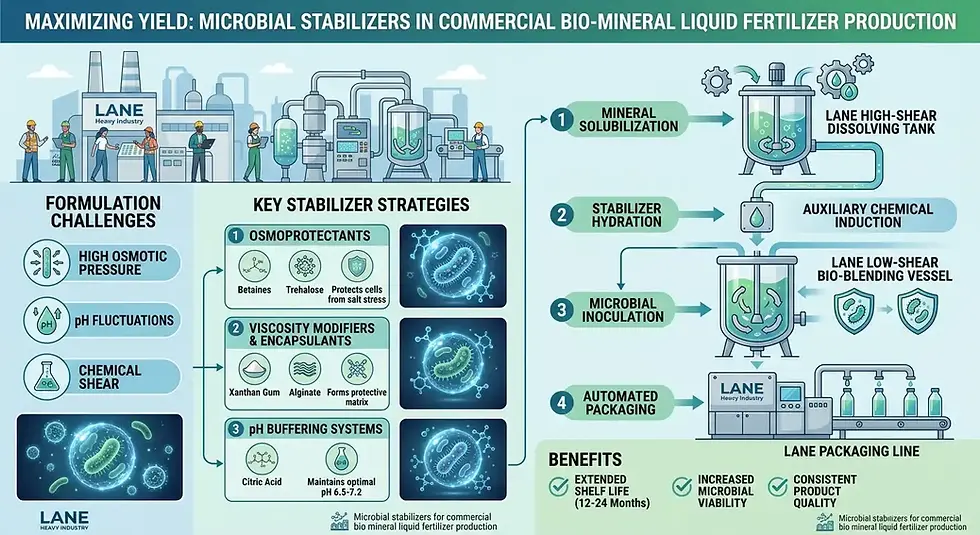
Process: The biomass is transferred to an Additive Mixing tank. Here, it is mixed with carriers (like liquid humic acid), protectants (glycerol, polymers), and adjuvants that aid survival and soil adhesion. High-shear homogenizers ensure a perfectly uniform suspension.
Purpose: This step is critical for product stability. A superior formulation from a well-equipped biofertilizer manufacturing plant ensures microbes remain viable during storage and reactivate quickly when applied to soil.

6. Stage 5: Packaging & Quality Assurance
The final product must be packaged without introducing contaminants.
Key Equipment from LANE: Automated Aseptic Filling and Packaging Lines.
Process: The finished liquid biofertilizer moves through pipes to an enclosed filling station. Bottles or containers are automatically filled, capped, and labeled in a clean environment. This aseptic process is vital to prevent post-production contamination.
Quality Assurance: Throughout the entire process, samples are pulled for lab testing. A plant's in-house lab verifies microbial purity, CFU count, pH, and absence of contaminants before the batch is released. This rigorous QA is what distinguishes a professional-grade operation.
7. Frequently Asked Questions (FAQs)
Q1: What is the most critical piece of equipment in a biofertilizer manufacturing plant?
A: While all stages are important, the Computer-Controlled Bioreactor is the heart of the plant. It controls the very life process—microbial fermentation—that creates the product's active ingredient. A failure here directly impacts yield and quality.
Q2: How automated is a typical plant?
A: Modern plants, like those built with LANE equipment, feature a high degree of automation in critical control points (temperature, pH, filling) to ensure consistency and reduce contamination risk. However, skilled technicians are essential for monitoring, lab work, and maintenance.
Q3: Can the same production line produce different types of biofertilizers?
A: Yes, but with strict protocols. The same fermenters and tanks can be used for different microbial strains (e.g., Rhizobium one week, Phosphobacteria the next) only after undergoing a rigorous Cleaning-in-Place (CIP) and Sterilization-in-Place (SIP) cycle to prevent cross-contamination.
Q4: What are the key utilities required to run such a plant?
A: A reliable biofertilizer manufacturing plant requires significant steam (for sterilization), clean water (for media and cooling), compressed air (for pneumatic controls and aeration), and stable electrical power. A robust utilities infrastructure is a major part of the capital investment.
Q5: Why is stainless steel the preferred material for equipment?
A: Stainless steel (typically SS 304 or 316) is non-reactive, corrosion-resistant, and can withstand repeated sterilization with steam and chemicals. Its smooth surface also allows for easy cleaning and prevents microbial niches from forming, which is crucial for maintaining aseptic conditions.

Email: sales@lanesvc.com
Contact number: +86 13526470520
Whatsapp: +86 13526470520

Comments