


Your Seaweed Kelp Liquid Fertilizer Production Line: From Harvest to Bottle
- Efat Elahi
- Jan 23
- 4 min read

Table of Contents
Introduction: The Power of the Sea
Phase 1: Raw Material Reception & Pre-treatment
Phase 2: The Crucial Extraction Process
Phase 3: Refinement & Formulation
Phase 4: Bottling, Labeling, and Packaging
Why Choose a LANE Heavy Industry Integrated Line?
Frequently Asked Questions (FAQ)

Introduction: The Power of the Sea
Seaweed kelp liquid fertilizer is a high-value organic fertilizer rich in natural growth hormones, micronutrients, and beneficial compounds. It is widely favored for improving crop yield, plant health and soil health and boosts crop resilience. The production of premium seaweed kelp liquid fertilizer relies on precision liquid fertilizer production line. For entrepreneurs and agribusinesses looking for entering the organic liquid fertilizer market, establishing Seaweed kelp liquid fertilizer production line is key. LANE Heavy Industry, a leading fertilizer machinery manufacturer with ISO 9001 certification, provides a one-stop production line solution that streamlines the journey from fresh kelp harvest to finished bottled products, ensuring efficiency, consistency, and product quality.
Phase 1: Raw Material Reception & Pre-treatment
The journey begins with the raw kelp, sourced as fresh or dried seaweed. A LANE production line is designed to handle both.
Washing & Cleaning: Freshly harvested kelp undergoes rigorous washing in dedicated systems to remove sand, salt, epiphytes, and other marine debris. Clean water recirculation systems ensure efficiency.
Size Reduction: Clean kelp is then conveyed to heavy-duty crushers or shredders. This machine Reduces the kelp into a slurry or small pieces and dramatically increases the surface area, which is critical for maximizing extraction yield in the next phase.

Phase 2: The Crucial Extraction Process
This is the heart of the operation where valuable nutrients are separated from the kelp biomass. LANE Heavy Industry offers solutions for the two most effective methods:
Biological Fermentation: The macerated kelp is transferred to temperature-controlled fermentation tanks. Specific microbial strains are introduced to break down the organic matter over a controlled period. This gentle method preserves heat-sensitive hormones like auxins and cytokinins.
Chemical Hydrolysis (Alkaline Extraction): For a faster, high-yield process, the kelp slurry is treated with a controlled, food-grade alkaline solution in reactor tanks. This breaks down cell walls to release alginates and nutrients. LANE systems precisely control temperature, pressure, and pH for consistency.
Phase 3: Refinement & Formulation
The raw extract now requires purification and blending to create a market-ready product.
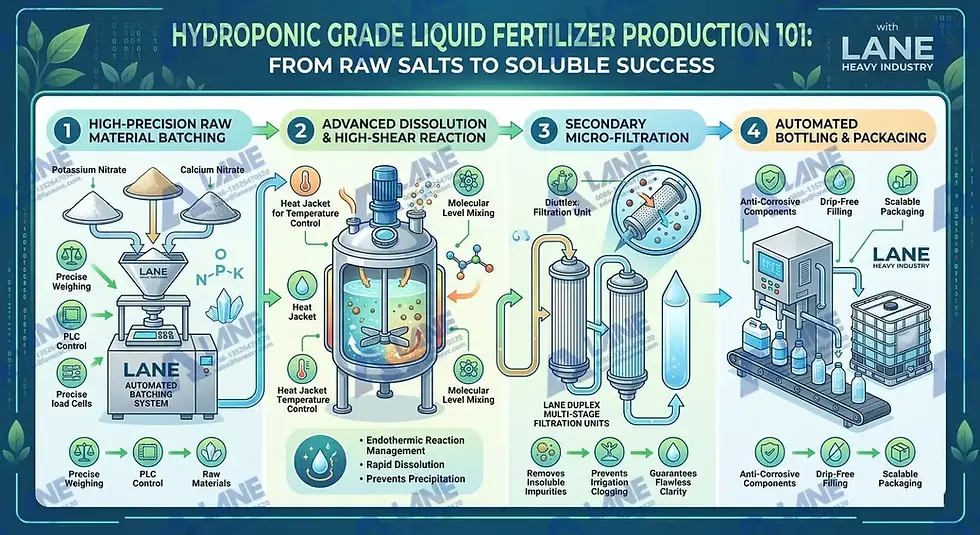
Solid-Liquid Separation: The extract mixture is pumped through high-efficiency separators, such as decanter centrifuges or filter presses. This removes insoluble fibrous solids, leaving a clear or semi-clear liquid concentrate.
Filtration & Clarification: Further refinement through multi-stage filtration (e.g., cartridge or membrane filters) ensures a sparkling, sediment-free liquid, enhancing shelf stability and consumer appeal.
Formulation & Blending: The pure kelp concentrate is transferred to blending tanks. Here, it can be standardized for nutrient content, diluted to specific grades, or fortified with additional ingredients like humic acids or micronutrients. Advanced agitation systems guarantee a homogenous final blend.
Phase 4: Bottling, Labeling, and Packaging
Transforming the finished liquid into a sellable product demands precision and hygiene.
Automated Filling: The liquid fertilizer is conveyed to automated filling machines. LANE integrates piston or gravity fillers that accurately dispense product into a variety of container sizes—from small bottles to large drums—with zero spillage.
Capping & Sealing: Immediately after filling, containers move to capping stations for secure sealing, whether with screw caps, tamper-evident closures, or spouts.
Labeling & Coding: Automated labelers apply product labels precisely, while inkjet printers add batch codes and expiration dates for traceability.
Palletizing: Finally, bottled products are packed into boxes or shrink-wrapped onto pallets, ready for storage and distribution.

Why Choose a LANE Heavy Industry Integrated Line?
Investing in a LANE Heavy Industry seaweed kelp liquid fertilizer production line offers distinct advantages:
Turnkey Solution: From initial design to installation and commissioning, LANE provides a single-source responsibility.
Food-Grade & Corrosion-Resistant Materials: All product-contact surfaces are constructed from stainless steel (e.g., SUS304/316) to prevent contamination and withstand corrosive nature of seaweed extracts.
Scalability & Automation: Lines are designed to scale with your business, from semi-automatic pilot plants to fully automated high-volume systems.
Process Expertise: LANE engineers bring valuable expertise in optimizing extraction yields and ensuring efficient, repeatable production cycles.
Frequently Asked Questions (FAQ)
Q1: What is the main benefit of seaweed kelp liquid fertilizer?
A: It provides a broad spectrum of readily available nutrients, natural plant growth hormones, and bio stimulants that enhance seed germination, root development, stress tolerance, and overall crop yield and quality.
Q2: Can the LANE production line handle different sources of seaweed?
A: Yes. The equipment is designed to be adaptable, with adjustable parameters to process various kelp species (like Ascophyllum or Ecklonia) whether received fresh, sun-dried, or as milled powder.
Q3: What is the production capacity of a standard LANE line?
A: LANE designs custom solutions. Capacities can range from small-scale operations of 500 liters per batch to large, continuous systems producing tens of thousands of liters per day.
Q4: Is the process environmentally friendly?
A: Absolutely. The production of seaweed kelp liquid fertilizer is inherently sustainable. LANE systems enhance this with features like water recirculation in washing stages and the potential to compost the leftover kelp solids for a zero-waste operation.
Q5: How do I get started with planning my production facility?
A: Contact LANE Heavy Industry with your target capacity, raw material type, and preferred extraction method. Their engineering team will provide a detailed layout and equipment proposal tailored to your specific project and budget.

Email: sales@lanesvc.com
Contact number: +86 13526470520
Whatsapp: +86 13526470520

Comments