


Step-by-Step: The Process Flow of a Modern Seaweed/Fish Hydrolysate Liquid Fertilizer Line
- Efat Elahi
- Jan 5
- 4 min read

Table of Contents
Introduction: Precision in Organic Production
Stage 1: Raw Material Intake & Pretreatment
Stage 2: Size Reduction & Slurry Formation
Stage 3: The Core: Controlled Enzymatic Hydrolysis
Stage 4: Solid-Liquid Separation & Filtration
Stage 5: Formulation, Stabilization, & Packaging
Frequently Asked Questions (FAQ)
Conclusion: Engineering for Excellence

1. Introduction: Precision in Organic Production
Producing high quality seaweed and fish emulsion liquid fertilizer is more then just mixing ingredients. It’s a controlled process where modern precise mixing, low-temperature hydrolysis and chemical science is used to preserve bioactive compounds. Seaweed and fish emulsion liquid fertilizer is a premium organic fertilizer that combines the nutritional advantages of seaweed and fish. Both of these raw materials provide a broad-spectrum nutrition including nitrogen, phosphorus and potassium.
seaweed and fish emulsion liquid fertilizer enhances soil fertility, promotes plant growth and improves stress resistance. This makes it widely favored in organic agriculture. LANE Heavy Industry, a professional machinery manufacturer has developed a modern, efficient production line for this fertilizer.
This step-by-step guide walks through the optimized process flow that ensures consistency, potency and scalability from raw marine materials to a bottled organic amendment.
2. Stage 1: Raw Material Intake & Pretreatment
The first step of the production is quality control. Fresh or frozen fish by-products (frames, viscera) and sustainably harvested seaweed (typically brown varieties like Ascophyllum) are received.

seaweed and fish emulsion liquid fertilizer production line Fish Preparation: Raw fish material is inspected and washed with clean water to remove impurities.
Seaweed Preparation: Seaweed undergoes thorough washing in specialized LANE Rotary Drum Washers to remove sand, salt, and epiphytes. This step is critical to prevent sediment in the final product and reduce mineral sodium content.
3. Stage 2: Size Reduction & Slurry Formation
To maximize the surface area for enzymatic action, materials are mechanically broken down.
The cleaned fish is passed through LANE Semi wet crusher or mincers to create a uniform mash.
The washed seaweed is chopped or shredded using LANE High-Shear Shredders.
Both materials are then combined in a predetermined ratio in a Premix Tank with water to create a slurry. This homogeneous mixture is the feedstock for the key hydrolysis stage.
4. Stage 3: The Core: Controlled Enzymatic Hydrolysis
This is the heart of the modern hydrolysate process, where proteins and complex carbohydrates are broken down into amino acids, peptides, and simple sugars.
The slurry is pumped into temperature-controlled, jacketed LANE Hydrolysis Reactors.
Specific proteolytic and carbohydrase enzymes are added. The pH and temperature (typically 45-55°C) are meticulously controlled by the reactor’s PLC system.
This gentle, low-temperature process lasts 2-4 hours, preserving the natural growth hormones (auxins, cytokinins) from seaweed and the bioactive peptides from fish, which are denatured by harsh chemical or high-heat methods.
5. Stage 4: Solid-Liquid Separation & Filtration
Once hydrolysis is complete, the nutrient-rich liquid must be separated from the insoluble organic solids (bone fragments, seaweed fibers).
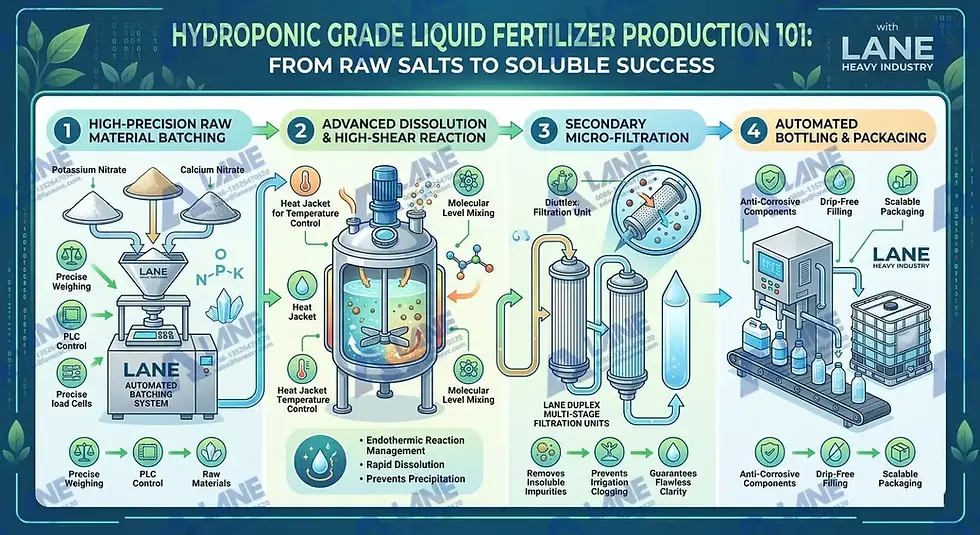
The digested slurry is first passed through a LANE Decanter Centrifuge, which performs a coarse separation, removing the majority of solids.
The liquid is then polished through a series of Multi-Stage Filtration Systems, including dual filter and fine cartridge filters, to achieve a clear, stable emulsion. The collected solids are valuable as a secondary organic soil amendment.
6. Stage 5: Formulation, Stabilization, & Packaging
The clarified hydrolysate is now ready to be finished.

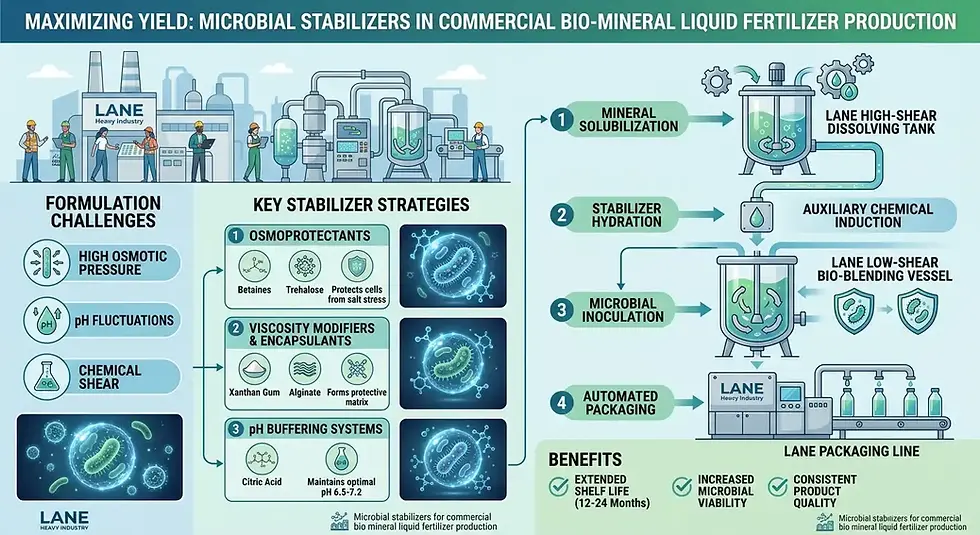
Formulation: The base liquid is transferred to LANE Blending and Storage Tanks. Here, other approved ingredients like potassium hydroxide (for pH adjustment) or chelated micronutrients can be uniformly mixed in.
Stabilization: To ensure microbial stability and shelf life, the product undergoes Low-Temperature Pasteurization in a LANE plate heat exchanger, precisely heated then rapidly cooled.
Packaging: The finished seaweed and fish emulsion liquid fertilizer is fed to an Automated Filling Line for bottling, capping, labeling, and case packing, ready for distribution.
7. Frequently Asked Questions (FAQ)
Q1: Why is enzymatic hydrolysis preferred over simple blending or chemical digestion?
A: Enzymatic hydrolysis breaks down materials at low temperatures, preserving the delicate, bioactive plant-growth compounds found in both seaweed and fish. Blending merely mixes particles, and chemical/thermal processes destroy these valuable substances, resulting in a less effective fertilizer.
Q2: How is odor controlled in this process flow?
A: Odor is minimized through several design features: enclosed processing tanks and reactors, rapid processing of raw materials, and the enzymatic hydrolysis process itself, which is less prone to putrefaction than uncontrolled decomposition. Exhaust air can also be treated via bio-scrubbers.
Q3: Can the line handle different ratios of seaweed to fish?
A: Absolutely. The LANE Premix and Batching System is designed for flexibility. Operators can adjust the raw material input ratios and processing parameters to produce different product formulations, from fish-dominant to seaweed-dominant blends, from the same line.
Q4: What is the typical production capacity of such a line?
A: LANE Heavy Industry designs modular systems scalable from pilot-scale lines (500-1,000 liters per batch) to fully continuous industrial systems capable of producing tens of thousands of liters per day. The process flow remains consistent, with equipment sized to match output goals.
Q5: Is the process considered environmentally sustainable?
A: Yes. It utilizes by-products from the fishing and aquaculture industries, reducing waste. The process is water-efficient, often incorporating recirculation. The main energy input is low-grade heat for hydrolysis, and all organic solids are captured for use as compost, creating a near-zero-waste operation.
8. Conclusion: Engineering for Excellence
LANE Heavy Industry's modern seaweed/fish hydrolysate liquid fertilizer production line realizes the efficient and high-quality production of seaweed and fish emulsion liquid fertilizer through five core steps: raw material pretreatment, mixed hydrolysis, filtration and purification, blending and modulation, and sterilization and filling. By integrating specialized machinery like hydrolytic reactors, centrifuges, and PLC controls, LANE Heavy Industry’s lines transform raw marine biomass into a consistent, potent, and stable organic fertilizer.

Email: sales@lanesvc.com
Contact number: +86 13526470520
Whatsapp: +86 13526470520

Comments