


Small DAP Production Plant Costs Explained: From Equipment to Operating Expenses


Diammonium phosphate (DAP) fertilizer is one of the most widely used phosphate fertilizers in the world due to its high nutrient content and excellent crop performance. DAP is the golden standard of global phosphorus fertilizers, making a small-scale production plant an incredibly lucrative venture. Launching a small-scale Diammonium Phosphate (DAP) fertilizer facility is an excellent way for regional agribusinesses and investors to secure supply chains and capitalize on localized agricultural demand. However, before launching a project, understanding small DAP fertilizer production plant costs is essential for making informed investment decisions.
Accurately projecting your upfront small DAP fertilizer production plant costs requires a deep understanding of how machinery configuration dictates your long-term return on investment. This article explains the key components that influence small DAP fertilizer production plant costs and how LANE Heavy Industry provides efficient fertilizer production line solutions to maximize profitability.
Capital Expenditures (CAPEX): Core Machinery Setup
For a small-scale plant—typically defined in the industry as producing 1 to 5 tons per hour (t/h)—your primary upfront cost will be the machinery. A cohesive, automated DAP fertilizer production line from LANE Heavy Industry relies on several tightly synchronized components.
Chemical Reaction and Slurry Preparation
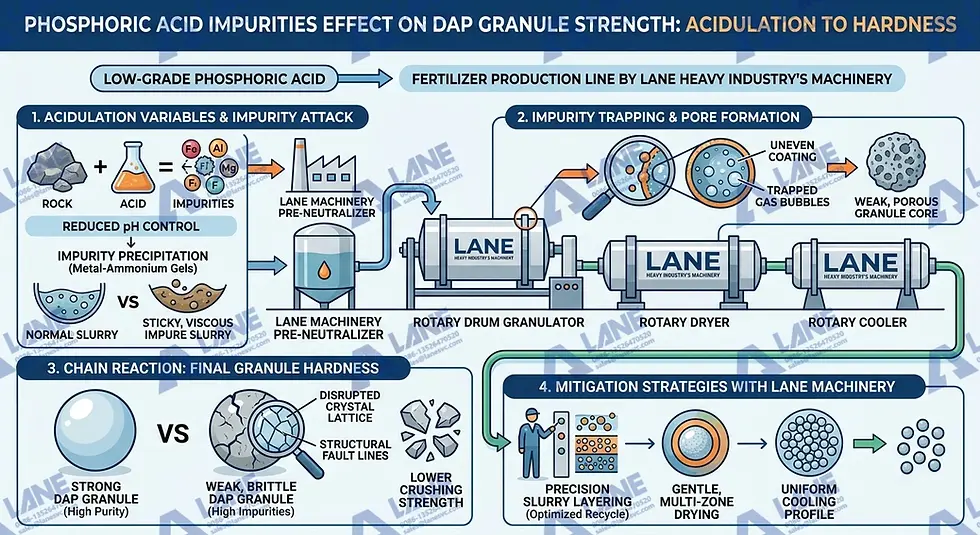
DAP production begins by reacting phosphoric acid with anhydrous ammonia. This requires corrosion-resistant, high-grade chemical reaction vessels. Because this reaction is highly exothermic (generates intense heat), investing in durable, premium materials upfront prevents costly maintenance and downtime later.

Granulation: The Heart of the System
Once the slurry is prepared, it is transferred to the granulation stage. LANE Heavy Industry provides two main options depending on your budget:
Rotary Drum Granulator: The industry standard for uniform, high-density granules. It features a high granulation rate (often exceeding 70%) and excellent durability.
Disc Granulator: A more budget-conscious alternative for ultra-small setups, though it operates with slightly less throughput than a rotary drum.
Thermal Processing: Drying and Cooling
Freshly formed DAP granules contain excess moisture and heat.
Rotary Dryer: Uses controlled heat to reduce moisture content so the fertilizer doesn't cake during storage.
Rotary Cooler: Quickly lowers the temperature of the granules, stabilizing their structural integrity before packaging.
Material Refining and Packaging
Rotary Screening Machine & Chain Crusher: The screening machine separates oversized and undersized particles. Oversized particles are sent to LANE's heavy-duty chain crusher and routed back via belt conveyors to the granulator. This creates a zero-waste, cost-saving closed loop.
Automatic Packing Scale: Automatically weighs and bags finished products into 25kg or 50kg bags, keeping manual labor costs to a minimum.
2. Infrastructure and Civil Engineering Costs
You cannot place heavy industrial rotary equipment on basic concrete. When estimating your total small DAP fertilizer production plant costs, allocate a portion of your budget to factory infrastructure:
Reinforced Foundations: Rotary drums, dryers, and coolers exert massive dynamic loads. They require deep, reinforced concrete bases to prevent shifting over time.
Environmental Systems: Compliance is non-negotiable. LANE Heavy Industry designs integrated cyclone dust collectors and gas scrubbing towers into their lines, helping you meet regional emission standards right out of the gate.
Utility Upgrades: A 1–5 t/h industrial line demands robust three-phase electrical connections and steady water access for cooling and scrubbing systems.
3. Operational Expenses (OPEX): Keeping the Plant Running

Once the ground is broken and the machines are spinning, your day-to-day profitability depends on managing your OPEX.
Raw Materials: This will always be your largest ongoing expense. Sourcing phosphoric acid and ammonia at stable wholesale prices is critical.
Energy Consumption: High-capacity rotary dryers require steady fuel (such as natural gas, diesel, or coal) to generate heat, alongside the electricity needed to drive the electric motors across the conveyor systems.
Labor and Maintenance: LANE Heavy Industry's high level of automation means a small 1-5 t/h plant can often be operated by a lean team of 4 to 8 workers per shift, significantly lowering monthly payroll expenses.
LANE's DAP Production Line Advantages
LANE Heavy Industry's DAP production line delivers significant cost advantages:
Feature | Benefit |
Smart neutralization | 20% operating cost reduction |
Heat recycling system | 30% energy savings |
Raw material efficiency | 95%+ utilization rate |
Granulation rate | 95% guaranteed |
Production timeline | 6–9 months (vs. 12–15 industry average) |
Operating Expense Breakdown (Annual)
For a 3-ton/hour plant producing 15,000 tons/year:
Expense Category | Annual Cost | Percentage |
Raw materials | $750,000 – $900,000 | 70–80% |
Energy | $90,000 – $135,000 | 10–15% |
Labor | $250,000 – $350,000 | 8–12% |
Maintenance | $15,000 – $20,000 | 2–3% |
Utilities | $30,000 – $50,000 | 3–5% |
Total Operating | $1,135,000 – $1,455,000 | 100% |
Profitability and ROI
Small DAP plants can achieve:
20–30% gross margins
8–12% net profit
35% faster ROI with LANE's 6–9 months production timeline
FAQ: Small DAP Fertilizer Production Plant Costs
Q1: What is the total cost for a small DAP plant?
A small DAP plant (3–5 tons/hour) requires $400,000–$1,200,000 total investment, with equipment being the largest expense at $150,000–$400,000.
Q2: How much does LANE's DAP production line cost?
LANE Heavy Industry's DAP production line ranges from $150,000 to $400,000, offering 20% operating cost savings and 30% energy reduction.
Q3: What are the biggest operating expenses?
Raw materials (70–80%) and energy (10–15%) represent the largest operating costs in DAP production.
Email: sales@lanesvc.com
Contact number: +86 13526470520
Whatsapp: +86 13526470520

Comments