


Raw Materials and Machines for MAP Production: Complete Guide & Essential Feedstocks


Monoammonium phosphate (MAP) is one of the most widely used high-nutrient phosphate fertilizers worldwide. MAP is known for its excellent water solubility and for its concentrated phosphorus content. It plays critical role in crop root development and flowering. qualified raw materials for MAP production determine final fertilizer quality, nutrient content, and production efficiency for fertilizer manufacturers, understanding the raw materials for MAP production and the machinery required is essential to ensure efficient, cost-effective, and scalable operations.
This comprehensive guide explores the raw materials for MAP production, the complete process flow, and how LANE Heavy Industry’s advanced MAP fertilizer production line can support reliable MAP manufacturing.
1. What is MAP Fertilizer?
MAP (NH₄H₂PO₄) is produced through a neutralization reaction between ammonia and phosphoric acid. It is typically used as a granular fertilizer and is valued for:
High phosphorus (P₂O₅) content (~40–54%)
Moderate nitrogen content (~10–12%)
Excellent solubility for fertigation and soil application
The quality of MAP largely depends on the raw materials for MAP production, making feedstock selection a crucial step.
2. Essential Raw Materials for MAP Production
To produce high-quality MAP fertilizer, manufacturers must carefully select and manage the following raw materials for MAP production:
2.1 Phosphoric Acid (H₃PO₄)
Phosphoric acid is the primary phosphorus source. It is typically derived from phosphate rock through wet-process acid production.
Key considerations:
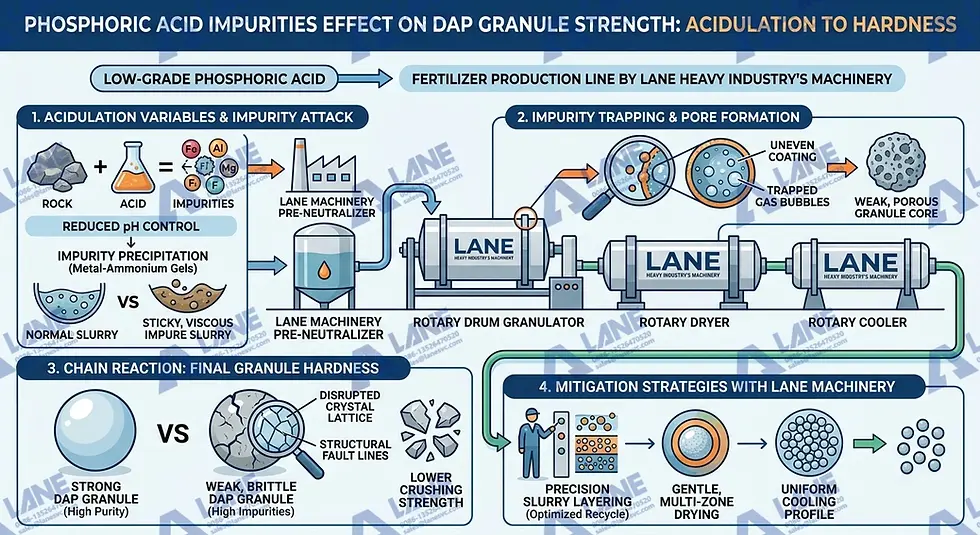
Purity level affects final MAP quality
Impurities like fluorides and heavy metals must be controlled
Concentration usually ranges from 40% to 55%
High-grade phosphoric acid ensures better granulation and nutrient availability, making it one of the most critical raw materials for MAP production.
2.2 Ammonia (NH₃)
Ammonia provides the nitrogen component and reacts with phosphoric acid to form MAP.
Key considerations:
Typically used in anhydrous form
Requires safe storage and handling systems
Reaction efficiency impacts product consistency
The balance between ammonia and acid is essential when optimizing raw materials for MAP production.
2.3 Additives and Fillers
In some production processes, additives are included to improve granulation and product stability:
Anti-caking agents
Binders
Moisture regulators
Although not always mandatory, these materials can enhance the performance of the final product and support smoother processing of raw materials for MAP production.
2.4 Recycled Materials
Modern plants often incorporate recycled fines and off-spec granules back into the system. This improves material utilization and reduces waste, optimizing the overall efficiency of raw materials for MAP production.

3. MAP Production Process Overview
The transformation of raw materials for MAP production into finished fertilizer involves several key steps:
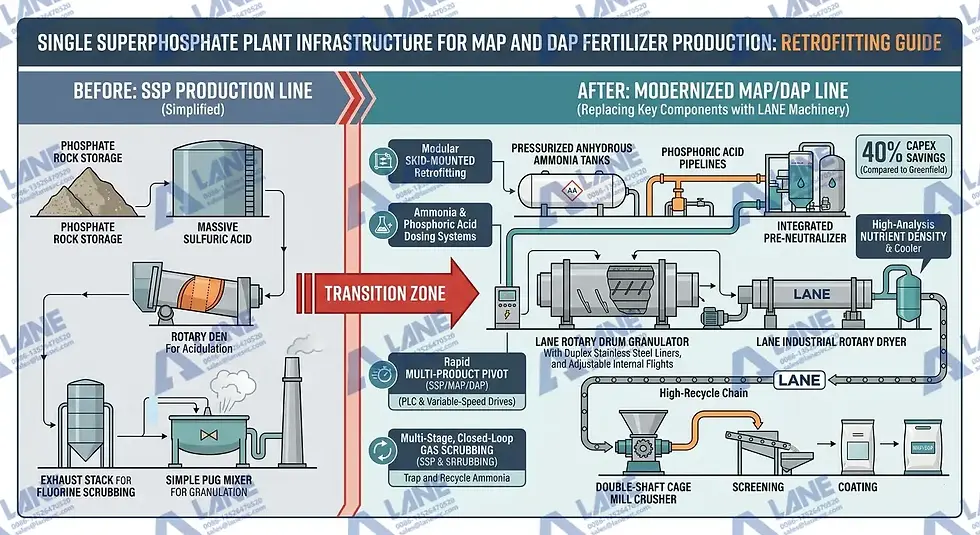
Step 1: Neutralization Reaction
Ammonia reacts with phosphoric acid in a reactor to form a slurry of monoammonium phosphate.
Step 2: Granulation
The slurry is fed into a Rotary Drum granulator where particles are formed into uniform granules.
Step 3: Drying
Granules are dried with Rotary Drum dryer to reduce moisture content and improve storage stability.
Step 4: Cooling
Cooling prevents caking and prepares the product for storage.
Step 5: Screening
Particles are classified by size; LANE vibrating screening machine separates oversized and undersized granules from on-size granules. oversized and undersized granules are sent to crushing machine to be recycled.
Step 6: Coating and Packaging
Final granules may be coated and then packed for distribution. LANE Automatic packaging weights the granules and package the final product for marketing.
4. Key Machines for MAP Production (LANE Heavy Industry)
LANE Heavy Industry provides a complete MAP fertilizer production line, designed for efficiency, automation, and scalability. Below are the essential machines:
4.1 Neutralization Reactor
Ensures precise reaction between ammonia and phosphoric acid
Controls temperature, pH, and reaction time
Critical for maximizing conversion of raw materials for MAP production
4.2 Granulator (Rotary Drum Granulator or Disc Granulator)
Converts slurry into uniform granules
Adjustable for different production capacities
Enhances particle strength and uniformity
4.3 Rotary Dryer
Removes excess moisture
Improves product durability
Ensures stability during storage and transport
4.4 Rotary Cooler
Reduces granule temperature
Prevents caking and degradation
4.5 Screening Machine
Separates qualified granules from oversized and undersized particles
Enables recycling, improving efficiency of raw materials for MAP production
4.6 Coating Machine
Applies anti-caking agents
Enhances product appearance and flowability

4.7 Automatic Packaging System
Ensures accurate weighing and bagging
Supports high-speed production lines
5. Advantages of LANE MAP Production Line
Using LANE Heavy Industry’s machinery offers several benefits:
High efficiency: Optimized use of raw materials for MAP production
Scalability: Suitable for small, medium, and large-scale plants
Automation: Reduced labor costs and improved consistency
Environmental compliance: Dust collection and waste recycling systems
These advantages make LANE a reliable partner for fertilizer manufacturers aiming to optimize their use of raw materials for MAP production.
6. Factors Affecting MAP Production Efficiency
To maximize output and quality, consider the following:
Raw material quality: Impacts reaction efficiency and granule strength
Process control: Temperature and pH must be carefully managed
Equipment performance: High-quality machinery ensures consistent results
Recycling rate: Efficient reuse of materials reduces costs
Proper management of these factors ensures optimal utilization of raw materials for MAP production.
7. Environmental and Safety Considerations
MAP production involves handling chemicals like ammonia and acids. Key measures include:
Gas scrubbing systems to reduce emissions
Proper storage tanks for ammonia
Wastewater treatment systems
Dust collection units
LANE’s integrated solutions help manufacturers safely handle raw materials for MAP production while meeting environmental regulations.
Frequently Asked Questions (FAQ)
Q1: What machines are essential for converting raw materials for MAP production into granules?
The essential LANE Heavy Industry machines include a vertical neutralization reactor for mixing raw materials for MAP production, a rotary drum granulator, a rotary dryer, a cooler, and a screening system to ensure uniform sizing.
Q2: Can LANE’s machinery handle lower-grade wet-process acid as raw materials for MAP production?
Yes. LANE’s equipment is built with advanced corrosion-resistant materials specifically designed to withstand the corrosive impurities found in cost-effective wet-process acid—the most common raw materials for MAP production globally.
Q3: How does the equipment prevent loss of raw materials for MAP production during processing?
LANE’s production line features a closed-loop dust collection and recycling system. Fine particles created during the crushing and handling of raw materials for MAP production are captured and reintroduced to the granulator, ensuring near-zero waste of valuable feedstock.

Email: sales@lanesvc.com
Contact number: +86 13526470520
Whatsapp: +86 13526470520

Comments