


MAP 11-52-0 and MAP 12-61-0 Production Process: From Raw Materials to Finished Product


Monoammonium phosphate (MAP) provides nitrogen and phosphorus to the plant. It a highly soluble fertilizer. But not all MAP is created the same. The MAP 11-52-0 and MAP 12-61-0 are different because of the purity, solubility, and application. The standard MAP 11-52-0 is a broad use fertilizer used by general farmers. MAP 12-61-0 on the other hand is used by modern farmers with precision system.
While MAP 11-52-0 and MAP 12-61-0 is getting popular day by day, investing on the manufacturing plant without understanding the process will cause problem to the investors. This article examines the real distinctions between MAP 11-52-0 and MAP 12-61-0 and explains how LANE Heavy Industry’s advanced MAP and DAP fertilizer production line enables manufacturers to produce both grades with precision and efficiency.
Understanding MAP 11-52-0 and MAP 12-61-0
Both MAP 11-52-0 and MAP 12-61-0 are produced through the neutralization of phosphoric acid with ammonia. MAP 11-52-0 contains approximately 11% nitrogen and 52% phosphorus pentoxide (P₂O₅), making it a popular fertilizer for field crops and soil applications.
The grading system for fertilizers follows the N-P-K format (nitrogen-phosphate-potash). For MAP fertilizers:
Property | MAP 11-52-0 | MAP 12-61-0 |
Nitrogen (N) | 11% | 12% |
Phosphate (P₂O₅) | 52% | 61% |
Potash (K₂O) | 0% | 0% |
Physical Form | Granular | Fine crystalline powder |
Water Solubility | Partial (not fully soluble) | 100% water-soluble |
Primary Use | Soil broadcast, starter fertilizer | Foliar spray, fertigation, hydroponics |

MAP 12-61-0 contains industry-leading 61% phosphorus concentration, the highest among solid fertilizers, making it ideal for crops requiring rapid phosphorus uptake. MAP 11-52-0, the most common agricultural-grade composition, contains 48–61% P₂O₅ depending on acid purity, with 11-52-0 being the standard.
MAP 12-61-0, on the other hand, is a high-purity technical-grade product containing approximately 12% nitrogen and 61% phosphorus pentoxide. Due to its superior solubility and low impurity content, it is widely used in water-soluble fertilizer formulations, hydroponics, foliar fertilizers, and drip irrigation systems.
Although the chemical reaction is similar, producing high-quality MAP 11-52-0 and MAP 12-61-0 requires different levels of process control and purification.
Step-by-Step Production Process
The chemical conversion and physical forming pathways require distinct machinery setups, categorized into two main processing archetypes engineered by LANE Heavy Industry.
The Granular MAP 11-52-0 Pathway (Rotary Drum Granulation Line)
For standard soil-applied MAP 11-52-0, the goal is to transform liquid/slurry chemicals into highly uniform, dense, and non-crushing spherical granules.
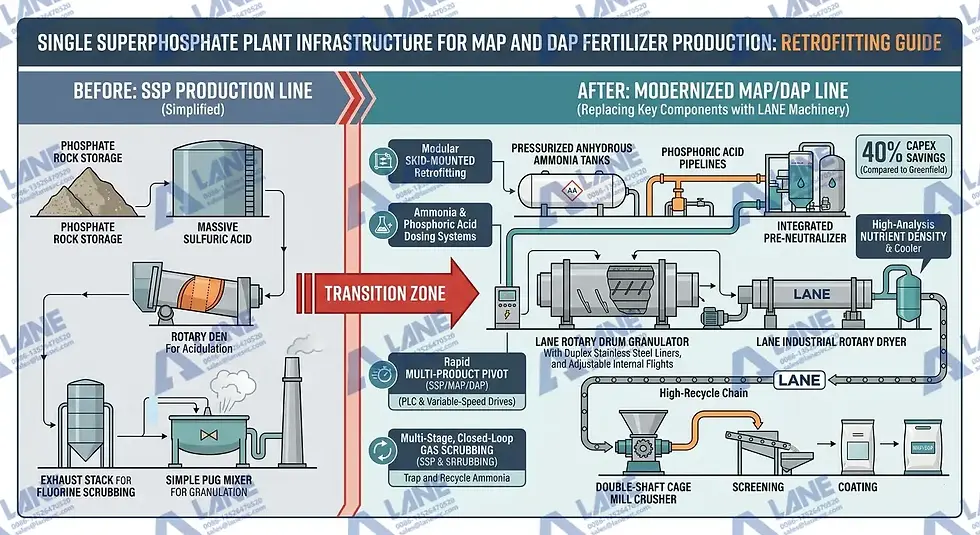
1.Chemical Neutralization & Slurry Preparation: Ammonia gas and phosphoric acid are metered directly into a pipe reactor or pre-neutralizer tank. The exothermic reaction reaches high temperatures, generating a hot MAP slurry with an optimized molar ratio of approximately 1.0 (one mole of ammonia to one mole of phosphoric acid).
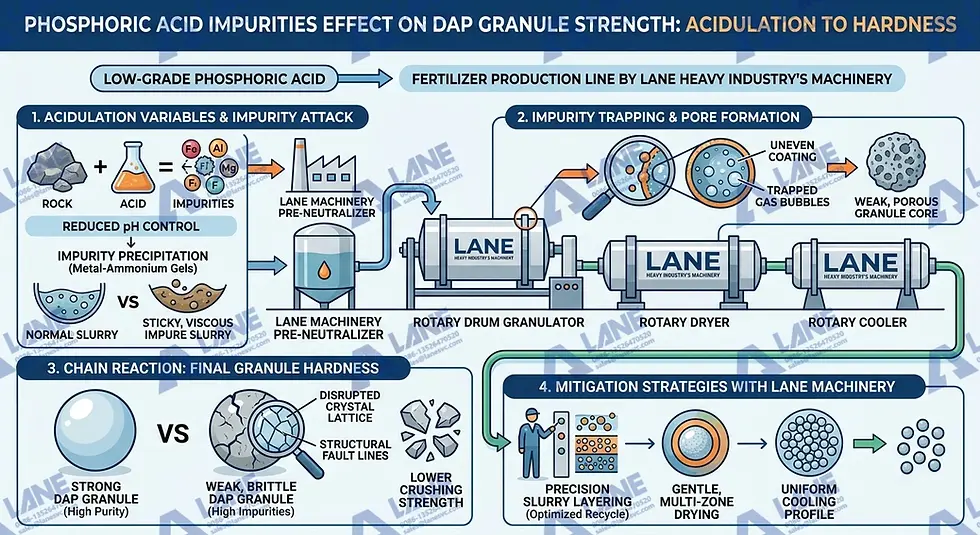
2.Rotary Drum Granulation: The hot slurry is sprayed continuously into LANE’s heavy-duty Rotary Drum Granulator, alongside recycled fine undersized particles. The rolling motion of the drum coats the solid seed crystals with liquid slurry, building uniform, dense spheres via rolling bed accretion. LANE units feature specialized corrosion-resistant linings to handle the aggressive chemical environment.
3.High-Efficiency Industrial Drying: The wet granules travel into a LANE Rotary Dryer. Because MAP is naturally hygroscopic (moisture-absorbing), lifting flights inside the dryer shower the material through a controlled hot air stream, safely driving moisture levels down below 1.5% without causing structural fracturing.
4.Cooling, Screening, and Anti-Caking Coating:The hot granules pass through a rotary cooler before entering LANE’s Rotary Screener. Oversized and undersized granules are automatically separated and redirected to a shaft crusher for recycling. The target 2-4mm granules enter a coating drum where a micro-layer of anti-caking oil or powder is applied to preserve shelf life during long-term storage or maritime export.

The Crystalline MAP 12-61-0 Pathway (Water-Soluble Powder Line)
Because MAP 12-61-0 must dissolve entirely without leaving sediment in irrigation lines, it completely bypasses the drum granulator, following a specialized crystallization path instead.
Crystallization and Centrifugation: The purified reaction liquor is piped into vacuum crystallizers where temperature drops trigger the formation of pure white MAP crystals. A high-speed centrifuge separates these premium crystals from the residual mother liquor.
Stainless Steel Drying & Blending: The damp crystals are dried using specialized fluid bed or rotary dryers constructed completely of 304 or 316 stainless steels by LANE Heavy Industry to eliminate metal cross-contamination.
Precision Industrial Batching: If the 12-61-0 powder is being incorporated into premium water-soluble NPK blends, it is channeled into LANE's Automated BB Fertilizer Blending System, which delivers precise weighing accuracy via intelligent PLC controls
FAQ: MAP 11-52-0 and MAP 12-61-0
Q1: Can I substitute MAP 11-52-0 for MAP 12-61-0?
A: No. MAP 11-52-0 is not water-soluble and should not be substituted for MAP 12-61-0 in fertigation, foliar, or hydroponic applications. They serve different markets.
Q2: Which MAP has higher phosphorus content?
A: MAP 12-61-0 has 61% P₂O₅, the highest phosphorus content among solid fertilizers. MAP 11-52-0 has 52% P₂O₅.
Q3: Is MAP better than DAP for phosphorus availability?
A: Yes. MAP's lower pH (around 5) prevents phosphate from bonding with soil calcium, maintaining phosphorus solubility better than DAP (pH 8+).
Q4: What equipment does LANE Heavy Industry provide for MAP production?
A: LANE provides complete production lines including reactors, granulators, crystallizers, dryers, coolers, and packaging systems for both MAP grades.
Email: sales@lanesvc.com
Contact number: +86 13526470520
Whatsapp: +86 13526470520

Comments