


Low Investment MAP and DAP Plant: Essential Equipment and Production Process


The global demand for phosphate fertilizers is growing as farmers are seeking higher crop yield and improved nutrient efficiency. Among the most used phosphate fertilizers, Monoammonium Phosphate (MAP) and Diammonium Phosphate (DAP), are valued for their high phosphorus content and excellent agronomic performance. They both provide vital phosphorus (P₂O₅) and nitrogen (N) inputs to the crops. For fertilizer manufacturers and investors looking to enter this market, establishing a low investment MAP and DAP plant is an attractive option.
Modern technology and equipment’s have made it possible to find efficient fertilizer plants with lower capital requirements than traditional large-scale chemical facilities. LANE Heavy Industry has manufactured a MAP and DAP production line, for investors with low capital. This guide explores the key components of a low investment MAP and DAP plant and explains how LANE Heavy Industry provides reliable and cost-effective fertilizer production solutions.
What Is a Low Investment MAP and DAP Plant?
A low investment MAP and DAP plant is a fertilizer manufacturing facility designed to produce MAP and DAP fertilizers while minimizing initial capital expenditure. Through modular design, energy-efficient machinery, and optimized process layouts, investors can reduce construction costs without sacrificing production quality.
Such plants are suitable for:
Fertilizer manufacturers entering the phosphate fertilizer market
Agricultural cooperatives
Chemical companies expanding product portfolios
Regional fertilizer distributors
Emerging market investors
Depending on production goals, capacities can range from 30,000 to 200,000 tons annually.

Understanding MAP and DAP Production
MAP and DAP fertilizers are produced by reacting phosphoric acid with ammonia under controlled conditions.
MAP Production: MAP is produced when phosphoric acid reacts with a limited amount of ammonia, creating a fertilizer grade commonly known as 11-52-0.
Advantages include:
High phosphorus concentration
Excellent water solubility
Suitable for starter fertilizers
Low nitrogen content
DAP Production: DAP is produced by introducing additional ammonia into the reaction process, resulting in a fertilizer grade typically known as 18-46-0.
Benefits include:
Higher nitrogen content
Excellent phosphorus availability
Broad agricultural application
Strong global market demand
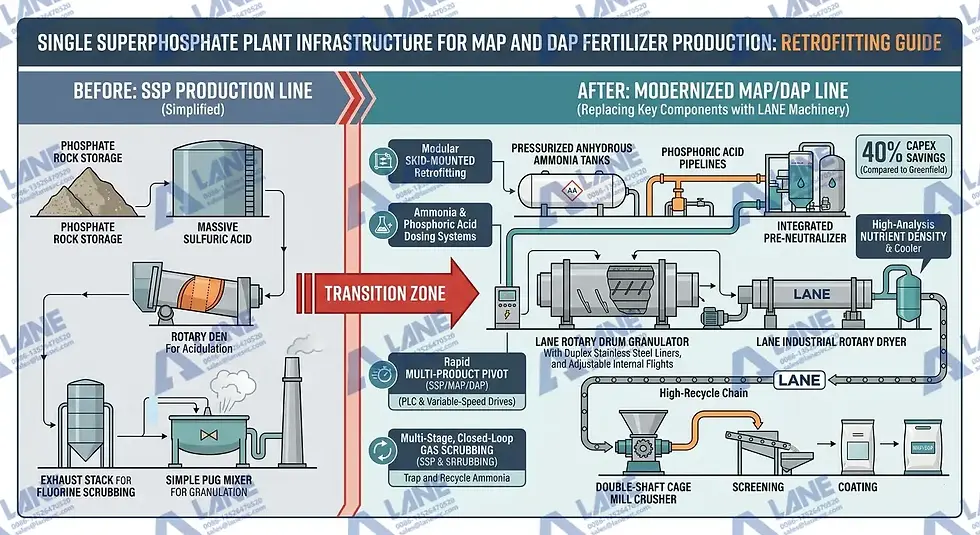
A modern low investment MAP and DAP plant can often switch between MAP and DAP production with minimal equipment modifications.
Step-by-Step Production Process Flow
A modern low investment MAP and DAP plant achieves capital efficiency by adopting a streamlined, horizontal process layout that replaces multi-story tower configurations. The production sequence functions as a continuous, closed loop:
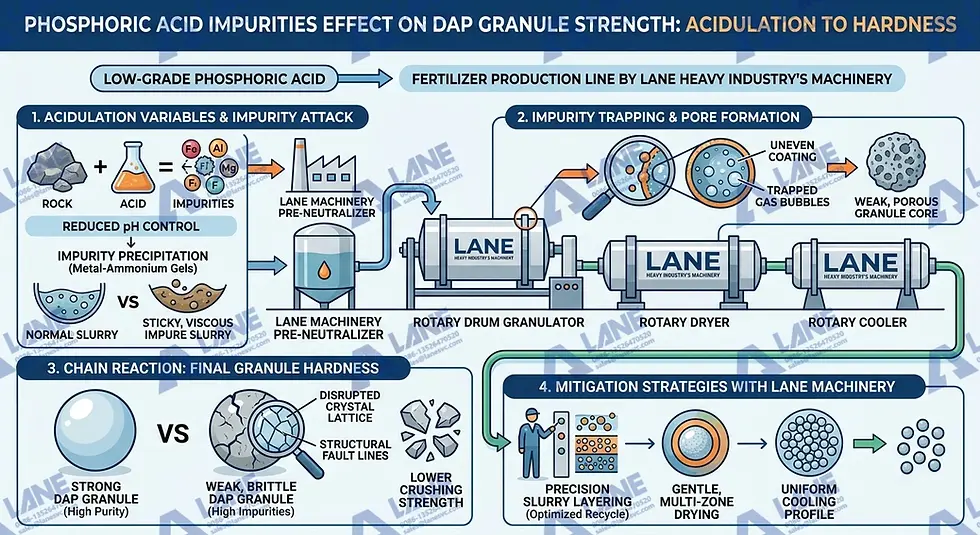
Reaction and Pre-Neutralization: Phosphoric acid and gaseous ammonia are fed into a compact pre-neutralizer tank or an inline pipe reactor. The intense exothermic heat evaporates a large portion of the moisture, forming a hot chemical slurry.
Rotary Granulation: The molten slurry is introduced into the granulator, where it coats a rolling bed of recycled, fine materials, layer by layer, forming spherical granules.
Thermal Dehydration (Drying): Moist granules move into a rotary dryer, where counter-current or co-current hot air flows reduce the moisture level to below 2.0%.
Cooling & Classification: Dried granules are cooled to lock in physical hardness and passed through heavy-duty vibrating screens. Perfect-size pellets (2.0–4.75mm) go to packaging, while oversized pellets are crushed and recycled back to step two alongside the undersized fines.
Essential Equipment Blueprint from LANE Heavy Industry
To ensure structural longevity and minimal downtime without incurring massive upfront costs, the selection of the core mechanical machinery is paramount. LANE Heavy Industry has engineered a suite of dedicated units explicitly optimized for a cost-effective phosphate plant layout.
Essential Machinery Unit | Key Technical Function | Low-Investment Strategic Value |
LANE Rotary Drum Granulator | Agglomerates the hot chemical slurry into uniform, dense spherical pellets through a continuous rolling action. | Utilizes engineering-grade acid-resistant rubber linings. Prevents sticky chemical buildup, reduces weight, and cuts maintenance costs. |
Instantly pulverizes hard, oversized recycled phosphate aggregates rejected by the screening system. | Equipped with wear-resistant synchronous chains that shatter lumps without clogging, maximizing continuous uptime. | |
Rapidly extracts internal moisture and reduces pellet temperature to prevent caking during warehousing. | Optimized thermal efficiency design allows the use of flexible, low-cost fuels (biomass, coal, gas, or heavy fuel oil). | |
Separates the output into precise grade fractions via single or dual-deck high-frequency mesh setups. | Simple mechanical design with self-cleaning tappings, preventing blinding by sticky phosphate dust. |

Investment Considerations
Before investing, buyers should consider raw material supply, utility demand, labor availability, and environmental requirements. Phosphoric acid and ammonia are critical feedstocks, so the plant should be located where sourcing and transport are practical. Power, fuel, water, and dust control systems also affect operating cost and long-term profitability.
Another important factor is plant layout. A compact, efficient layout helps reduce piping, transport distance, and installation complexity. LANE Heavy Industry’s fertilizer production line is useful here because it can be designed to match the actual needs of the project instead of forcing the investor into a one-size-fits-all setup.
FAQ
Q1: What is the main advantage of a low investment MAP and DAP plant?
It lowers startup cost while still allowing production of two high-demand phosphate fertilizers.
Q2: Can one line produce both MAP and DAP?
Yes. A properly designed production line can be adjusted to support both products.
Q3: What equipment is most important?
The reaction, granulation, drying, and screening systems are the most critical for product quality.
Q4: Is LANE Heavy Industry’s line suitable for small investors?
Yes. It is designed to support practical, scalable fertilizer production with controlled investment.
Email: sales@lanesvc.com
Contact number: +86 13526470520
Whatsapp: +86 13526470520

Comments