


Key Considerations for Production of Commercial Organic Liquid Fertilizers


The successful commercial production of Organic Liquid Fertilizers depends on efficiency of the production machines. Organic Liquid Fertilizers offer a nutrient-dense solution that enhances soil health, promotes robust plant growth, and reduces reliance on synthetic chemicals. However, producing high-quality, consistent commercial Organic Liquid Fertilizers requires careful planning, adherence to strict standards, and the right equipment. This article outlines the key considerations for successful production with the experience of LANE Heavy Industry and why LANE can transform these considerations into an efficient, profitable liquid fertilizer production line.
Table of Contents
The Foundation: Sourcing and Preparing Raw Materials
The Core Process: Controlled Fermentation
Refinement and Formulation: Creating a Market-Ready Product
Quality, Compliance, and Scaling with LANE Heavy Industry
Conclusion
Frequently Asked Questions
1. The Foundation: Sourcing and Preparing Raw Materials
The first step of producing commercial Organic Liquid Fertilizers is to get consistent organic raw materials. A commercial plant must secure reliable, high-volume supply of raw materials such as animal manure, food processing waste, agricultural residues, or specialized plant matter.
The raw material is first sent to pre-treatment area. The biomass must be crushed and homogenized to a uniform particle size. This increases the surface area for microbial action, ensuring a faster, more consistent, and complete fermentation. LANE Heavy Industry production line integrates semi wet crusher and mixers at this initial stage. This method transforms variable raw waste into a consistent slurry. This is the first step for repeatable batches of Organic Liquid Fertilizers.
2. The Core Process: Controlled Fermentation
Fermentation is where biology meets industrial engineering. The choice between anaerobic (without oxygen) and aerobic (with oxygen) fermentation will define your product and process.
Anaerobic Digestion: Conducted in sealed reactors, this process breaks down organic matter to produce biogas and a nutrient-rich liquid digestate. It is excellent for wet wastes and adds a renewable energy co-product.
Aerobic Fermentation: This oxygen-dependent process is faster and focuses on building populations of beneficial aerobic microbes directly into the fertilizer solution.
For consistent commercial-grade Organic Liquid Fertilizers, this stage demands precision. LANE Heavy Industry’s fermentation tanks are engineered with critical control systems:
Temperature Control: Automated heating/cooling maintains the optimal range for microbial activity.
Agitation Systems: Slow-speed mixers ensure even heat distribution, prevent sedimentation, and maintain contact between microbes and feedstock.
Aeration Management (for aerobic systems): Precise air injection systems optimize oxygen levels to maximize microbial growth and minimize odors.

3. Refinement and Formulation: Creating a Market-Ready Product
The output of the fermentation tank is a raw broth. Transforming it into a stable, effective, and marketable Organic Liquid Fertilizer requires sophisticated post-processing.
Solid-Liquid Separation: The fermented slurry is passed through a series of separators (e.g., screw presses, centrifuges) to remove coarse and fine solids. These solids can be further processed into powdered organic fertilizer, while the liquid moves forward.
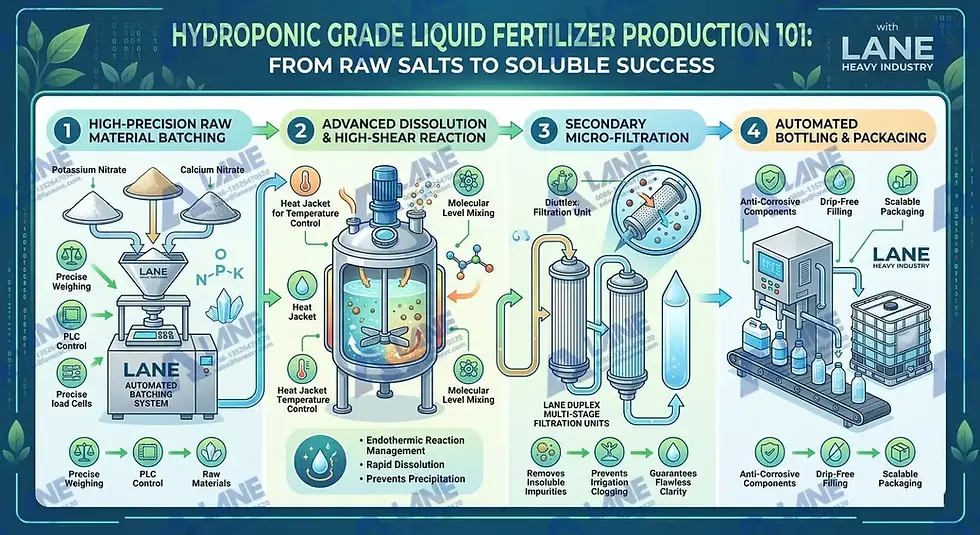
Filtration and Clarification: For a premium clear liquid product, multi-stage filtration systems remove micron and sub-micron particles. This step prevents clogging in irrigation systems and enhances product shelf life and appearance.
Nutrient Fortification and Balancing: To meet specific crop requirements and guarantee consistent NPK (Nitrogen, Phosphorus, Potassium) values, purified liquid can be transferred to blending tanks. Here, automated dosing systems add and homogenize approved organic nutrient sources or pH adjusters.
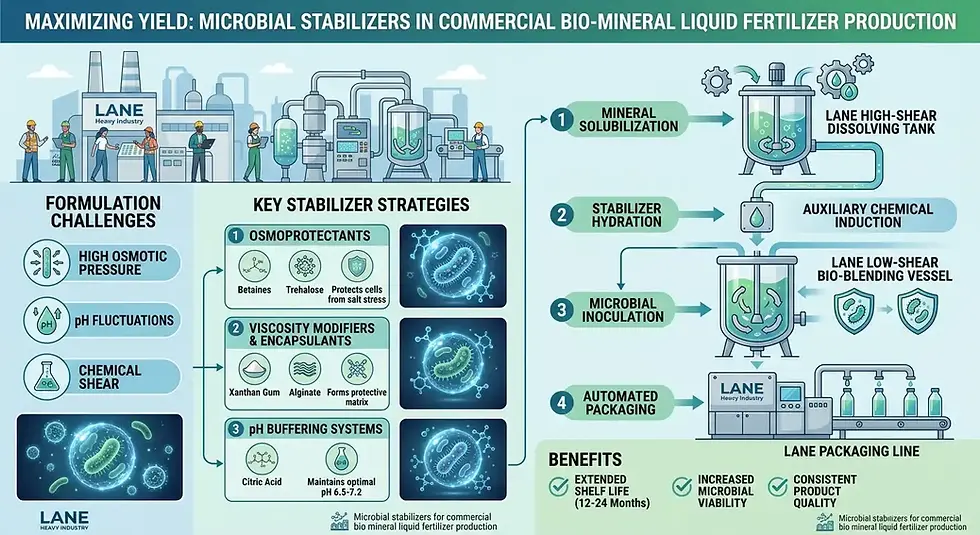
Stabilization and Preservation: To ensure the Organic Liquid Fertilizers remain effective during storage, stabilizers may be added to prevent nutrient degradation or microbial spoilage, which is crucial for commercial distribution.
4. Quality, Compliance, and Scaling with LANE Heavy Industry
Commercial production is governed by more than just process; it involves certification, quality assurance, and scalable design.
Certification Compliance: Producing certified organic fertilizers requires meticulous documentation of all inputs and processes. Your equipment layout must facilitate traceability, and materials must be compliant. LANE’s engineers can design systems that adhere to these audit trails.
In-House Quality Control (QC): A commercial plant needs a dedicated QC lab for routine testing of nutrient content, pH, microbial load, and contaminant levels. This data is vital for batch consistency and labeling accuracy.
The Advantage of an Integrated Production Line: A piecemeal approach from different vendors creates bottlenecks. A turnkey solution from LANE Heavy Industry ensures seamless integration from the pre-treatment feeder to the final filling machine. This integration maximizes efficiency, minimizes labor, and ensures hygiene. Their expertise allows for designing modular lines that can scale your output from pilot plant to full industrial capacity, all focused on the efficient manufacture of Organic Liquid Fertilizers.

5. Conclusion
Transitioning to commercial production of Organic Liquid Fertilizers is a significant undertaking that rewards a systematic approach. This approach prioritizes raw material quality, efficient production processes, strict quality control, cost-efficiency, and sustainability. By integrating LANE Heavy Industry’s advanced production line, producers can streamline operations, ensure consistent product quality, and scale their businesses to meet growing market demand for Organic Liquid Fertilizers.
Frequently Asked Questions
1. What is the minimum viable scale for a commercial production line?
While definitions vary, a truly commercial operation typically starts at a capacity of 5,000 to 10,000 tons per year. LANE Heavy Industry designs modular lines that can start at this scale and be expanded as market demand grows.
2. How long does the complete production process take?
The timeline varies based on feedstock and method. Aerobic fermentation can take 7-15 days for complete processing. Anaerobic digestion can take 20-40 days. Post-fermentation refining (separation, filtration, blending) is a continuous process that adds hours to a few days.
3. Can I use multiple types of raw materials in one production run?
Yes, but it requires careful formulation. Consistent blending in the pre-treatment stage is crucial. LANE’s mixing and feeding systems are designed to handle and homogenize diverse feedstock blends to create a uniform input for fermentation.
4. What are the biggest regulatory hurdles for commercial sale?
Regulations vary by country and region but generally focus on:
Accurate and truthful nutrient content labeling,
Limits on heavy metals and pathogens, and
Compliance with organic certification standards if marketed as "organic."
Your equipment design must support meeting these standards through controlled processing and hygiene.

Email: sales@lanesvc.com
Contact number: +86 13526470520
Whatsapp: +86 13526470520

Comments