


Industrial MAP Production Solution: A Step-by-Step Process for Modern Fertilizer Facilities


The demand of high-efficiency phosphorus fertilizers has reached an all-time high, due to the need for increased crop yields and sustainable agricultural practices. Monoammonium Phosphate (MAP) is one of the most widely used phosphate fertilizer in the agriculture industry. It stands out due to its high concentration of phosphorus content, excellent water solubility, and stable nutrient release. However, to produce MAP in large quantity, manufacturers need industrial MAP production solution.
As fertilizer demand increases worldwide, manufacturers are investing in more efficient and automated production facilities. A professional industrial MAP production solution helps fertilizer producers improve product consistency, lower operating costs, and achieve large-scale output with stable quality. LANE Heavy Industry Machinery provides complete fertilizer production line systems for MAP manufacturing, helping businesses build modern, high-efficiency fertilizer plants.
What Is MAP
MAP is valued for its high phosphorus content, good solubility, and suitability for blending or direct field application. It is commonly produced by reacting phosphoric acid with ammonia. The reaction process needs careful control of temperature, pH, and moisture to achieve a quality product. In industrial MAP production solution, MAP may be produced as granular fertilizer or high-purity soluble material depending on the market target and plant configuration.
Why Modern Plants Choose It
Modern fertilizer facilities choose MAP because the product is compact, efficient to transport, and widely accepted in both large-scale agriculture and specialty fertilizer markets. It is especially useful where growers need a fast-acting phosphorus source that also supplies ammonium nitrogen. Lane’s industrial MAP production solution is positioned for plants that want an integrated solution covering mixing, reaction, granulation, drying, cooling, screening, and packaging.

Step-by-Step Process
1. Raw material preparation
The process begins with selecting qualified phosphoric acid and ammonia, then checking concentration and impurity levels before feeding them into the system. This stage is critical because raw-material quality directly affects product purity, crystal formation, and downstream equipment performance. Lane’s fertilizer production approach emphasizes plant design and equipment matching to the chosen raw materials and output target.
2. Reaction and neutralization
Phosphoric acid is reacted with ammonia in a controlled neutralization step to form MAP slurry. pH control is essential in this stage and reaction conditions are managed in a narrow range to prevent off-spec product and nutrient loss. A stable reaction system helps the plant maintain consistent composition and makes the rest of the line easier to operate.
3. Granulation or crystallization
After the reaction, the slurry is sent to granulation or crystallization depending on whether the target is granular MAP or soluble MAP. For high-purity soluble grades, crystallization and separation systems are used to improve product quality. For Granular MAP, high quality Rotary Drum granulator or Disk granulator are used to improve product quality. The granular MAP lines focus on forming uniform particles for agricultural use. Lane’s line can be configured with granulation-related equipment to support continuous fertilizer manufacturing.
The formed MAP fertilizer is then dried to reduce moisture and stabilize physical properties. After drying the cooling process protect the particle strength and storage quality. This section of the line is important because excessive moisture can lead to caking, poor flowability, and packaging problems. Proper drying and cooling improve the handling performance of finished fertilizer in warehouse and shipping operations.
5. Screening and recycling
Next, the product passes through screening equipment to separate qualified particles from oversized or undersized material. Off-size materials are recycled back into the process, which improves yield and reduces waste. This closed loop approach is one reason modern fertilizer lines achieve better efficiency than simple batch operations.
6. Packaging and storage
The final step is automatic weighing, bagging, and sealing for shipment or storage. Reliable packaging protects product quality during transport and supports higher throughput in commercial fertilizer facilities. Lane’s production line concept is built for end-to-end handling, so producers can move from raw input to finished bagged product in one integrated workflow.

Lane Equipment Value
Lane Heavy Industry’s industrial MAP production solution is presented as a complete fertilizer manufacturing solution rather than a single machine purchase. Its broader fertilizer plant guidance highlights crushers, mixers, granulators, dryers, coolers, and packaging machines as core components of an efficient line. For MAP producers, that means the plant can be designed around capacity, product form, and quality requirements instead of forcing a one-size-fits-all setup.
Quality Control Points
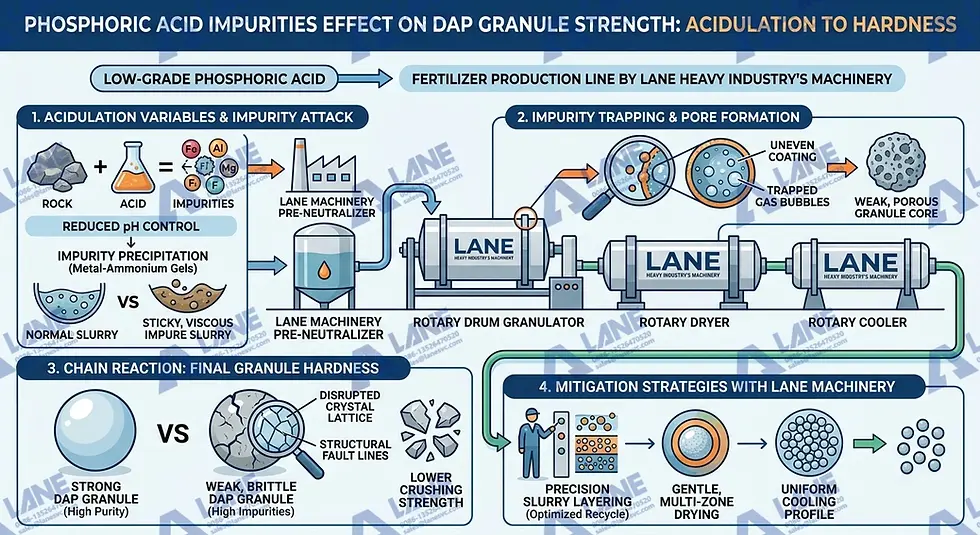
A successful MAP plant needs strong quality control at every stage. Key checks include raw-material inspection, reaction monitoring, moisture control, particle-size control, and final product testing for nutrient content and purity. High-purity MAP systems also need impurity management, especially when merchant-grade phosphoric acid is used as feedstock.
Frequently Asked Questions (FAQ)
Q1: How long does it take to install a complete industrial MAP production solution?
The timeline depends on plant capacity and site readiness. LANE Heavy Industry provides professional layout design and dispatches an experienced team for overseas installation and commissioning, typically completing a large-scale line in a matter of months once civil works are ready.
Q2: What kind of warranty and support does LANE offer?
LANE backs its equipment with a comprehensive 5-year warranty. Their support includes factory training, installation guidance, and ongoing after-sales service to ensure the production line operates optimally throughout its lifecycle.
Q3: Can this system produce other phosphate fertilizers like DAP?
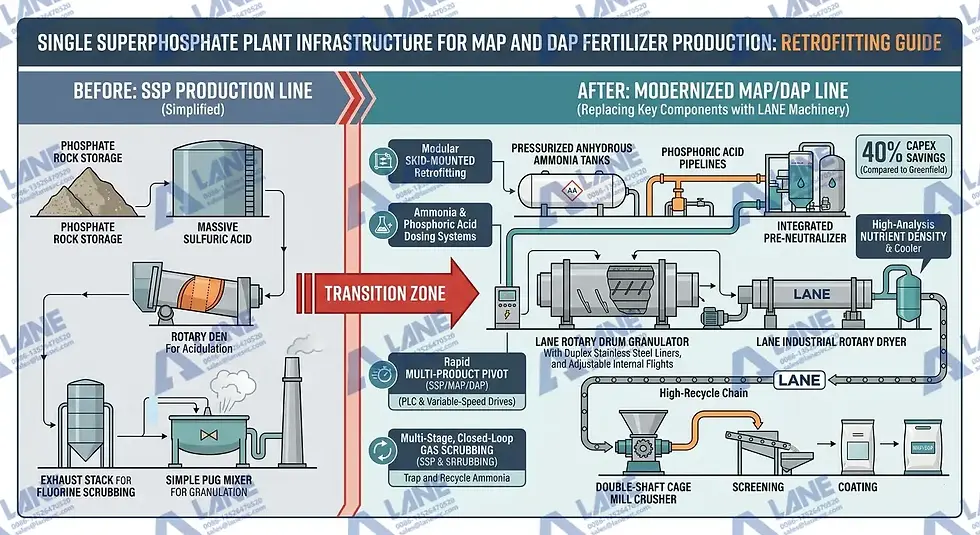
Yes. The core equipment in LANE’s industrial MAP production solution is adaptable. With appropriate modifications to the reaction and formulation stages, the same granulation and finishing line can be used to produce DAP (Diammonium Phosphate) and NPK compound fertilizers, offering long-term flexibility.
Q4: Is the system environmentally friendly?
Absolutely. Closed-loop recycling of fines eliminates solid waste, while integrated dust collection and gas scrubbing systems capture emissions and dust, ensuring the plant meets stringent environmental standards.

Email: sales@lanesvc.com
Contact number: +86 13526470520
Whatsapp: +86 13526470520

Comments