


Industrial DAP Fertilizer Production Solution: From Raw Materials to High-Quality Granules


Diammonium phosphate (DAP) is one of the most used phosphate fertilizers in global agriculture. It is known for its high nutrient concentration, excellent storage stability, and wide crop compatibility. It contains 18% Nitrogen and 46% Phosphorus (P₂O₅). However, producing a consistent, high-strength, and dust-free granule requires more than just raw materials; it demands a sophisticated industrial DAP fertilizer production solution that integrates chemistry, mechanical engineering, and environmental stewardship.
As agricultural demand grows, fertilizer manufacturers are investing in a professional industrial DAP fertilizer production solution to improve production efficiency, ensure product quality, and maximize profitability. As a leading fertilizer machinery manufacturer, LANE Heavy Industry Machinery provides customized DAP fertilizer production lines for capacities ranging from 10,000 to 300,000 tons annually.
The Chemistry of Success: Raw Material Neutralization
The core of the DAP production process is the neutralization of phosphoric acid with ammonia. This is a highly exothermic chemical reaction that must be precisely controlled to achieve the desired nitrogen-to-phosphorus ratio. The chemical equation governing this process is:
2NH₃ + H₃PO₄ → (NH₄)₂HPO₄ + Heat
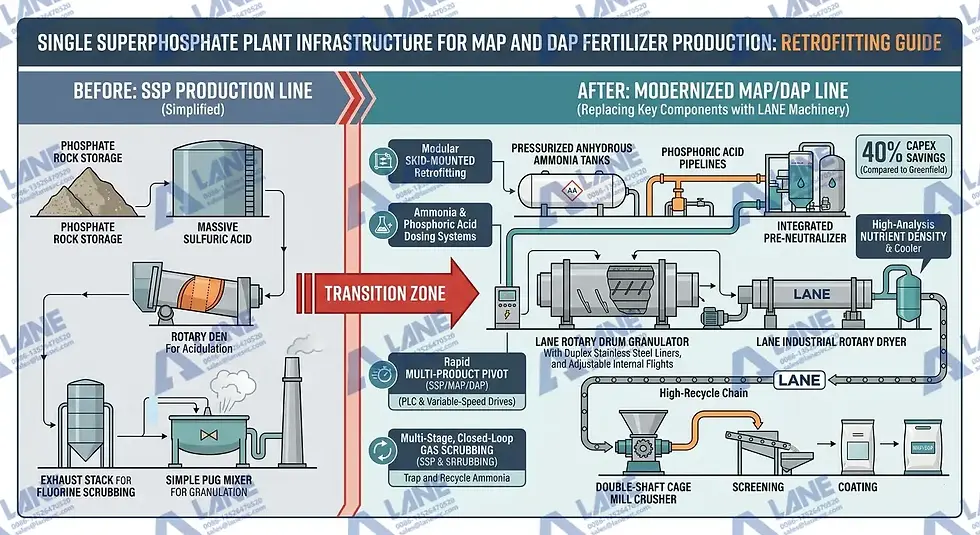
LANE’s solution utilizes a specialized Tubular Reactor or a pre-neutralization tank depending on the scale of the production. In the reactor, liquid or gaseous ammonia is injected into phosphoric acid, at a concentration of 40% to 52%. The heat generated by this reaction is harnessed to evaporate excess water.

Core Equipment: The LANE Heavy Industry Advantage
An industrial DAP fertilizer production solution is only as reliable as its weakest component. LANE Heavy Industry focuses on durability and precision across the entire machine array:
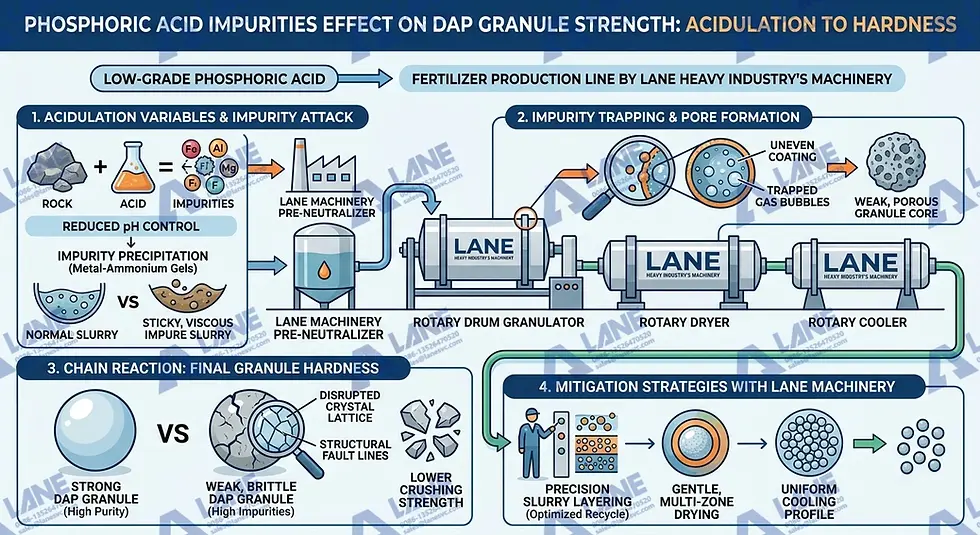
This is the centerpiece of the granulation stage. LANE’s Rotary Drum Granulator is designed with a specific internal flight arrangement and spray systems that allow the slurry to coat "seed" particles (returned fines) uniformly.
This "layering" process ensures that each granule is dense and structurally sound. Our machines feature specialized rubber linings to prevent material buildup, significantly reducing downtime for cleaning.
B. High-Efficiency Rotary Dryer & Cooler
Moisture control is critical. After granulation, the DAP particles contain approximately 2% to 5% moisture. Our rotary dryers use a counter-current airflow design to bring moisture levels down to less than 1.5%. Following this, the rotary cooler brings the temperature down to ambient levels, which is essential for preventing "caking" during storage and transportation.
C. Precision Screening System
Uniformity is a key quality metric for B2B buyers. Our rotary screens separate the product into three categories:
Oversized: Sent to the chain crusher.
Undersized: Returned as fines for granulation.
Qualified Granules: The final product.
Step-by-Step Process Flow
The workflow of a LANE-engineered industrial DAP fertilizer production solution is optimized for continuous operation:
Slurry Preparation: Raw phosphoric acid and ammonia react in the neutralization system to form a hot DAP slurry.
Granulation: The slurry is sprayed into the rotary drum granulator. As the drum rotates, the slurry coats recycled granules, growing them to the target size, typically 2-4mm.
Drying: The wet granules are moved to the rotary dryer where hot air removes residual moisture.
Cooling: The hot, dry granules are cooled to stabilize their chemical structure.
Screening: Mechanical screens ensure only granules of the correct diameter proceed to the next stage.
Coating: A specialized coating machine applies a microscopic layer of oil or anti-caking agent to the granules, giving them a professional sheen and preventing moisture absorption.
Packaging: Automated bagging systems weigh and seal the product into 25kg, 50kg, or 1000kg bags.

Operational risks and mitigation
Ammonia handling: Requires leak detection, ventilation, and emergency plans; proper storage and vaporization equipment are essential for safety.
Moisture and caking: Precise dryer control and effective coatings mitigate caking; screening and recycle loops reduce off-spec production.
Emissions and wastes: If the line includes phosphoric acid production, plan for gypsum handling, scrubbers, and wastewater treatment to meet environmental regulations.
Conclusion
A successful industrial DAP fertilizer production solution is the result of balancing chemical precision with mechanical robustness. LANE Heavy Industry Machinery provides the expertise and the hardware to turn raw phosphate and ammonia into a world-class fertilizer product. LANE Heavy Industry Machinery provides complete DAP fertilizer production lines designed for reliability, scalability, and long-term profitability. For manufacturers planning a new fertilizer plant or upgrading an existing facility, investing in a modern industrial DAP fertilizer production solution is the foundation for future growth.

Email: sales@lanesvc.com
Contact number: +86 13526470520
Whatsapp: +86 13526470520

Comments