


How a Fully Automated Liquid Fertilizer Production Line Ensures Perfect Ionic Balance for Hydroponic Vegetables
- Efat Elahi
- Dec 24, 2025
- 4 min read

Table of Contents
Introduction: The Ionic Imperative in Hydroponics
The Pitfalls of Manual Production: Where Imbalance Creeps In
Precision from the Start: Automated Raw Material Handling & Dosing
The Science of Synthesis: Controlled Mixing and Chelation
Real-Time Guardians: In-Line Sensors and Instant Adjustment
The Data-Driven Guarantee: Traceability and Consistent Output
Conclusion: Perfect Balance as a Standard, Not an Exception
FAQ: Understanding Automation and Ionic Balance

1. Introduction: The Ionic Imperative in Hydroponics
Hydroponic cultivation is a soilless growing method that relies on nutrient-rich solutions. Hydroponic systems deliver nutrients directly to the roots in their ionic form. This method has revolutionized modern agriculture by enabling high-yield, space-efficient vegetable production. Liquid fertilizer for hydroponic vegetables must contain precise ratios of essential ions such as nitrogen (N), phosphorus (P), potassium (K), calcium (Ca²⁺), magnesium (Mg²⁺), and chloride (Cl⁻).
Imbalance in liquid fertilizer for hydroponic vegetables can lead to antagonism, where certain ions inhibit the absorption of others. This stunts plant growth and reduces yields. Traditional manual fertilizer mixing is prone to human error. A fully automated liquid fertilizer production line developed by LANE Heavy Industry is made to eliminate these errors.
2. The Pitfalls of Manual Production: Where Imbalance Creeps In
Manual or semi-automated production is vulnerable to human and mechanical error. A slight deviation in raw material, a minute miscalculation in water volume, or an inconsistent mixing time can alter the ionic profile. The smallest deviations can lead to nutrient lockout. Excess ions prevent the uptake of others; it causes deficiencies in a "full" nutrient solution. The result is stunted growth, blossom-end rot, or leaf chlorosis in your hydroponic vegetables. Automation eliminates these variables at their source.

3. Precision from the Start: Automated Raw Material Handling & Dosing
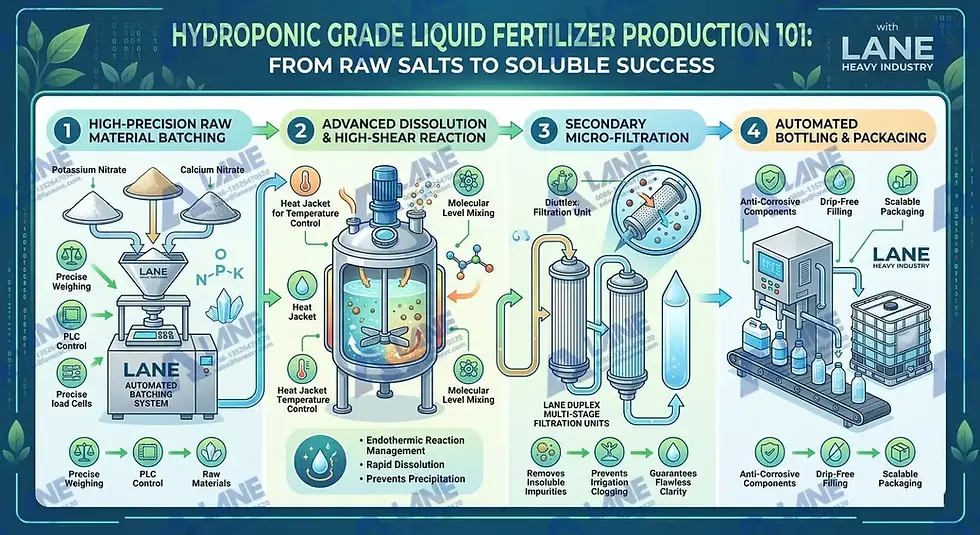
The journey of liquid fertilizer for hydroponic vegetables begins with accuracy in batching. In a fully automated line from LANE Heavy Industry, the full process is untouched by human hands. The automatic batching and dosing system dispenses each raw material directly from bulk storage to the mixing tank. You can input your own recipe into the PLC or computer control panel. This foundational step ensures the intended ionic ratios are perfectly established before mixing even begins.
4. The Science of Synthesis: Controlled Mixing and Chelation
Mixing is not just blending; it is a controlled process in liquid fertilizer for hydroponic vegetables. LANE Heavy Industry’s automated reactors manage this critical phase. This system controls the temperature and agitation speed of the mixer.
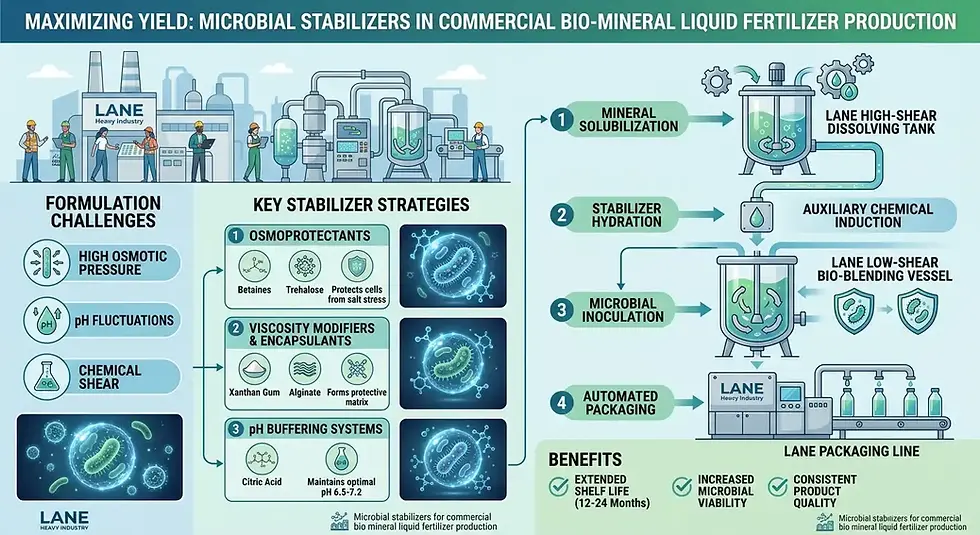
Raw Material Mixing: Raw materials are first sent to dissolve with water in a separate raw material mixing tank. This is done to prevent premature reactions that form insoluble precipitates.
Main Mixing: Raw material solutions are mixed in a dedicated high-shear mixer. Here they are mixed perfectly to create the base formulation.
Chelation Stability: The base formulation is sent to the additive mixing tank. The system creates an ideal pH and temperature environment for chelating agents to properly bind micronutrients, ensuring they remain soluble and bioavailable in the final liquid fertilizer for hydroponic vegetables.
Dual Filtration: The liquid then passes through dual filtration systems. LANE uses sub-micron cartridges and dual filters to ensure that the final liquid fertilizer for hydroponic vegetables doesn’t contain any undissolved particulate matter. This results in a crystal-clear, stable liquid fertilizer. This makes sure that the fertilizer won’t clog your sensitive hydroponic drippers. Then they are sent to the Storage tank for settling
5. Real-Time Guardians: In-Line Sensors and Instant Adjustment

In an automated production line, analytical sensors continuously monitor the solution to keep the quality of the production intact.
Conductivity (EC) Sensors: Track total dissolved ions in real-time.
pH Sensors: Monitor acidity, a critical factor for ionic stability and nutrient availability.
Density Meters: Provide additional data on concentration.The live data is fed to the production line’s Programmable Logic Controller (PLC). This system can automatically make micro-adjustments if a sensor reading deviates from the recipe’s strict setpoint.
6. The Data-Driven Guarantee: Traceability and Consistent Output
Every parameter of every batch is logged automatically into the system. This includes ingredient lot numbers, weights, mixing times, temperatures, and every sensor reading. This creates a complete digital fingerprint which can help you get EU certification. When a grower uses this liquid fertilizer for hydroponic vegetables, they are not just using a product; they are deploying a verifiably consistent ionic recipe.This data-driven process means the production line can replicate the same formulation with the same amount of recipe in continuous batches. This provides growers with the confidence to fine-tune their systems for peak vegetable performance.
7. Conclusion: Perfect Balance as a Standard, Not an Exception
As hydroponic agriculture continues to expand globally, the demand for high-quality, ionically balanced liquid fertilizer for hydroponic vegetables will only grow. LANE Heavy Industry’s fully automated fertilizer production lines represent the future of this industry, combining precision, reliability, and efficiency to solve the core challenge of ionic balance. LANE Heavy Industry’s precision machinery delivers unwavering nutritional integrity, allowing growers to focus not on correcting problems, but on maximizing the potential of their crops.

Email: sales@lanesvc.com
Contact number: +86 13526470520
Whatsapp: +86 13526470520

Comments