


Certified MAP Granulator Machine: 5 TPH High-Efficiency Fertilizer Production


The demand for high-quality phosphate fertilizers is continuing to rise. To meet this demand for high-quality MAP fertilizer, Manufacturer like LANE has created high-quality, consistent and energy efficient Certified map granulator machine. Monoammonium Phosphate (MAP) stands as one of the most vital compound fertilizers globally. it provides highly soluble source of both phosphorus and nitrogen to crops. A Certified map granulator machine ensures stable MAP granule formation, uniform particle size, and optimized nutrient retention.
For fertilizer plants aiming at medium-scale production, a 5 TPH system offers the perfect balance between investment cost and production capacity. This article will explore how a 5 TPH (tons per hour) MAP fertilizer production line operates and the specific ways in which the machinery manufactured by LANE Heavy Industry elevates the entire production process.
The Importance of MAP in Modern Agriculture
Before diving into the mechanics of the production line, it is essential to understand why MAP is such a sought-after commodity. MAP provides plants with a balanced kick-start of nitrogen and a heavy dose of phosphorus, which is critical for root development and early plant growth.
However, raw MAP can be difficult to store, transport, and apply evenly in its powdered or raw liquid states. This is where granulation becomes vital. Transforming raw materials into uniform, hard, and spherical granules ensures that when farmers spread the fertilizer, every square foot of soil receives the exact same nutrient ratio. Achieving this consistent granule quality at a commercial scale requires top-tier equipment like a certified MAP granulator machine.
The 5 TPH Fertilizer Production Line: A Step-by-Step Overview
A 5 TPH production line is an ideal capacity for many medium-to-large scale fertilizer manufacturers. It strikes a perfect balance between high volume and manageable capital investment. LANE Heavy Industry has established itself as an expert in providing turn-key solutions for these capacities.
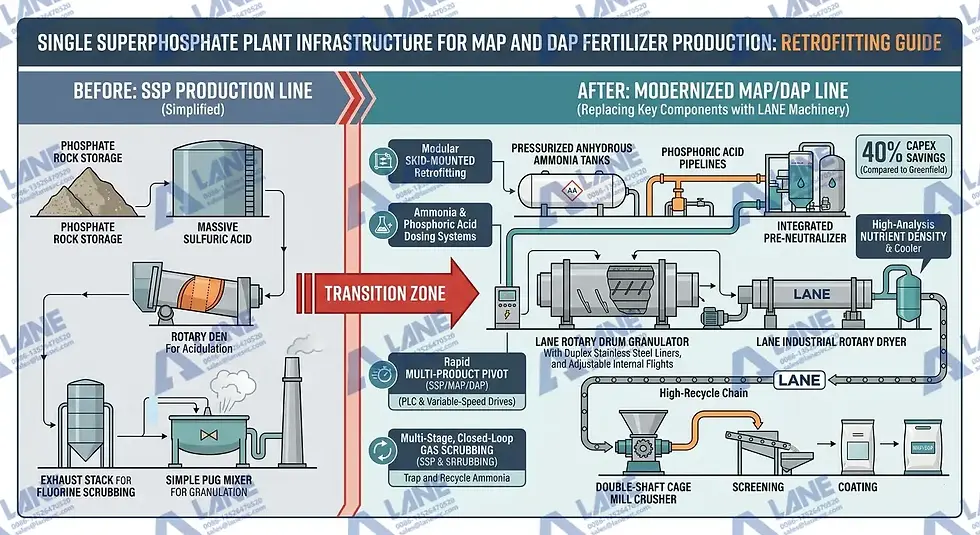
Let us break down how a high-efficiency fertilizer production line operates from start to finish, highlighting where the certified MAP granulator machine fits into the sequence.
1. Raw Material Batching and Mixing
The process begins with the precise measurement of raw materials. In the case of MAP, phosphoric acid and ammonia are reacted, or dry powdered forms of MAP are gathered alongside any other necessary filler or nutrient additives.
Automatic Batching Systems: LANE Heavy Industry provides automated batching systems that ensure materials are proportioned with absolute accuracy according to the desired formula.
Crushing: If raw materials contain large clumps, a vertical or chain crusher breaks them down into a fine powder.

2. Mixing and Neutralization
In this stage, phosphoric acid reacts with ammonia to form MAP slurry or a horizontal mixer blends the ingredients thoroughly to ensure a uniform composition before feeding them into the next stage. Key control parameters include:
pH balance
Temperature control
Reaction ratio
LANE systems feature advanced reaction tanks ensuring stable slurry quality before granulation.
Equipment used:
Neutralization reactor
Slurry tank
Pumping system
3. The Granulation Stage: The Core of the Process
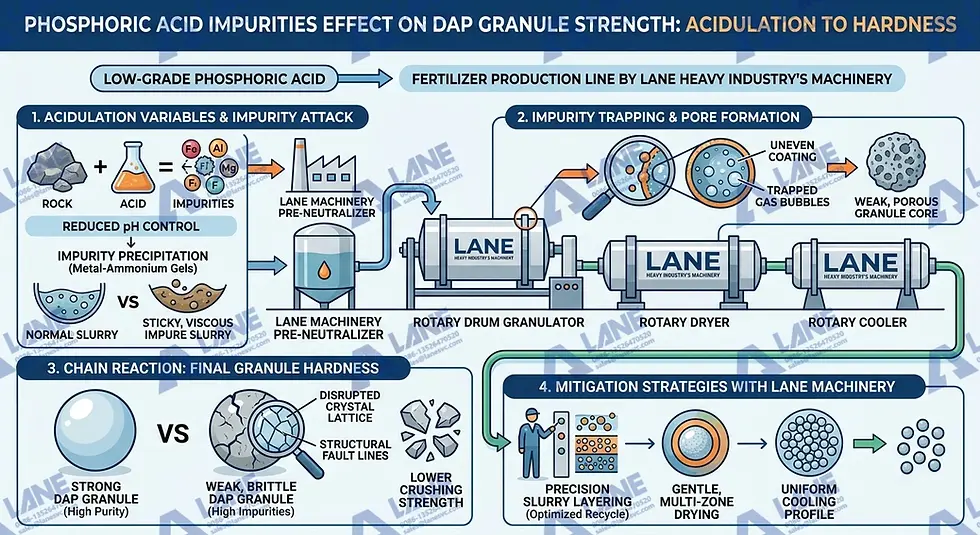
For a 5 TPH MAP production line, rotary drum granulators are often the preferred choice. The mixed material enters the slightly inclined, rotating cylinder. As the drum rotates, the materials roll and tumble. By introducing a measured amount of water, steam, or liquid raw material, the fine particles begin to adhere to one another.
The continuous rolling motion causes the particles to compact and agglomerate into perfect spheres.
A certified MAP granulator machine is engineered specifically to withstand the chemical properties of MAP and ensure that particle sizing remains highly uniform, minimizing waste and recycling rates.
4. Rotary Drying System
Freshly formed granules leaving the granulator have a relatively high moisture content and are still somewhat soft. To survive bulk handling, storage, and mechanical spreading, they must be hardened.
The wet granules are transported via belt conveyor into a massive rotary dryer.
LANE Heavy Industry’s drying machines utilize optimized internal lifting flights that shower the granules through a stream of hot air generated by a furnace. This ensures rapid and highly uniform moisture removal without damaging the physical structure of the granules.
5. Rotary Cooling System
Once the granules emerge from the dryer, they are quite hot. If packaged immediately at high temperatures, they will absorb moisture from the air as they cool, leading to severe caking and clumping in the bags.
The rotary cooler works similarly to the dryer but passes ambient or chilled air through the falling granules.
This quickly reduces the product temperature to near-normal levels, preparing it perfectly for the next step.

6. Screening and Re-Processing
No granulator creates 100% perfect granules on the first pass. To guarantee that the final bag contains only premium product, the line features a rotary screening machine.
Oversized granules are sent back to the crusher to be broken down and granulated again.
Undersized fines fall through the mesh and are routed directly back to the granulator to serve as nuclei for new granules.
Only the perfectly sized granules (typically 2 to 5 mm) pass through to the final processing stages.
7. Coating and Automatic Packaging
Before heading into the bags, the finished MAP granules often pass through a coating machine. Here, a thin layer of oil or powder anti-caking agent is applied. This protects the granules from moisture during long periods of storage.
Finally, the product reaches the automated packaging scales. These systems automatically weigh, fill, and seal bags at high speed, readying the premium 5 TPH output for the market.
Why Choose LANE Heavy Industry’s Machinery?
When investing in a high-capacity fertilizer line, selecting the right machinery partner is half the battle. LANE Heavy Industry offers several distinct advantages for operators looking to acquire a certified MAP granulator machine and full production setups:
Longevity and Durability: Fertilizer production involves heavy friction and corrosive chemical elements. LANE Heavy Industry uses highly wear-resistant materials and robust internal linings to ensure that machines have an extended operational lifespan.
Advanced Automation: From batching to final palletizing, the production lines are designed to require minimal manual labor, lowering operating costs and removing human error from the formula.
Turnkey Engineering Support: They provide full project delivery, including customized 3D plant layouts, foundation planning, and overseas installation teams to ensure your 5 TPH line starts running smoothly from day one.

Email: sales@lanesvc.com
Contact number: +86 13526470520
Whatsapp: +86 13526470520

Comments