


Bio-organic Compound NPK Fertilizer Manufacturing: Processes, Equipment, and Quality Standards


Bio-organic compound NPK fertilizer manufacturing is a sustainable approach to producing fertilizers that combines organic nutrients, beneficial microorganisms, and balanced chemical NPK (nitrogen, phosphorus, potassium) elements. This type of fertilizer fulfills the demands of modern eco-friendly high-efficiency nutrient. Farmers and manufacturers always seek solutions that deliver Bio-organic compound NPK fertilizer manufacturing has emerged as a leading response to this demand.
This manufacturing process recycles organic waste and ensures crops receive comprehensive nutrition, promoting soil health and reducing environmental pollution. As a leading provider of fertilizer production solutions, LANE Heavy Industry’s machinery offers a complete, automated bio-organic compound NPK fertilizer manufacturing line that streamlines each production stage, ensuring consistency, efficiency, and compliance with global quality standards.
The Manufacturing Process: A Step-by-Step Workflow
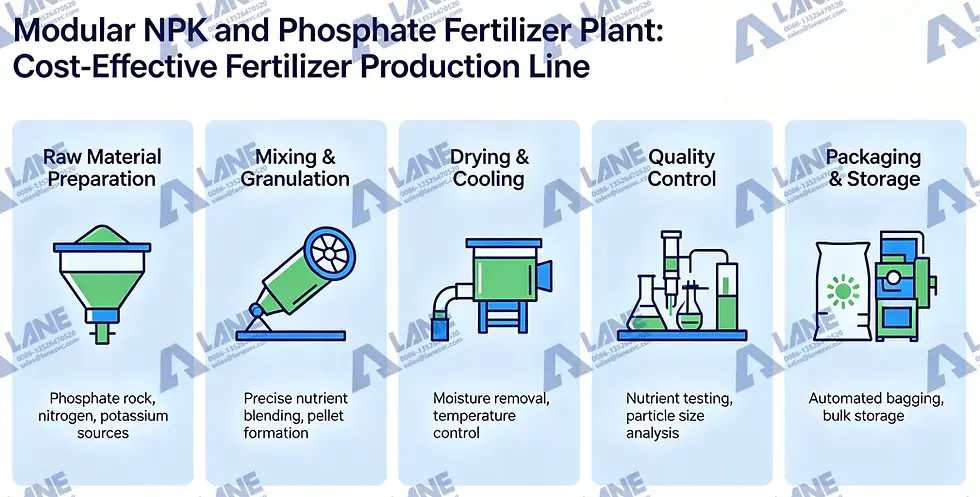
Successful bio-organic compound NPK fertilizer manufacturing follows a systematic sequence of operations designed to transform raw organic and mineral materials into uniform, high-performance granules. Each stage of the manufacturing process plays a critical role in determining the final products value.
1. Composting and Fermentation
The foundation of quality bio-organic compound NPK fertilizer manufacturing lies in through organic matter decomposition. Raw materials such as livestock manure, crop residues, and agricultural byproducts undergo controlled aerobic fermentation using LANE Heavy Industry's specialized compost turners. These machines maintain optimal temperature (55-70°C) and moisture levels while ensuring uniform oxygen distribution, eliminating pathogens and weed seeds while preserving beneficial microbial populations.

2. Crushing and Homogenization
Fermented organic material must be reduced to a consistent particle size before blending. LANE's semi-wet material crushers efficiently process fibrous and moist organic matter, producing a fine powder suitable for uniform mixing.
3. Precision Mixing
The crushed organic base is combined with precisely measured NPK mineral components in LANE's dual-shaft mixers. This critical phase of bio-organic compound NPK fertilizer manufacturing ensures that every granule contains identical nutrient ratios, a fundamental requirement for reliable field performance.
4. Granulation
Granulation converts the blended powder into spherical particles ideal for mechanical spreading. LANE Heavy Industry provides multiple granulation options for bio-organic compound NPK fertilizer manufacturing, including rotary drum granulators for high-capacity production and new-type Two in One granulator that preserve microbial viability through gentle agitation.
5. Drying and Cooling
Fresh granules contain excess moisture that compromises storage stability. Rotary drum dryers reduce moisture content to below 10%, while counter-flow coolers stabilize granule structure and prevent caking during bulk storage.
6. Screening and Coating
Vibrating or rotary screens separate properly sized granules from oversized and undersized particles. Qualified granules may receive a protective coating to enhance flowability and extend nutrient release characteristics.
7. Packaging
Automated weighing and bagging systems complete the bio-organic compound NPK fertilizer manufacturing line, delivering accurately filled, professionally sealed packages ready for distribution.
Essential Equipment from LANE Heavy Industry
LANE Heavy Industry's turnkey production lines incorporate specialized machinery engineered specifically for bio-organic compound NPK fertilizer manufacturing. Key equipment includes:
Equipment Type | Function in Production Line |
Compost Turner | Accelerates organic fermentation and pathogen elimination |
Semi-Wet Crusher | Reduces fermented material to uniform powder |
dual-shaft Mixer | Blends organic and mineral components homogeneously |
Rotary Drum Granulator | Forms spherical granules with high balling rate |
Rotary Dryer & Cooler | Reduces moisture and stabilizes granule structure |
Screening Machine | Ensures uniform particle size distribution |
Automatic Packager | Delivers accurate weighing and sealing |
All LANE equipment carries ISO9001 certification and benefits from comprehensive after-sales support, including installation guidance, technical training, and a five-year warranty.

Quality Standards in Bio-organic Compound NPK Production
Maintaining rigorous quality standards is essential to successful bio-organic compound NPK fertilizer manufacturing. Production facilities must adhere to multiple quality parameters:
Nutrient Content Verification: Finished products must consistently meet declared NPK ratios, typically verified through laboratory analysis of representative samples.
Organic Matter Threshold: Quality bio-organic fertilizers maintain minimum organic matter content (often 20-45%) to deliver soil conditioning benefits.
Microbial Viability: The bio-organic compound NPK fertilizer manufacturing process must preserve beneficial microorganism populations, which contribute to nutrient cycling and disease suppression in soil.
Moisture Control: Final moisture content below 10% prevents caking and ensures extended shelf life.
Particle Uniformity: Consistent granule size (typically 2-4 mm) facilitates even field application with mechanical spreaders.
Heavy Metal Compliance: Products must meet regulatory limits for heavy metal contaminants, a consideration particularly important when processing industrial byproducts.
Conclusion
Bio-organic compound NPK fertilizer manufacturing represents a critical advancement in sustainable agriculture. It represents a sophisticated convergence of biological science and chemical engineering. Leveraging LANE Heavy Industry’s modern production line, manufacturers can produce high-quality, nutrient-rich fertilizers efficiently while minimizing environmental impact. As sustainable agriculture continues to gain prominence globally, investment in modern bio-organic compound NPK fertilizer manufacturing infrastructure positions producers to meet evolving market demands while contributing positively to agricultural sustainability.
Frequently Asked Questions (FAQ)
Q1: What distinguishes bio-organic compound NPK fertilizer from standard compound fertilizers?
Bio-organic formulations incorporate fermented organic matter and beneficial microorganisms alongside mineral NPK nutrients, providing both immediate plant nutrition and long-term soil improvement benefits that standard chemical fertilizers cannot deliver.
Q2: What production capacity can LANE Heavy Industry provide for bio-organic compound NPK fertilizer manufacturing?
LANE offers complete production lines ranging from 0.5 to 100 tons per hour, fully customizable to client specifications and site conditions.
Q3: How long does installation of a complete bio-organic NPK fertilizer manufacturing line require?
A typical medium-scale line producing 5 tons per hour requires approximately 60-90 days for installation and commissioning, depending on site preparation.

Email: sales@lanesvc.com
Contact number: +86 13526470520
Whatsapp: +86 13526470520


Comments