


Step-by-Step Approaches to Eco-friendly NPK Fertilizer Production


NPK fertilizers contain nitrogen (N), phosphorus (P), and potassium (K), the three macronutrients that crops consume most. They are essential for crop yield and soil fertility. However, traditional production methods often involve high energy consumption, excessive dust emissions, and inefficient material utilization. As the global focus shifts toward sustainable agriculture, traditional fertilizer production models face significant environmental challenges. An Eco-friendly NPK fertilizer production line, on the other hand, reduces energy consumption, lowers dust emissions, and improves nutrient utilization.
An Eco-friendly NPK fertilizer production provides balance between profitability and environmental responsibility. It has become the key to enhancing a company’s core competitiveness. In this article, we explore step-by-step approaches to building an efficient and sustainable Eco-friendly NPK fertilizer production line using advanced NPK production equipment from LANE Heavy Industry Machinery.
Why Eco-friendly NPK Fertilizer Production Matters
Conventional fertilizer production can generate several environmental challenges:
Dust pollution during crushing, mixing, and screening
High energy consumption in drying and cooling
Material loss from inefficient granulation
Wastewater contamination
Carbon emissions from outdated equipment
Eco-friendly production focuses on solving these problems through:
Closed-loop dust collection systems
Energy-efficient drying technology
Precise batching and automation
Waste recycling and raw material reuse
Reduced chemical waste and emissions
For fertilizer manufacturers, this means lower operational costs, easier environmental compliance, and stronger market competitiveness.
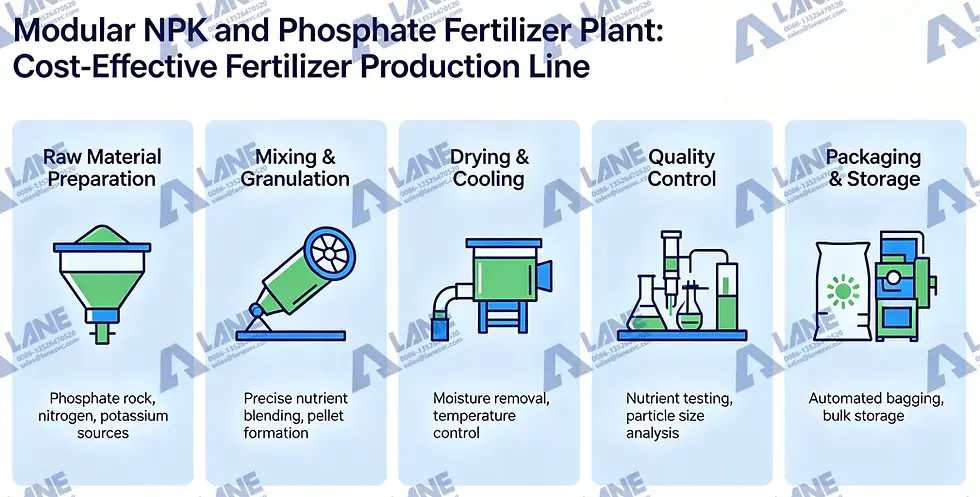
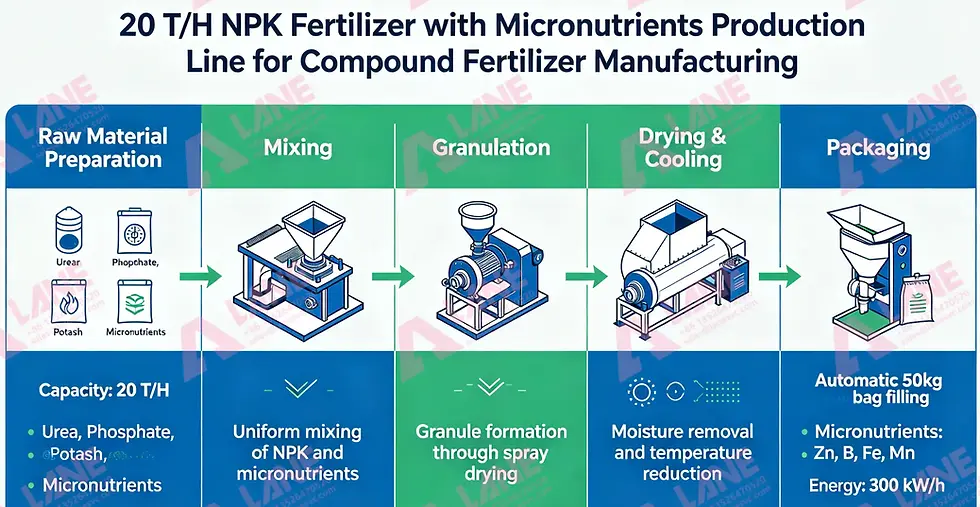
Steps of Eco-Friendly Production Line
1. Automated Precision Batching
The first step in eco-friendly production begins with the precise control of raw materials. LANE Heavy Industry’s automated batching system utilizes microcomputer controls to accurately dispense raw materials according to the set NPK (Nitrogen, Phosphorus, Potassium) ratios. Precise measurement prevents the waste of expensive raw materials, ensuring nutrient balance in every batch.
2. Mixing and Crushing: Uniformity Determines Efficiency

Once the product is discharged through the batching system, the raw material is sent to LANE hammer crusher or cage crusher. Raw materials sometimes contain clumps; LANE crushers refine them to ensure smooth downstream mixing. LANE’s double-shaft mixer ensures that nitrogen, phosphorus, potassium, and trace elements reach a uniform distribution in a very short time.
3. Core Granulation: Choosing Eco-friendly Methods
In Eco-friendly NPK fertilizer production, granulation is the most critical stage. LANE Heavy Industry recommends its self-developed Rotary Drum Granulator or Disc granulator.
High Granulation Rate: Our rotary drum granulator achieves a granulation rate of over 90%, significantly reducing the volume of return materials and lowering the energy consumption of the circulation system.
Steam-Assisted Technology: By introducing a small amount of steam to adjust material temperature, granulation efficiency is increased, and the need for chemical binders is reduced, further enhancing the fertilizer's environmental profile.
4. Drying and Cooling: Energy Recovery and Control
Drying is typically the most energy-intensive part of a fertilizer plant. LANE Heavy Industry’s rotary dryers feature a hot air circulation system:
Efficient Thermal Utilization: Optimized internal lifting flights ensure full contact between the material and hot air, shortening drying time.
Waste Heat Recovery: Hot air from the dryer can be channeled into the cooler for secondary heat exchange, significantly reducing overall coal or gas consumption.
5. Screening and Feedback System: Closed-Loop Production
To ensure consistent particle size, the production line is equipped with vibrating screen machines. Qualified granules proceed to the coating stage, while undersized powder or oversized granules are automatically returned to the crushing and granulation stages. This closed-loop production mode ensures 100% raw material utilization and achieves "zero waste" in the production process.
6. Environmental Protection: Multi-Stage Dust Collection
True Eco-friendly NPK fertilizer production must address tail gas emissions. LANE Heavy Industry provides multi-stage dust removal solutions as standard equipment:
Cyclone Dust Collector: Collects large particles for reuse.
Gravity Settling Chamber: Further reduces gas velocity to capture fine powders.
Wet Scrubber/Baghouse Filter: Ensures that exhaust gases released into the atmosphere meet the strictest environmental standards, reducing ammonia leakage and PM2.5 emissions.

7. Automated Coating and Packaging
Finally, a coating machine treats the surface of the granules. This not only increases the brightness of the particles but also allows for the addition of slow-release coatings. This helps reduce fertilizer leaching into the soil, protecting groundwater from nitrate pollution. LANE’s automated packaging machines complete the final weighing and sealing, requiring no manual contact and ensuring operational safety.
Why Choose LANE Heavy Industry Machinery?
LANE Heavy Industry does more than just provide machines; we provide an engineered approach to Eco-friendly NPK fertilizer production. Our equipment offers the following advantages:
Corrosion Resistance: Key components use stainless steel or high-polymer linings, extending equipment life in acidic or alkaline environments.
Intelligent Control: Integrated PLC systems monitor the energy efficiency of the production line in real-time.
Global Service Support: Whether you are in Africa, Europe, or Asia, we provide on-site installation and technical training.
Conclusion
The future of fertilizer manufacturing is no longer just about output, it is about sustainability, efficiency, and compliance. Achieving Eco-friendly NPK fertilizer production has become a necessary path for the transformation of the fertilizer industry. By utilizing professional machinery from LANE Heavy Industry, manufacturers can not only significantly improve production efficiency but also establish a green, sustainable brand image in a competitive market. By integrating automation, dust collection, energy-saving granulation, and recycling systems, manufacturers can achieve profitable and responsible Eco-friendly NPK fertilizer production.
Frequently Asked Questions (FAQ)
Q1: Is the initial investment for an eco-friendly NPK production line high?
While the initial cost of equipped dust removal and automation systems is slightly higher than traditional simple lines, the investment is typically recovered within 1-2 years through reduced material waste, lower energy bills, and the avoidance of environmental fines.
Q2: Does your equipment support the production of organic-inorganic compound fertilizers?
Yes. LANE’s rotary drum granulation lines are highly adaptable. They can process NPK chemical components as well as organic matter or humic acid to produce more ecologically friendly hybrid fertilizers.
Q3: How is the dust problem solved during production?
We utilize fully enclosed conveyors and multi-stage pulse bag filters. In the drying and cooling phases, all tail gas must pass through a washing tower to ensure emission concentrations are well below international standards.

Email: sales@lanesvc.com
Contact number: +86 13526470520
Whatsapp: +86 13526470520

Comments