


Ammonium Phosphate and Diammonium Phosphate: Properties, Uses, and Safety Explained

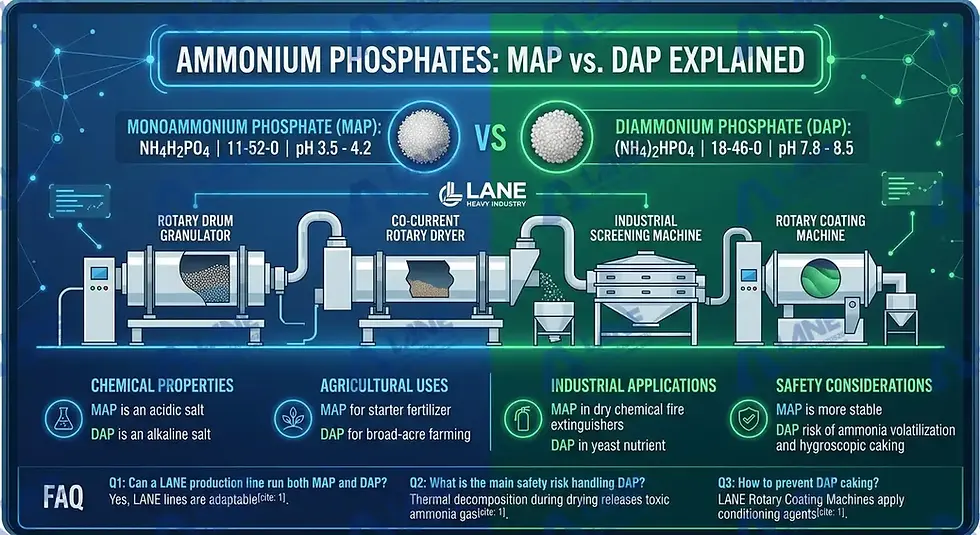
The synthesis of ammonium-based phosphatic fertilizers is done by neutralizing phosphoric acid with anhydrous ammonia. But the molecular ration of this reaction introduces two compounds with different operational profile. Monoammonium phosphate and Diammonium phosphate are among the most used fertilizer in the world. Creating these fertilizers is a consistent challenge of balancing chemical properties, nutrient compositions, and application characteristics. Turnkey compound fertilizer lines from LANE Heavy Industry provide the specialized automated controls and corrosion-resistant alloys needed to tame these reactive chemistry profiles.
As global demand for high-efficiency fertilizers continues to grow, manufacturers require advanced production equipment to ensure consistent quality. LANE Heavy Industry provides complete fertilizer production lines designed for large-scale production of both MAP and DAP fertilizers.
What Are Monoammonium Phosphate and Diammonium Phosphate?
Monoammonium phosphate and Diammonium phosphate are water-soluble phosphate fertilizers produced by reacting phosphoric acid with ammonia.
Monoammonium Phosphate (MAP) has the chemical formula of NH₄H₂PO₄. It contains 11% Nitrogen (N) and 52% Phosphate (P₂O₅). It is one of the most concentrated phosphorus fertilizers available and is used in modern agriculture due to its high nutrient efficiency.
Diammonium Phosphate (DAP) has the chemical formula (NH₄)₂HPO₄. It has the nutrient content of 18% Nitrogen (N), 46% Phosphate (P₂O₅). DAP contains more nitrogen than MAP and it is one of the most popular phosphate fertilizers globally.
Key Differences Between MAP and DAP
Property | MAP | DAP |
Ammonium ions | 1 | 2 |
Nitrogen content | 10-12% | 18% |
Phosphorus content | 50-52% P₂O₅ | 46% P₂O₅ |
Solution pH | Acidic (4.4-4.8) | Alkaline (7.5-8.0) |
Best soil type | High pH soils (>7.5) | Low pH soils |
The primary difference is the number of ammonia ions: MAP contains one ammonium ion per phosphate versus two for DAP. When MAP dissolves, it produces acidic pH while DAP is more alkaline, affecting phosphorus availability differently based on soil pH.

Key Properties of Monoammonium Phosphate and Diammonium Phosphate
High Nutrient Concentration: one of the major advantages of Monoammonium phosphate and Diammonium phosphate is their high nutrient density.
Excellent Water Solubility: Both MAP and DAP dissolve readily in water, allowing nutrients to become available to plant roots quickly.
This property makes them suitable for:
Field crops
Vegetable production
Fruit orchards
Greenhouse cultivation
Fertigation systems
Good Storage Stability: When properly stored, Monoammonium phosphate and Diammonium phosphate maintain their nutrient content for extended periods.
Their granulated form provides:
Easy handling
Reduced dust generation
Improved spreading performance
Better storage characteristics
Different Soil Reactions: One important difference involves soil pH effects.
MAP produces a slightly acidic reaction around fertilizer granules, which can improve phosphorus availability in alkaline soils.
DAP initially creates a temporary alkaline environment that may influence nutrient availability depending on soil conditions.
Production Excellence with LANE Heavy Industry Machinery
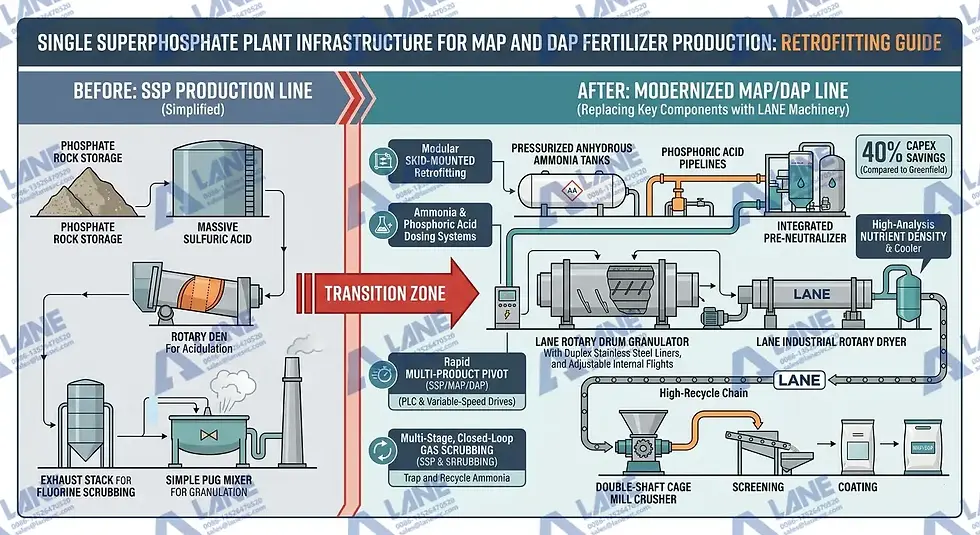
To navigate these strict chemical variances and safety hazards, modern manufacturing plants require versatile, heavily reinforced equipment. LANE Heavy Industry designs turnkey compound fertilizer production lines engineered specifically to transition seamlessly between MAP and DAP processing.
Reactor and Rotary Drum Granulation
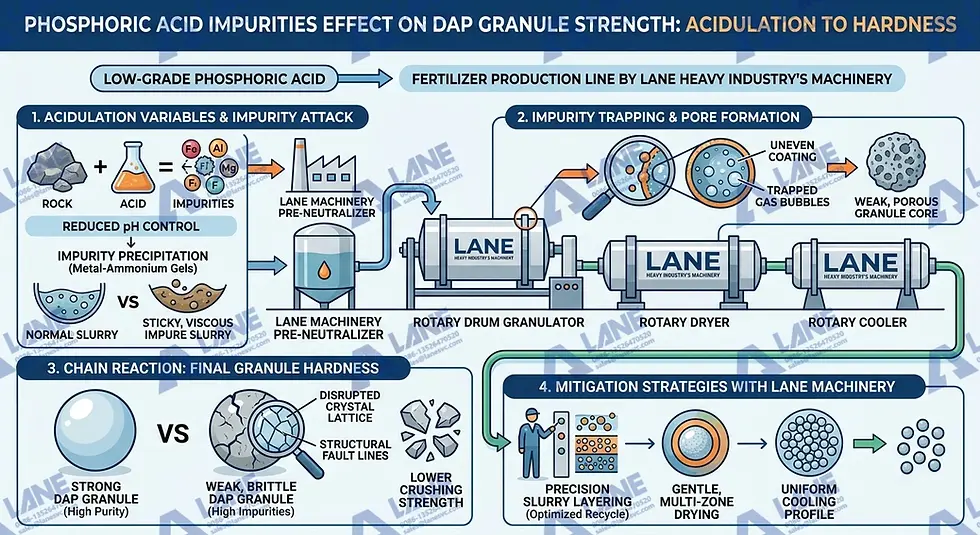
The heart of the LANE Heavy Industry processing line is the advanced Rotary Drum Granulator. Given the corrosive nature of the wet-process phosphoric acid slurries and the high heat of ammoniation, LANE equips its granulators with specialized, acid-resistant engineering rubber linings or heavy-duty stainless steel shells. This design actively prevents material build-up and sticky scaling, which is a constant challenge during DAP formulation.
Automated Thermal Control in Drying
To safely dry DAP without triggering thermal degradation and hazardous ammonia gas release, LANE Heavy Industry employs co-current Rotary Dryers integrated with automated PLC burner controls. Thermal sensors dynamically monitor the inlet and exhaust air, ensuring that the internal core temperature of the granular bed stays securely below the degradation threshold while achieving optimal moisture reduction.
Emissions Control and Coating
LANE Heavy Industry incorporates closed-loop chemical scrubbing systems into their lines to trap any fugitive ammonia vapor from the granulation and drying loops, returning it to the pre-neutralizer vessel. To address DAP's hygroscopic caking risks, the line concludes with a specialized Rotary Coating Machine that evenly distributes anti-caking oils and protective surface agents, ensuring safe packaging and long-distance transport.

Safety Considerations
Although Monoammonium phosphate and Diammonium phosphate are generally considered safe agricultural products, proper handling practices should always be followed.
Storage Safety: Store fertilizers in:
Dry environments
Well-ventilated warehouses
Areas protected from moisture
Excess moisture may lead to caking and reduced product quality.
Personal Protection: Workers handling fertilizer materials should use:
Gloves
Protective eyewear
Dust masks when necessary
These precautions help minimize irritation from fertilizer dust.
Environmental Responsibility: Proper application rates should be followed to prevent nutrient runoff and protect surrounding ecosystems.
Responsible fertilizer management improves nutrient use efficiency while reducing environmental impact.
FAQ
1. What is the difference between Monoammonium phosphate and Diammonium phosphate?
MAP contains approximately 11% nitrogen and 52% phosphate, while DAP contains about 18% nitrogen and 46% phosphate.
2. Which fertilizer contains more phosphorus?
Monoammonium phosphate contains a higher concentration of phosphorus than Diammonium phosphate.
3. Are Monoammonium phosphate and Diammonium phosphate water soluble?
Yes. Both fertilizers dissolve readily in water and provide quickly available nutrients for plants.
4. What crops commonly use MAP and DAP fertilizers?
Corn, wheat, rice, soybeans, vegetables, fruits, and many other crops commonly use these phosphate fertilizers.
Email: sales@lanesvc.com
Contact number: +86 13526470520
Whatsapp: +86 13526470520

Comments