


100,000 Ton MAP Production Plant: From Concept to Commissioning


Building a 100,000 ton MAP production plant is a strategic investment that requires careful planning, precise execution, and reliable equipment. As the demand for phosphate fertilizers continues to rise, fertilizer manufacturers are investing in larger and more efficient production facilities. A properly designed 100,000 ton MAP production plant can deliver stable output, lower production costs, and strong competitiveness in domestic and export markets. A 100,000 ton annual capacity strikes the perfect balance of scale, efficiency, and flexibility.
For industrial investors, scaling up to a 100,000 ton MAP production plant represents a significant milestone that balances high-volume output with operational efficiency. With advance MAP production line from LANE Heavy Industry Machinery Technology Co., Ltd., building a large-scale MAP facility is now more efficient, automated, and reliable than ever before.
Why Choose a 100,000 Ton MAP Production Plant?
A 100,000 ton MAP production plant is considered the ideal medium-to-large industrial scale for phosphate fertilizer manufacturing.
Key advantages include:
Lower production cost per ton through economies of scale
Higher automation and reduced labor requirements
Stable product quality for export markets
Better return on investment compared with smaller plants
Easier integration with NPK and compound fertilizer systems
This production capacity is large enough to support industrial profitability while remaining manageable in terms of capital expenditure and operational complexity.
1. Conceptual Design and Raw Material Strategy
The foundation of a 100,000 ton MAP production plant lies in the precise calculation of inputs. MAP NH₄H₂PO is typically produced by reacting anhydrous ammonia with phosphoric acid.
At a 100,000-ton annual capacity, the facility must handle massive volumes of raw materials daily. LANE Heavy Industry’s engineering team begins with a "mass balance" calculation, ensuring that the feeding systems—including acid tanks and ammonia vaporization units—are calibrated for continuous, 24/7 operation.

2. The Core Reaction: Pipe Reactor Technology
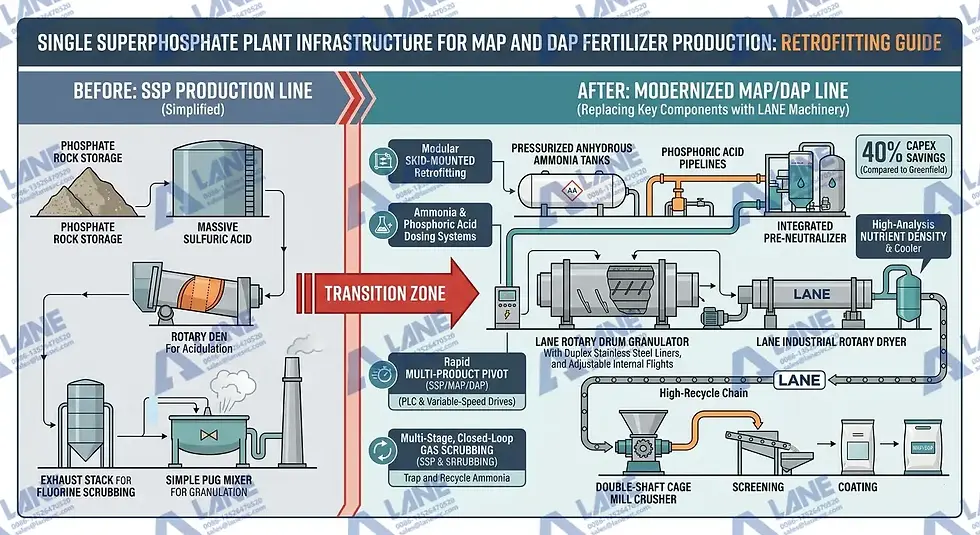
Modern MAP production has shifted away from traditional pre-neutralizer tanks toward Pipe Reactor Technology. In a LANE Heavy Industry production line, the phosphoric acid and ammonia react instantly within a specialized pipe reactor.
This process is exothermic, meaning it generates its own heat. By utilizing this energy, the moisture content of the resulting slurry is significantly reduced, which lowers the fuel consumption required in the subsequent drying stage. This "green" approach to chemical heat utilization is a hallmark of efficient MAP plant design.
3. Granulation: Shaping the Product
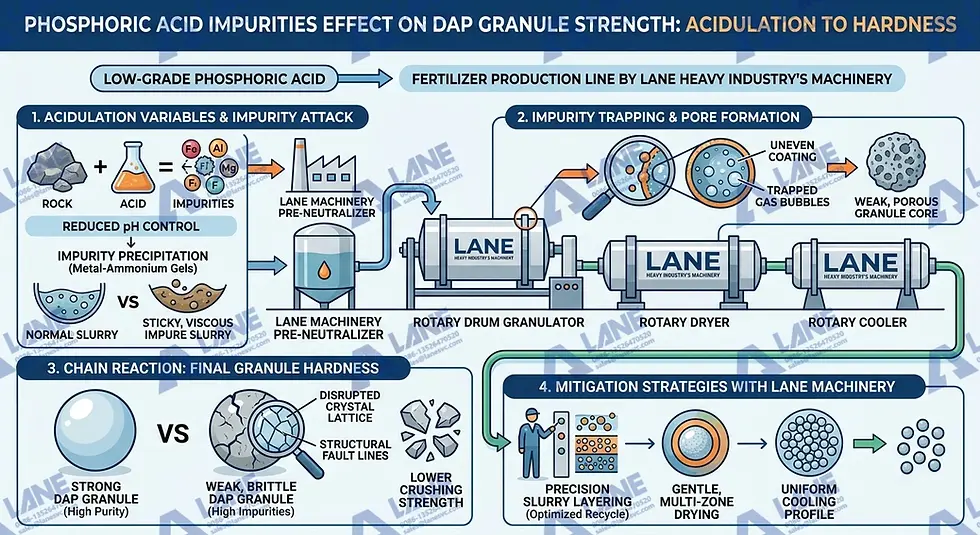
Once the MAP slurry is formed, it is sprayed into a Rotary Drum Granulator. This is where the physical quality of the fertilizer is determined.
Coating and Layering: As the drum rotates, the slurry coats "seed" particles, building them up into uniform spheres.
Precision Control: LANE’s granulators feature adjustable speeds and internal flights designed to optimize the rolling motion, ensuring that the final granules are hard, dust-free, and within the 2-4mm target range.
4. Drying and Cooling: Ensuring Stability
A 100,000 ton MAP production plant generates a vast amount of material that must be stabilized before packaging.
Rotary Dryer: Using a counter-current or co-current airflow, the dryer reduces moisture to less than 1%. LANE’s dryers are lined with specialized materials to prevent the sticky MAP particles from adhering to the drum.
Rotary Cooler: Cooling is critical to prevent "caking" in storage. The granules are brought down to near-ambient temperatures, ensuring they remain free-flowing during transport.
5. Screening and Recycling
Efficiency is defined by the "recycle ratio." In a LANE production line, high-frequency vibrating screens separate the product:
Oversize: Crushed and returned to the granulator.
Fines: Returned directly to the granulator as seed material.
On-size: Proceed to the final coating and packaging stage.

6. Commissioning: The Road to Full Capacity
Before we hand over the production line to the buyer, we do "dry runs" to test mechanical alignment followed by "wet runs" where raw materials are introduced. We provide on-site technical support to calibrate the automated PLC control systems, ensuring that the transition from a cold plant to a steaming 100,000-ton powerhouse is seamless and safe.
FAQ: 100,000 Ton MAP Production Plant
Q1: What is the footprint required for a 100,000 ton MAP plant?
Typically, a plant of this capacity requires approximately 5,000 to 8,000 square meters, depending on the storage requirements for raw phosphoric acid and finished product silos.
Q2: Can this line produce other fertilizers like DAP?
Yes. LANE Heavy Industry designs many of its lines with flexibility. By adjusting the molar ratio of ammonia to phosphoric acid and modifying the granulation parameters, the same line can often be adapted to produce Diammonium Phosphate (DAP) or NPK compounds.
Q3: How does LANE Heavy Industry address environmental concerns?
Our MAP production lines include integrated scrubbing systems. These units capture ammonia slip and dust particles, recycling them back into the process as a dilute acid solution, ensuring compliance with international emission standards.

Email: sales@lanesvc.com
Contact number: +86 13526470520
Whatsapp: +86 13526470520

Comments