


Understanding the Role of a Pellet Machine Used in Tofu Cat Litter Production
- celine zhang
- Jan 13
- 4 min read

Table of Contents
Introduction to Pellet Machines in Tofu Cat Litter Production
Why Pellet Formation Is Different in Tofu Cat Litter
What a Pellet Machine Actually Does During the Forming Stage
Common Pellet Quality Issues Linked to Improper Pelletizing
How Pellet Machines Interact With Upstream and Downstream Processes
Industry Trends in Pellet Machine Design for Tofu Cat Litter
Final Thoughts on Pellet Machines in Tofu Cat Litter Manufacturing
Introduction to Pellet Machines in Tofu Cat Litter Production
In recent years, tofu-based cat litter has gained wide attention due to its biodegradable nature, flushability, and plant-based origin. As more manufacturers enter this segment, production challenges that were once secondary have become increasingly visible. One of the most frequently discussed—but often misunderstood—elements is the pellet machine used in tofu cat litter production.
Rather than being a standalone solution, the pellet machine plays a transitional role between material preparation and downstream stabilization. Its influence extends beyond shaping pellets; it directly affects density, internal bonding, and how pellets behave during drying, screening, and packaging. Understanding this role from a process perspective is essential before attempting to optimize product quality or scale production.

Why Pellet Formation Is Different in Tofu Cat Litter
Pelletizing tofu cat litter is fundamentally different from pelletizing mineral-based or synthetic materials. The core reason lies in the raw material composition.
Tofu cat litter is typically derived from plant-based residues rich in fiber and protein. These materials absorb water easily, deform under pressure, and recover partially after compression. This elastic behavior means that pellet shape is not “locked in” at the moment of extrusion or rolling.
As a result, the pellet machine used in tofu cat litter production must interact with material behavior rather than simply force it into shape. Over-compression may lead to internal stress, while under-compression often results in pellets that collapse or fragment later in the process.
This is why pellet formation in tofu cat litter should be viewed as controlled consolidation, not aggressive shaping.
What a Pellet Machine Actually Does During the Forming Stage
From a process standpoint, the pellet machine performs three essential functions:
It consolidates mixed material into a defined geometry
It redistributes moisture and fiber alignment
It creates internal cohesion sufficient for downstream handling
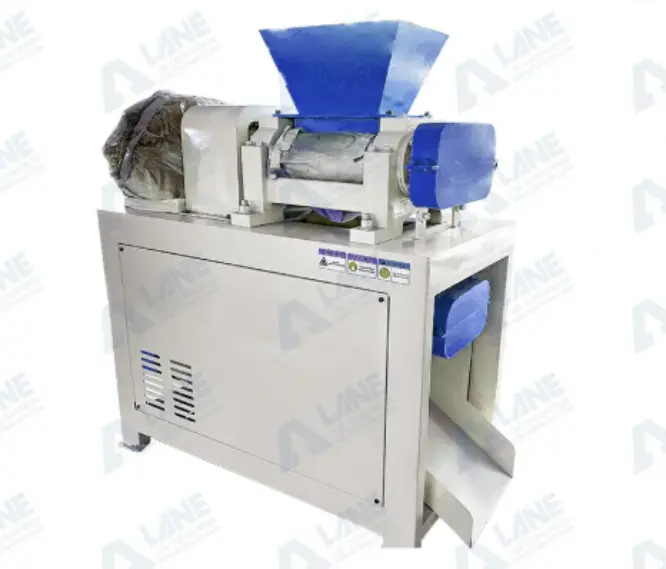
Unlike common assumptions, the pellet machine used in tofu cat litter production does not “finish” the pellet. Instead, it prepares the pellet for drying, where final hardness and stability are developed.
During forming, pressure, residence time, and surface interaction all influence pellet behavior. Even slight variations can change how pellets respond to thermal stress later. This explains why pellet quality issues are often misattributed to drying when their origin lies earlier in the forming stage.
Common Pellet Quality Issues Linked to Improper Pelletizing
Many quality issues observed in finished tofu cat litter can be traced back to pelletizing behavior rather than formulation alone.
Common symptoms include:
Pellets that appear intact after forming but crack after drying
Excessive fines generation during screening
Pellets that soften quickly when exposed to humidity
In many cases, these problems occur when the pellet machine used in tofu cat litter production does not match the material’s moisture window or fiber structure. Pellets may leave the forming stage looking acceptable, only to fail under thermal or mechanical stress.
Understanding this cause-and-effect relationship allows manufacturers to adjust process logic instead of repeatedly modifying formulations.
How Pellet Machines Interact With Upstream and Downstream Processes
Pelletizing never operates in isolation. Its effectiveness depends heavily on upstream preparation and downstream stabilization.
Upstream, inconsistent mixing or uneven moisture distribution leads to pellets with variable internal density. No pellet machine used in tofu cat litter production can fully compensate for poorly prepared feed material.
Downstream, drying amplifies any weaknesses created during forming. Pellets with uneven compression shrink irregularly, increasing breakage risk during screening and conveying.
This interconnected behavior is why many experienced producers evaluate pellet machines as part of a process chain, not as individual units.

Industry Trends in Pellet Machine Design for Tofu Cat Litter
As tofu cat litter production matures, industry expectations for pellet machines are also evolving.
Instead of focusing solely on output capacity, manufacturers are paying closer attention to forming consistency and long-term operational stability. There is growing interest in pellet machine designs that apply pressure more gradually, allowing plant-based materials to bind naturally rather than being forced into shape.
For companies expanding into tofu cat litter, understanding how a pellet machine used in tofu cat litter production aligns with material behavior is becoming a competitive advantage rather than a technical detail.
Final Thoughts on Pellet Machines in Tofu Cat Litter Manufacturing
The pellet machine occupies a critical but often underestimated position in tofu cat litter production. Its role is not limited to shaping pellets; it influences material behavior throughout the entire production line.
Viewing the pellet machine used in tofu cat litter production as part of a broader process system helps manufacturers diagnose quality issues more effectively and build more resilient production strategies. As the industry continues to grow, this process-level understanding will matter as much as equipment selection itself.
LANE Heavy Industry looks forward to having the opportunity to cooperate with you.

Email: sales@lanesvc.com
Contact number: +86 13526470520
Whatsapp: +86 13526470520


Comments