


Optimizing Efficiency: A Guide to Modern Muriate of Potash Plant Machines


In the global food industry fertilizer stands as the backbone of agriculture productivity. One of the most essential parts of the fertilizer industry is potassium chloride, commonly known as Muriate of Potash (MOP). This fertilizer support plant water retention, enzyme activation, and photosynthesis to boost crop yield and quality. To meet the rising demand for high-quality MOP, modern Muriate of Potash plant machines must prioritize efficiency, consistency, and energy savings.
LANE Heavy Industry has emerged as a leader in the fertilizer integrated machinery solutions. Our machines transform raw potash into high-value, nutrient-rich granules. This guide explores the critical components of a modern MOP production line and how optimizing these machines can revolutionize your output.
The Role of MOP in Global Agriculture
Potassium is one of the three essential micronutrients for plant growth. Muriate of Potash is the most utilized potassium source because of its high potassium concentration and cost-effectiveness. However, raw potash is often mined in a form that is too irregular for modern farming equipment. This is where LANE’s tailored c come into play. These machines are designed to take potassium ore and convert them into uniform dust-free granules that can easily spread across vast farmlands.

The LANE Heavy Industry Production Line: A Breakdown
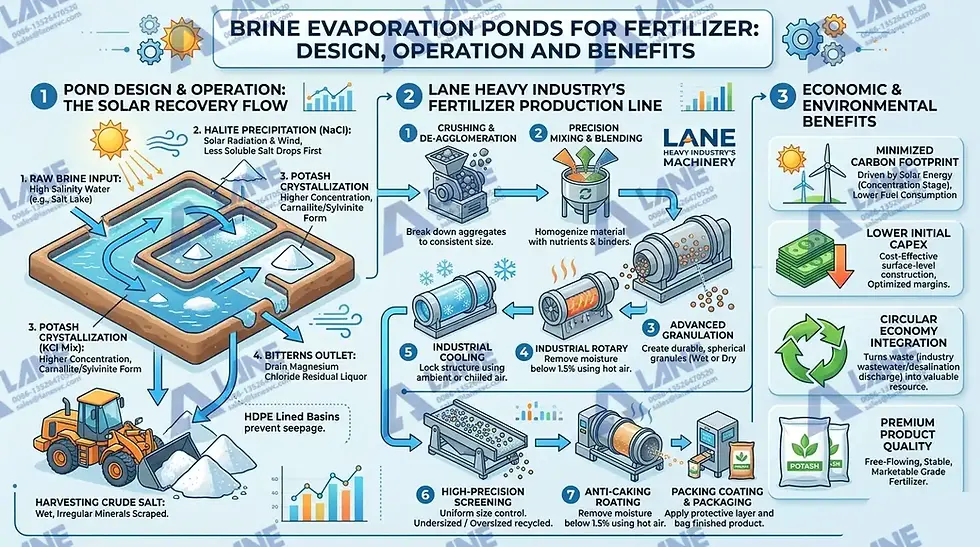
A high-efficiency production line is a symphony of synchronized equipment. LANE Heavy Industry focuses on a "dry granulation" process. Our process is more energy-efficient than wet methods for potash. Here are the core Muriate of Potash plant machines that define a modern facility:
1. The Dynamic batching System
Efficiency begins with precision. Modern systems utilize automated belt scales and hoppers to ensure the raw MOP is fed into the system at a constant rate. Inconsistent feeding leads to "surges" in the rollers, which can damage equipment and produce uneven granules. LANE dynamic feeding system accurately measures and discharges material to the production line.
2. The Crushing and Breaking System
The raw material and raw MOP need to be crushed for even distribution of the nutrients. LANE uses ball mills/impact crusher in this stage.
This is the "beating heart" of the Muriate of Potash plant machines. Unlike wet granulation which requires binders and massive drying drums, the LANE Double Roller Press uses mechanical pressure to squeeze MOP powder into solid flakes.
High Pressure: The rollers exert immense force to overcome the natural repulsion of the particles.
Low Energy: Because no water is added, the need for high-heat drying is eliminated, saving up to 40% in energy costs.
4. The Screening Machine
Consistency is the hallmark of a premium fertilizer. The Rotary screening or The vibrating screening machine separates the product into three streams:
Oversize: Sent back to the crusher.
Product Grade: Sent to the next stage.
Undersize (Fines): Recycled back to the roller press. Optimization of these Muriate of Potash plant machines involves fine-tuning the vibration frequency to ensure maximum throughput with minimal clogging.
5. Polishing and Coating
To prevent caking during transport and storage, the granules are often "polished" to remove sharp edges and then coated with a thin layer of oil or wax. This ensures the farmer receives a free-flowing product that doesn't clog their seeders.
Strategies for Optimizing Plant Efficiency
Investing in Muriate of Potash plant machines is only the first step. To achieve peak ROI, plant managers must focus on three pillars:
I. Material Moisture Control
While MOP granulation is a "dry" process, the ambient moisture of the raw material must be strictly monitored. If the potash is too dry, it won't bond; if it's too damp, it will stick to the rollers. LANE’s integrated sensors help maintain the "sweet spot" for optimal compaction.
II. Wear-Resistant Metallurgy
Muriate of Potash is inherently abrasive and corrosive. The rollers in your Muriate of Potash plant machines are subject to extreme wear. Using LANE’s specialized alloy surfaces—often treated with surface hardening technologies—can extend the lifespan of the rollers by 300% compared to standard steel.
III. Automated Control Systems (PLC)
The modern fertilizer plant is a "smart" plant. By using Centralized PLC systems, operators can monitor the load on each machine in real-time. If the screening machine becomes bogged down, the system automatically slows the feeder, preventing a total line shutdown.

Why Choose LANE Heavy Industry Machinery?
LANE Heavy Industry doesn't just sell individual Muriate of Potash plant machines; they provide a modular ecosystem. our equipment is designed with a small footprint, making it ideal for both new installations and retrofitting existing plants.
By focusing on the dry extrusion method, LANE helps producers bypass the need for expensive boilers and large-scale drying cylinders, drastically lowering the initial capital expenditure (CAPEX) and ongoing operational costs (OPEX).
The Environmental Impact of Modern Machines
As environmental regulations tighten, the "dust-free" nature of modern Muriate of Potash plant machines becomes a competitive advantage. High-efficiency dust collection systems integrated into the LANE production line ensure that nearly 99% of airborne particles are captured and recycled back into the granulation process. This not only protects the environment but also ensures that every ounce of raw material is turned into a saleable product.
Conclusion
The modern Muriate of Potash plant machines have turned fertilizer production from a messy, energy-intensive process into a streamlined science. Investing in modern Muriate of Potash plant machines from LANE Heavy Industry delivers higher production efficiency, consistent product quality, lower energy costs, and greater flexibility. As global demand for MOP grows, producers who adopt these advanced Muriate of Potash plant machines gain a competitive edge
FAQ: Muriate of Potash Plant Machines
Q: Can these machines handle other types of fertilizer?
A: Yes, LANE’s roller press technology is versatile and can be used for NPK compounds, Ammonium Sulfate, and other chemical powders, though settings must be adjusted for each material.
Q: What is the average lifespan of the rollers?
A: Depending on the abrasiveness of the potash and the hours of operation, LANE rollers typically last between 8,000 to 12,000 hours before requiring resurfacing or replacement.
Q: Is the dry granulation process better than the wet process?
A: For Muriate of Potash, dry granulation is often preferred because it avoids the high cost of drying and uses significantly less water, making it eco-friendlier and more cost-effective.

Email: sales@lanesvc.com
Contact number: +86 13526470520
Whatsapp: +86 13526470520


Comments