


MOP Fertilizer with Additive Plant: Complete Production Process & Quality Control

Updated: Mar 25

MOP (Muriate of Potash) is a widely is the most popular potassium fertilizer. It improves crop yield and quality. Enhancing MOP with additives can increase nutrient efficiency and plant absorption, making it a preferred choice for modern agriculture. Starting a MOP Fertilizer with Additive Plant is a promising business opportunity. LANE Heavy industry offers customized solution for large-scale production. It combines advance machinery, optimized process and quality control.
This article explores the complete production workflow, the machinery involved, and how quality is maintained throughout. The quality and consistency of MOP Fertilizer with Additive Plant directly determine its market competitiveness and agricultural effectiveness. By leveraging LANE’s advanced production lines, understanding market demand, and following this guide, investors can launch a profitable MOP Fertilizer with Additive Plant business that meets the needs of modern agriculture and delivers long-term returns.
MOP Fertilizer with Additive Plant: Overview
The MOP Fertilizer with Additive Plant integrates potash granulation with the blending of beneficial additives such as micronutrients, anti-caking agents, or controlled-release compounds. This integration ensures uniform nutrient distribution in every granule and enhance fertilizer effectiveness. LANE Heavy Industry designs and manufactures MOP fertilizer production lines that are flexible, energy-efficient and fully automated. This allows farmers and fertilizer manufacturers to produce high-quality MOP-based fertilizer reliably.

Complete Production Process
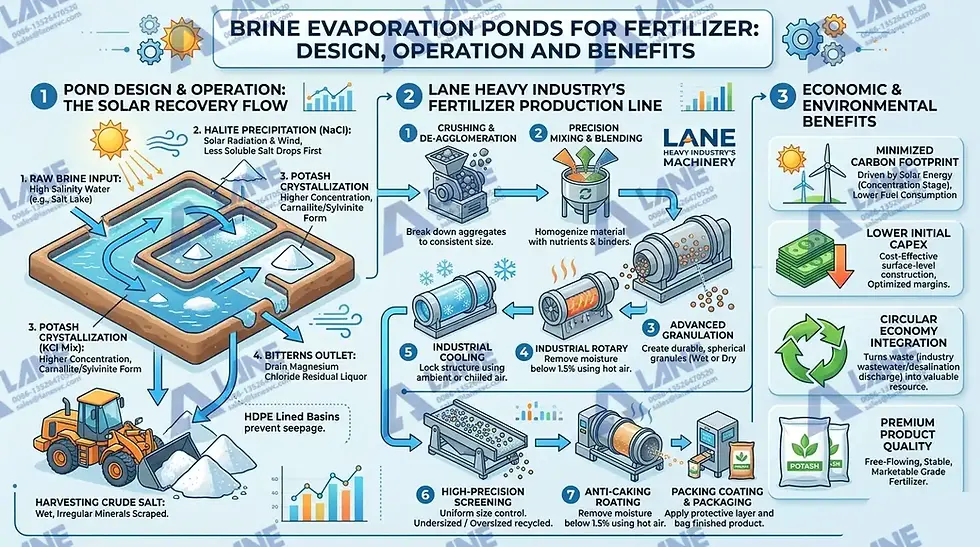
Raw Material Preparation: The raw materials are prepared and stored in safe container. It saves the raw material from any kind of contamination. High-purity MOP crystals are first screened and crushed to achieve uniform particle size. Additives like sulfur, magnesium, or iron compounds are also measured accurately. Proper raw material preparation ensures smooth processing and consistent product quality.
Mixing: In this stage, MOP and additives are blended in precise proportions using LANE Heavy Industry’s high-capacity Horizontal mixer or twin-shaft mixer. The equipment’s ensures homogeneous mixing, which is critical for nutrient uniformity. This step is particularly important when working with multiple additives to ensure each granule contains the intended nutrient profile.
Granulation: Granulation is a key step in the MOP Fertilizer with Additive Plant. LANE Heavy Industry offers Double Roller granulator and Rotary Drum granulators are designed to produce dense, round, and durable granules. During granulation, additives are fully integrated into MOP, preventing nutrient segregation. Advanced moisture and temperature control during this step ensure the granules maintain optimal physical properties.
Drying: Granules generated in the granulation stage contain excess moisture that can affect storage and quality. In the drying phase, granules pass through a rotary dryer equipped with energy-efficient burners and precise airflow control. Drying ensures that MOP granules with additives are stable, free-flowing, and resistant to caking.
Cooling: After drying, granules are hot and may stick together if cooled insufficiently. The MOP Fertilizer with Additive Plant uses a counterflow cooler to bring the granules to ambient temperature gradually. This step preserves granule integrity and ensures consistent size distribution.
Screening & Sieving: Granules are then screened with our Rotary Screening machine to remove oversized or undersized particles. Oversized particles can be crushed and recycled into the granulation stage, while fine particles are returned to the mixer. This loop guarantees high efficiency and minimal waste in the MOP Fertilizer with Additive Plant.
Coating & Anti-Caking Treatment: Some MOP fertilizers with additives may include anti-caking agents or coatings to improve storage stability. This optional step prevents clumping and ensures smooth spreading during agricultural application. LANE Heavy Industry provides efficient coating drums that evenly apply additives to the granules’ surface.
Packaging & Storage: Finally, the finished MOP granules with additives are conveyed to automatic packaging machines. Multi-layer bags or bulk storage silos can be used depending on market requirements. Packaging ensures minimal nutrient loss and protects the product from moisture.
Quality Control in MOP Fertilizer with Additive Plant
Quality is a top priority in any MOP Fertilizer with Additive Plant. LANE Heavy Industry implements rigorous monitoring at every stage:
Raw Material Inspection: Ensures purity and correct particle size before production.
Mixing Homogeneity Tests: Samples are analyzed to confirm uniform additive distribution.
Granule Strength & Size Analysis: Ensures durability during transport and application.
Moisture & Temperature Control: Critical for drying and storage stability.
Final Product Testing: Fertilizer is analyzed for nutrient content, caking, and flowability.
These quality control measures guarantee that each batch meets international standards and customer expectations.

Advantages of LANE Heavy Industry’s MOP Fertilizer with Additive Plant
High automation and minimal labor requirement.
Energy-efficient production, reducing operational costs.
Consistent granule size and nutrient uniformity.
Integrated additive system for enhanced fertilizer performance.
Flexible design suitable for large-scale or modular expansion.
FAQ: MOP Fertilizer with Additive Plant
Q1: What is the primary purpose of a MOP Fertilizer with Additive Plant?
A: It produces high-quality MOP fertilizer granules with integrated additives for improved nutrient absorption and crop yield.
Q2: Can different additives be used in the plant?
A: Yes, the plant is flexible and can incorporate micronutrients, anti-caking agents, or controlled-release compounds.
Q3: How does LANE Heavy Industry ensure uniform mixing?
A: Through advanced mixing systems and real-time quality monitoring, ensuring every granule has a consistent nutrient profile.
Q4: What is the typical production capacity?
A: Production capacity varies by plant configuration but can range from 10,000 to 100,000 tons per year, depending on customer requirements.
Q5: Is the plant energy-efficient?
A: Yes, LANE Heavy Industry designs its MOP Fertilizer with Additive Plant with energy-saving dryers, coolers, and granulators.
Conclusion
A MOP Fertilizer with Additive Plant equipped with LANE Heavy Industry machinery delivers the precision, consistency, and efficiency required for premium fertilizer production. Our cutting-edge production ensures high-quality, nutrient-rich granules that meet modern agricultural demands. By implementing quality control protocols across production line, we make sure producers can manufacture additive-enhanced MOP fertilizers. Only products that meet international and industry standards are allowed to leave the factory.

Email: sales@lanesvc.com
Contact number: +86 13526470520
Whatsapp: +86 13526470520


Comments