


MOP Fertilizer Granulation Plant for Wheat: Production & Application Guide


Wheat is a staple crop worldwide. It needs nutrient for growth. Potassium is one of the most crucial nutrients for wheat growth. Sufficient potassium is critical for the healthy growth, stress resistance and high yield. The MOP fertilizer granulation plant for wheat is the key equipment to process raw MOP into granular fertilizer that is easy to apply, store and transport. For large-scale production, investing in a MOP fertilizer granulation plant for wheat from LANE Heavy Industry can streamline fertilizer manufacturing.
This guide details the production process of MOP fertilizer plant, practical application and answer some common questions.
Why Choose a MOP Fertilizer Granulation Plant for Wheat?
A MOP fertilizer granulation plant for wheat is designed to produce uniform, high-quality potassium chloride granules suitable for wheat cultivation. Potassium as a fertilizer enhances root development, strengthens steams, and increases resistance to drought and disease in wheat. Using a modern granulation plant ensure that the fertilizer produced has optimal granule size, moisture content and nutrient distribution.
LANE Heavy Industry’s machinery is known for high efficiency, low energy consumption, and long-term durability. Their production lines are customizable to meet the specific requirements of large, medium, and small-scale fertilizer manufacturers.

Components of a MOP Fertilizer Granulation Plant for Wheat
A complete MOP fertilizer granulation plant for wheat includes several key components:
Raw Material Handling Equipment: The raw materials are dusty and can be easily be contaminated. LANE offers storage silos, belt conveyors, and feeders for smooth material transport. Potassium chloride is the primary raw material.
Granulation System: LANE Heavy Industry offers rotary drum granulators and Double Roller granulators. These machines convert powdered MOP into uniform granules suitable for wheat fields.
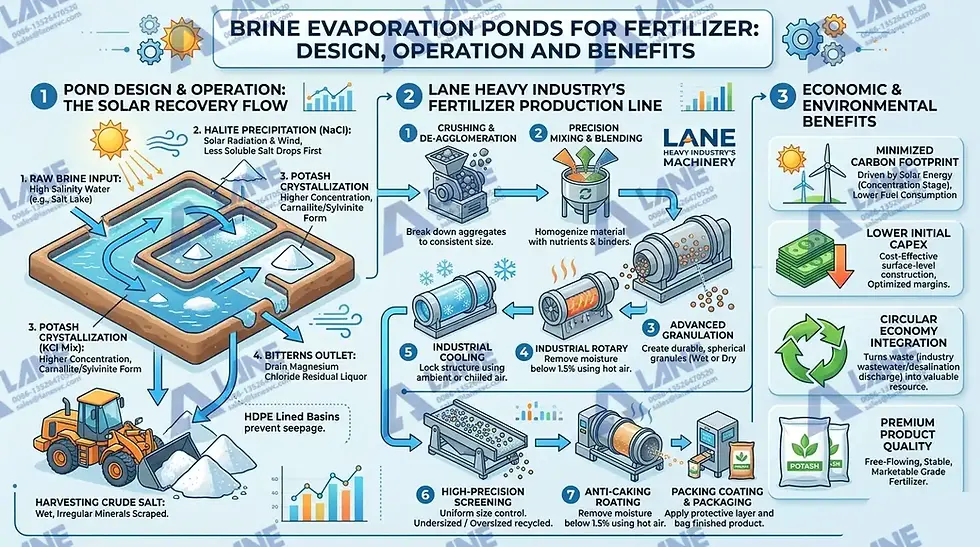
Drying & Cooling Equipment: After wet granulation the granules contain high moisture and needs to be reduced to prevent caking. Rotary dryers and coolers ensure granules are stable for storage and transport.
Screening and Crushing Machines: LANE vibrating screening machine separate oversized granules and break down clumps to produce uniform-size MOP granules, ideal for spreading in wheat fields.
Packing System – Automatic packing machines ensure the fertilizer is securely bagged for storage and distribution.
LANE Heavy Industry ensures all equipment in a MOP fertilizer granulation plant for wheat is energy-efficient, reliable, and easy to operate, allowing manufacturers to maximize production capacity with minimal downtime.
Production Process of MOP Fertilizer for Wheat
The production of MOP fertilizer in a granulation plant involves several steps:
Raw Material Preparation – Muriate of Potash is crushed and screened to a fine powder. Any impurities are removed to ensure high-quality granules.
Granulation – Using Double Roller or rotary drum granulators, powdered MOP is transformed into spherical granules. Moisture content and temperature are closely controlled to prevent cracking.
Drying – Granules are dried in rotary dryers to reduce moisture content to around 1–2%, making them suitable for storage.
Cooling – Hot granules are cooled using rotary coolers to stabilize the product and improve handling.
Screening and Recirculation – Oversized or undersized granules are crushed and recycled back into the granulator to ensure uniformity. The on-size granules are conveyed to the packing machine.
Packing – Finished MOP granules are weighed and packed using automatic packaging machines for shipment.
With a MOP fertilizer granulation plant for wheat, the entire process is automated, ensuring consistent quality and efficiency.

Application of MOP Fertilizer in Wheat Fields
MOP fertilizer is primarily used to supply potassium. It’s a vital nutrient for wheat growth. Proper application enhances grain size, resistance to diseases, and drought tolerance. Here are some key tips:
Timing: Apply MOP during pre-sowing or at the tillering stage for maximum nutrient absorption.
Dosage: – Typical potassium requirements range from 60–120 kg per hectare, depending on soil fertility.
Method – Broadcasting, banding, or mixing MOP with other fertilizers ensures even distribution.
Combination Fertilization – MOP can be used alongside nitrogen (N) and phosphorus (P) fertilizers to achieve balanced nutrition.
Using MOP granules produced from a high-quality MOP fertilizer granulation plant for wheat ensures slow, uniform nutrient release, preventing wastage and environmental impact.
Advantages of LANE Heavy Industry’s MOP Fertilizer Granulation Plant for Wheat
High Efficiency – Advanced granulators produce more fertilizer per hour with lower energy consumption.
Customizable Production Lines – Scalable solutions for small, medium, and large operations.
Uniform Granule Size – Reduces wastage during application and improves crop absorption.
Durable Machinery – Long-lasting equipment minimizes maintenance costs.
Automated Processes – Reduces labor costs and improves operational safety.
FAQ
Q1: What is the typical production capacity of a MOP fertilizer granulation plant for wheat?
A: Depending on the configuration, production ranges from 2 tons/hour to over 20 tons/hour.
Q2: Can the plant produce other potassium-based fertilizers?
A: Yes, LANE Heavy Industry machinery can be adapted for NPK and other compound fertilizers.
Q3: How uniform are the granules produced?
A: Granules are highly uniform, typically 2–4 mm in diameter, ideal for wheat field application.
Q4: Is the plant energy-efficient?
A: Yes, advanced drying and granulation technologies minimize energy consumption.
Q5: What is the lifespan of the machinery?
A: With proper maintenance, the equipment can operate reliably for over 15 years.

Email: sales@lanesvc.com
Contact number: +86 13526470520
Whatsapp: +86 13526470520


Comments