


A Deep Dive into the NPK Fertilizer Industrial Plant with Potassium Chloride Granulation Process


Introduction
In modern agriculture, efficient nutrient delivery is crucial for crop yield and quality. Because of that the demand for high-efficiency, nutrient-balanced fertilizers continues to rise. Among the production solution for compound fertilizer, NPK fertilizer industrial plant with Potassium Chloride offers a reliable solution for large-scale production while ensuring premium granules and enhanced potassium content. NPK fertilizers contains Nitrogen (N), Phosphorus (P), and Potassium (K). They are wildly used for balanced soil nutrition. When paired with advanced machinery from LANE Heavy Industry, the NPK fertilizer industrial plant with Potassium Chloride achieves unmatched efficiency, consistency, and product quality, revolutionizing how farmers access high-performance fertilizers.
What is an NPK Fertilizer Industrial Plant with Potassium Chloride?
An NPK fertilizer industrial plant with Potassium Chloride is a specialized facility designed for manufacturing compound fertilizers with precise nutrient ratios. The addition of Potassium Chloride enhances potassium levels, critical for plant growth, root development, and stress resistance. LANE Heavy Industry provides NPK production lines optimized for granulation, drying, cooling, and packaging. Our plants are ideal for enterprises aiming for high output, consistent quality, and operational efficiency.
Key Components of the NPK Fertilizer Industrial Plant with Potassium Chloride
1. Raw Material Preparation
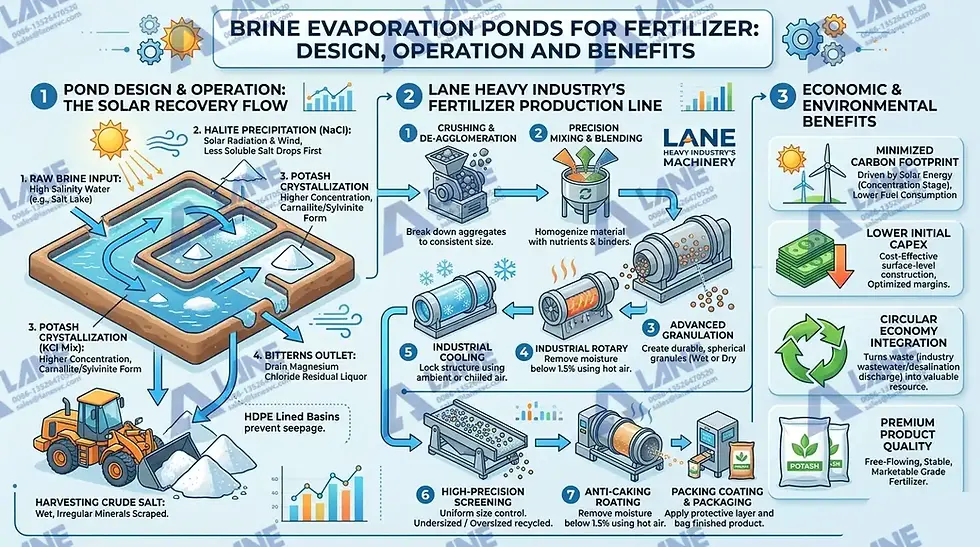
The production process begins with crushing, screening, and mixing raw materials such as urea, ammonium phosphate, and Potassium Chloride. LANE Heavy Industry’s crushers and mixers ensure uniform particle sizes, preventing nutrient segregation and ensuring a consistent final product.

2. Granulation
Granulation is the core process in an NPK fertilizer industrial plant with Potassium Chloride. Potassium Chloride is blended into the mixture and formed into uniform granules using high-efficiency Rotary Drum granulators. LANE Heavy Industry’s technology ensures high granulation rates, low energy consumption, and stable particle size, which improves fertilizer application efficiency.
Granules contain moisture after formation, which must be reduced for storage and handling. Rotary dryers remove excess water, while rotary coolers lower granule temperature, preventing caking. LANE Heavy Industry focuses on energy-efficient designs, reducing operational costs while maintaining granule quality.
4. Screening and Coating
Vibrating Screening separates granules by size, ensuring uniformity. Oversized or undersized particles are recycled into the granulator. Optional coating drums apply anti-caking agents, particularly important for Potassium Chloride-based fertilizers prone to moisture absorption.
5. Packaging and Storage
The final product is packaged using automated bagging systems, facilitating high-volume production with minimal labor. LANE Heavy Industry’s integrated solutions streamline packaging, maintaining product quality and market readiness.
Advantages of Using LANE Heavy Industry’s Production Line
High Efficiency: Achieves high granulation rates and output.
Energy Saving: Optimized machinery reduces electricity and fuel consumption.
Flexibility: Supports various NPK ratios and additional nutrients.
Durability: Constructed from wear-resistant materials for long-term operation.
Automation: Integrated control systems reduce human error and labor costs.
Applications of NPK Fertilizer Industrial Plant with Potassium Chloride
The NPK fertilizers produced are suitable for:
Cereals and grains
Vegetables and fruits
Cash crops and plantations
The inclusion of Potassium Chloride improves crop quality, yield, and resistance to environmental stress. Farmers benefit from easy-to-apply granules with consistent nutrient release.

Conclusion
The NPK fertilizer industrial plant with Potassium Chloride represents the pinnacle of modern fertilizer manufacturing. LANE heavy Industry faces the challenge of granulation by transforming low-viscosity KCl into uniform, high-strength fertilizer granules with our Rotary Drum Granulator. For companies seeking reliable, high-performing fertilizer production solutions, investing in an NPK fertilizer industrial plant with Potassium Chloride is a strategic choice for long-term growth and success. With balling rates exceeding 95%, robust corrosion-resistant construction, and comprehensive automation, LANE’s production lines offer fertilizer manufacturers a reliable path to high-quality NPK production.
FAQ: NPK Fertilizer Industrial Plant with Potassium Chloride
Q1: What is the production capacity of such a plant?
A1: LANE Heavy Industry offers plants with capacities ranging from 30,000 to 300,000 tons per year, customizable to client needs.
Q2: Why is Potassium Chloride added to NPK fertilizers?
A2: It provides essential potassium, promoting root development, stress resistance, and improved crop quality.
Q3: Can this plant produce different NPK ratios?
A3: Yes, the production line can adjust raw material ratios to create various NPK combinations.
Q4: How energy-efficient is the plant?
A4: The plant uses energy-saving dryers, coolers, and granulators, significantly reducing electricity consumption.

Email: sales@lanesvc.com
Contact number: +86 13526470520
Whatsapp: +86 13526470520


Comments