


What Is Potassium Fertilizers Salt Index? Everything You Need to Know

The Potassium fertilizers salt index is one of the most overlooked factors in fertilizer selection and soil management. It helps farmers, agronomists, and manufacturers to understand how potassium sources affect soil salinity and plant health. Farmers apply potassium to boost crops drought resistance, stalk strength, and overall yield. But if you select the wrong potassium or apply in wrong application method, you could dehydrate your plants from the roots.
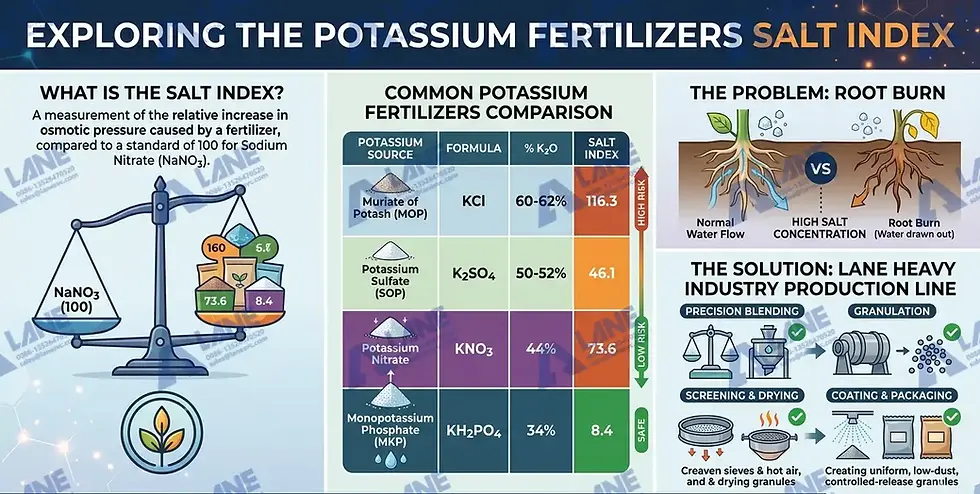
The Potassium fertilizers salt index measures how much a fertilizer increases the osmotic pressure of the soil solution compared to a standard reference (usually sodium nitrate). A higher index result means greater chance of salt stress on plants. In this article we explain about potassium fertilizer salt index and how potassium fertilizer production line from LANE help you produce low salt index potassium fertilizer.
Why the Potassium Fertilizers Salt Index Matters
Plants absorb water through osmosis. When soil salinity increases due to fertilizer application, water becomes harder for roots to absorb—even if moisture is available. This leads to:
Seed germination problems
Root burn or dehydration stress
Reduced nutrient uptake
Lower crop yield
The Potassium fertilizers salt index helps growers predict these risks and choose safer fertilizer options for sensitive crops such as vegetables, fruits, and greenhouse plants.
It is especially important in:
Greenhouse farming systems
Drip irrigation and fertigation
Sandy or low-buffer soils
High-value crop production

How Potassium Fertilizers Affect Soil Salinity
Different potassium fertilizers behave differently in soil because of their chemical composition. Some dissolve quickly and release more ions into the soil solution, increasing salinity, while others are more balanced or contain additional nutrients that reduce stress.
For example:
Potassium chloride releases chloride ions, increasing salt load
Potassium sulfate has a moderate effect on salinity
Monopotassium phosphate is highly efficient with very low salt impact
This variation is why the Potassium fertilizers salt index is critical when comparing fertilizer types.
Potassium Fertilizers Salt Index Comparison
Different potassium fertilizer sources have significantly different salt index values:
Potassium Fertilizer | Chemical Formula | Grade (N-P-K) | Relative Salt Index |
Potassium Chloride (MOP) | KCl | 0-0-60 | 116 |
Potassium Nitrate | KNO₃ | 13-0-44 | 74 |
Potassium Sulfate (SOP) | K₂SO₄ | 0-0-50 | 46 |
K-Mag (Sulpo-mag) | K₂SO₄·MgSO₄ | 0-0-22-11 | 43 |
Key observations from this potassium fertilizers salt index comparison:
Potassium chloride (MOP) has the highest salt index at 116, making it most likely to cause fertilizer burn when applied near seeds
Potassium sulfate (SOP) has a significantly lower salt index of 46, making it safer for sensitive crops and in-furrow applications
K-Mag offers an excellent low-salt alternative at 43 while providing additional magnesium and sulfur nutrients
Potassium nitrate falls in the middle range at 74, offering both nitrogen and potassium with moderate salt risk
Potassium Fertilizer Production Line from LANE Heavy Industry
LANE Heavy Industry provides complete fertilizer production systems designed to manufacture high-quality potassium-based fertilizers with stable performance and controlled chemical properties.
A standard production line includes several integrated systems:
Raw Material Processing System: Raw materials are crushed with chain crusher or cage crusher and prepared to ensure uniform particle size, improving reaction efficiency and product consistency.
Automatic Batching System: Precise dosing technology ensures accurate nutrient ratios, which is critical for controlling fertilizer quality and maintaining consistent Potassium fertilizers salt index levels.
Mixing Equipment: High-efficiency horizontal mixers guarantee uniform blending of potassium sources with nitrogen, phosphorus, and additives.
Granulation System: LANE offers multiple granulation technologies, including:
Rotary drum granulators
Double roller extrusion granulators
These machines produce strong, uniform granules suitable for commercial fertilizer distribution.
Drying and Cooling System: Moisture control improves granule hardness, reduces caking, and enhances storage stability.
Screening System: Separates qualified granules from oversize and undersize particles to ensure product uniformity.
Packaging System: Automated weighing and packaging systems increase efficiency and reduce labor costs.

Conclusion
The Potassium fertilizers salt index is kay factor often overlook but is necessary for determining the safety, efficiency, and crop performance of the fertilizer. Understanding potassium fertilizers salt index is essential for making informed fertilizer selection and application decisions. Potassium chloride remains the most common and economical potassium source despite its high salt index of 116, while potassium sulfate and K-Mag offer lower-salt alternatives for sensitive applications.
Turnkey solution from LANE Heavy Industry ensures consistent quality, formulation control, and the ability to produce various potassium fertilizer grades with predictable salt index characteristics.
Frequently Asked Questions (FAQ)
Q1: What is the salt index of potassium chloride?
A: Potassium chloride (muriate of potash) has a relative salt index of 116, the highest among common potassium fertilizers.
Q2: Which potassium fertilizer has the lowest salt index?
A: K-Mag has the lowest salt index at 43, making it safest for sensitive crops while providing magnesium and sulfur.
Q3: What salt index is safe for in-furrow application?
A: Products with salt indexes less than 20 should be used for in-furrow applications on sensitive crops.
Q4: How is salt index calculated?
A: Salt index compares the osmotic pressure increase from a fertilizer to the same weight of sodium nitrate (assigned value of 100).
Q5: Can production lines control salt index?
A: Yes, LANE Heavy Industry's automated blending and quality control systems enable precise formulation control to produce specific salt index values.
Email: sales@lanesvc.com
Contact number: +86 13526470520
Whatsapp: +86 13526470520


Comments