


Small-Scale Organic Liquid Fertilizer Production Line for Italy Local Farms

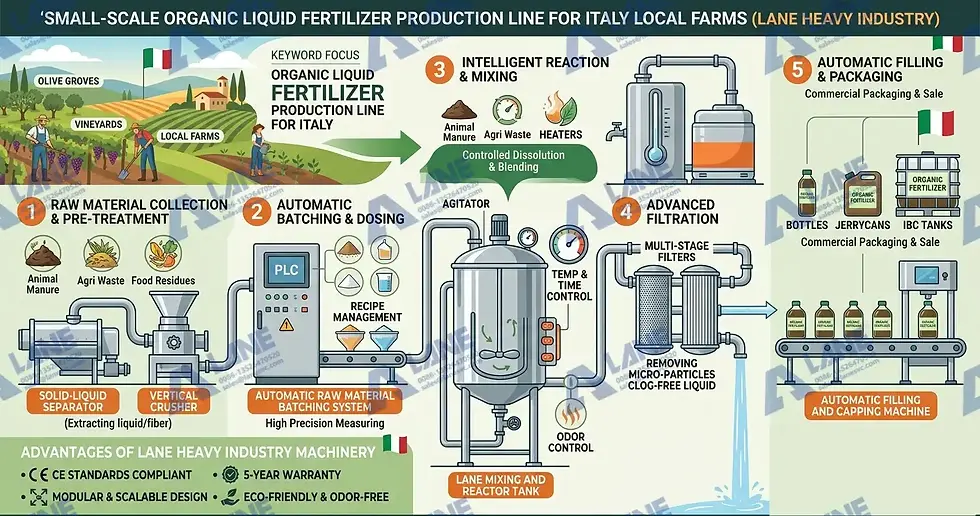
Italy is famous for its agriculture industry. They are known for premium crops such as wine grapes, olives, durum wheat, fruits, and vegetables, all of which depend on efficient, high-quality nutrient management. Small farms seek affordable and efficient path toward sustainable agriculture. This helps producers turn organic raw materials into valuable liquid nutrients that support healthier soils, stronger crops, and more precise fertilization. An organic liquid fertilizer production line for Italy gives small producers a way to convert organic raw materials into a marketable fertilizer that supports soil health, crop vigor, and sustainable farming goals.
By utilizing local waste such as animal manure, agricultural residues, and food processing by-products, farms can produce high-value bio-stimulants and liquid nutrients. A small-scale production line allows local farms to convert livestock manure, food waste, and crop residues into nutrient-rich liquid fertilizer. With modern liquid fertilizer production equipment from LANE Heavy Industry, Italian farmers can reduce production costs, improve soil health, and support circular agriculture.
Why Italy Needs Localized Liquid Organic Fertilizer Production
Italian agriculture thrives on premium-quality cash crops, including grapes, olives, citrus fruits, and vegetables. These crops respond exceptionally well to liquid fertigation and foliar spraying due to the rapid nutrient absorption rates.
Investing in a specialized organic liquid fertilizer production line for Italy solves three critical challenges for local regional hubs:
Waste Management: It converts abundant regional organic waste (such as grape pomace from wineries or olive cake from mills) into premium bio-fertilizers.
Cost Reduction: It bypasses expensive international logistics and soaring commercial fertilizer prices by manufacturing inputs directly on-site or regionally.
Soil Conservation: It restores organic carbon levels in Mediterranean soils, aligning perfectly with the European Union’s Green Deal and organic farming mandates.

Core Machinery for a Compact Farm-Scale Line
A small-scale organic liquid fertilizer production line for Italy from LANE typically features these key pieces of equipment, optimized for farm-level throughput:
Solid-Liquid Separator: Reduces moisture in fresh manure, separating solids for composting and liquids for further processing.
Stainless Steel Fermentation Tank: Equipped with heating, insulation, and a stirring mechanism to accelerate aerobic or anaerobic decomposition using microbial inoculants.
Duplex Filtration Unit: Removes fine particles down to 100 microns, preventing nozzle clogging during application.
UV Sterilizer: Eliminates pathogens, ensuring the liquid fertilizer is safe for edible crops without chemical preservatives.
Mixing and Formulation Tank: Enables blending with permitted micronutrients, seaweed extracts, or molasses to create custom recipes for vineyards, olive groves, or vegetable farms.
Manual or Semi-Automatic Filling Station: Dispenses finished liquid into 5L, 10L, or 20L containers suitable for on-farm use or local sale.
This setup provides everything an Italian farm needs to transform raw organic waste into a stable, ready-to-use liquid fertilizer. LANE’s equipment is tailored to the exact feedstock the farm has available, whether that’s dairy cow slurry in Lombardy, grape marc in Tuscany, or olive mill wastewater in Puglia. Each organic liquid fertilizer production line for Italy is a custom configuration, not a one-size-fits-all product.
Advantages of LANE Heavy Industry Equipment for Italian Farms
Compliance with CE Standards: All machinery from LANE Heavy Industry comes with optional international certifications (CE, ISO9001), fulfilling strict European safety and environmental regulations.
Modular & Scalable Design: The small-scale organic liquid fertilizer production line for Italy is built with space constraints in mind. It can easily be expanded by adding extra reactor tanks if regional demand spikes.
Five-Year Equipment Warranty: LANE provides an industry-leading five-year warranty alongside 24/7 remote technical guidance, giving local Italian operators long-term investment security.
Eco-Friendly Closed Systems: The closed-loop design recycles rinsing agents and contains vapors, ensuring the entire organic liquid fertilizer production line for Italy remains odor-free and eco-friendly.

Market Potential in Italy
Italy’s organic farming industry is one of the largest in Europe. This creates strong opportunities for local fertilizer production.
By investing in an Organic liquid fertilizer production line for Italy, farms can:
Produce fertilizer for internal use
Sell organic fertilizer locally
Create additional income streams
Improve agricultural sustainability
With increasing environmental awareness, the future market for organic liquid fertilizer remains highly promising.
FAQ
1. What is the ideal capacity for a small-scale Organic liquid fertilizer production line for Italy?
Most local farms choose systems with capacities ranging from 1–10 tons per day.
2. Can the production line process animal manure?
Yes, livestock and poultry manure are common raw materials for liquid fertilizer production.
3. Is the system fully automated?
LANE Heavy Industry provides semi-automatic and fully automatic solutions depending on customer needs.
4. How long does the fermentation process take?
Fermentation usually takes between 5 and 15 days.
Email: sales@lanesvc.com
Contact number: +86 13526470520
Whatsapp: +86 13526470520


Comments