


Installation & Maintenance of the 15 TPH Customizable Organic Fertilizer Production System


Organic fertilizer is made from bio-degradable organic matters, manure, sea and fish wastes. To create organic fertilizer, you must have an efficient organic fertilizer production line. Investing in a high-capacity production line is only the first step. The 15 TPH customizable organic fertilizer production system from LANE Heavy Industry is designed to meet the growing demand for high-quality organic fertilizer production. LANE Heavy Industry engineers its equipment for durability but even the most durable machinery requires correct setup and ongoing care to deliver consistent 15-ton-per-hour output.
Table of Contents
Pre-Installation: Site Preparation
Foundation and Anchoring
Assembly and Alignment
Commissioning and Trial Run
Daily Maintenance Checklist
Weekly and Monthly Maintenance
Wear Parts Management
Frequently Asked Questions (FAQ)
Conclusion
1. Pre-Installation: Site Preparation
Before the first component of your 15 TPH customizable organic fertilizer production system arrives, proper site preparation is crucial. LANE Heavy Industry provides detailed layout drawings, but the following factors must be addressed by the client:
Space Requirements: A 15 TPH customizable organic fertilizer production system requires a footprint of 1,500–2,500 square meters, depending on configuration (including raw material storage, processing area, and finished product warehouse).
Power Supply: The system demands a stable three-phase power supply. Ensure that the installed transformer capacity matches the total motor power (often 300–500 kW) with adequate safety margin.
Overhead Crane: For maintenance of heavy components like the rotary drum granulator and dryer, an overhead crane with sufficient lifting capacity (minimum 5 tons) must be installed.
LANE Heavy Industry’s technical team can conduct a site survey to verify that your facility meets the requirements for a 15 TPH customizable organic fertilizer production system.
2. Foundation and Anchoring
A 15 TPH customizable organic fertilizer production system includes rotating equipment that generates significant dynamic loads. Improper foundations lead to misalignment, excessive vibration, and premature bearing failure.
Concrete Foundation: LANE provides detailed foundation drawings. The concrete must have adequate thickness (typically 400–600 mm) and reinforcement to support the weight of the equipment and dampen vibrations.
Anchor Bolts: Use high-strength anchor bolts positioned according to LANE’s template. After the concrete cures, the equipment is leveled using precision shims before final tightening.

3. Assembly and Alignment
Assembling a 15 TPH customizable organic fertilizer production system requires experienced technicians. LANE Heavy Industry offers on-site supervision to ensure correct assembly:
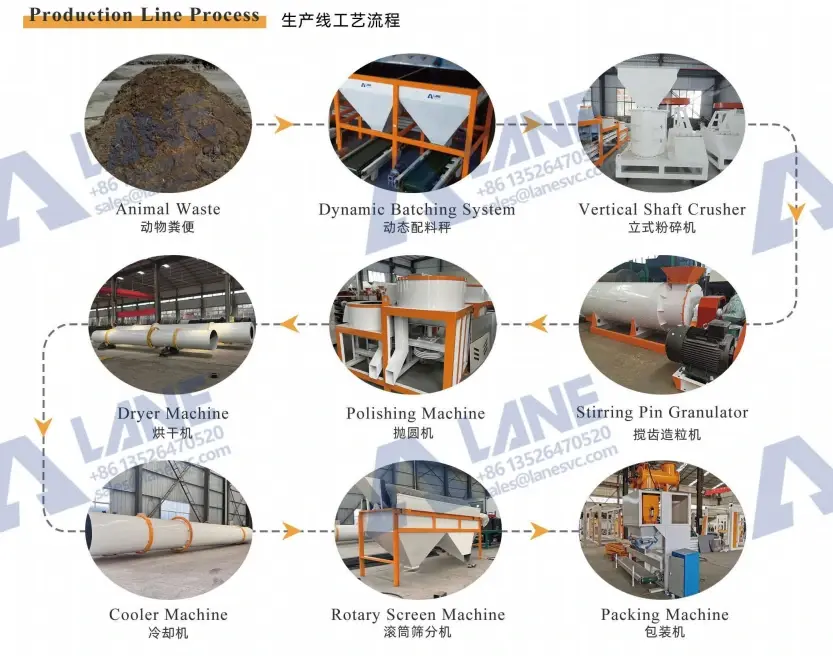
Component Placement: Modules such as the hammer crusher, twin shaft mixer, Stirring Pin granulator, dryer, cooler, Rotary screener, and coating machine are positioned according to the flow sequence.
Alignment: The rotary drum granulator and dryer are critical. Their alignment must be checked with laser alignment tools to ensure the drum runs true and the support rollers wear evenly.
Conveyor Installation: Belt conveyors and bucket elevators must be aligned to prevent belt tracking issues.
4. Commissioning and Trial Run
Once assembled, the 15 TPH customizable organic fertilizer production system undergoes a commissioning phase:
No-Load Test: Each motor is run individually to check rotation direction, temperature rise, and vibration.
Load Test: The system is fed with raw materials at gradually increasing throughput. LANE’s engineers adjust parameters (e.g., dryer temperature, granulator speed) to achieve the rated 15 TPH output.
Training: LANE provides on-site training for your operators, covering startup sequences, shutdown procedures, and emergency stops.
5. Daily Maintenance Checklist
To keep your 15 TPH customizable organic fertilizer production system running smoothly, operators should perform daily checks:
Lubrication: Verify oil levels in gearboxes and bearings. The 15 TPH customizable organic fertilizer production system uses centralized lubrication points; ensure grease is being supplied.
Belt Tension: Check conveyor belts for proper tension and tracking.
Fasteners: Inspect bolts on crusher hammers, mixer blades, and screen frames for tightness.
Unusual Noise/Vibration: Listen for abnormal sounds that may indicate bearing wear or material buildup.
6. Weekly and Monthly Maintenance
A more thorough inspection schedule extends the life of your 15 TPH customizable organic fertilizer production system:
Weekly: Clean magnetic separators to remove ferrous contaminants. Check dryer and cooler seals for air leaks. Inspect V-belts for wear and replace if frayed.
Monthly: Measure wear on crusher hammers and replace when they lose more than 30% of original mass. Check granulator drum lining thickness. Inspect all electrical connections in the control panel.
7. Wear Parts Management
Certain components of a 15 TPH customizable organic fertilizer production system are consumable. LANE Heavy Industry recommends maintaining a spare parts inventory to minimize downtime:
Crusher Hammers: Typically replaced every 500–800 hours, depending on material abrasiveness.
Granulator Liner Plates: Polyurethane or stainless-steel liners protect the drum; inspect monthly.
Sieve Screens: The rotary screener’s mesh should be inspected weekly for tears.
Seals and Bearings: Keep critical bearings and rotary seals in stock.
LANE Heavy Industry provides a comprehensive spare parts list with part numbers for your specific 15 TPH customizable organic fertilizer production system.
8. Frequently Asked Questions (FAQ)
Q1: How long does installation of the 15 TPH customizable organic fertilizer production system take?
A: With site preparation complete, the mechanical installation typically takes 20–30 working days. Commissioning and trial run add another 5–7 days. LANE Heavy Industry dispatches engineers to supervise the process.
Q2: What training does LANE provide for maintenance staff?
A: LANE provides hands-on training covering daily inspections, lubrication schedules, wear part replacement, and troubleshooting for your 15 TPH customizable organic fertilizer production system. Detailed operation and maintenance manuals are also supplied.
Q3: How often should the rotary dryer alignment be checked?
A: Alignment of the rotary dryer should be checked every 6 months. However, if you notice abnormal vibration or uneven tire wear, immediate inspection is required.

Email: sales@lanesvc.com
Contact number: +86 13526470520
Whatsapp: +86 13526470520


Comments