


How to Produce MAP Fertilizer: Common Mistakes and How to Avoid Them
- Efat Elahi
- Nov 27, 2025
- 4 min read

Monoammonium Phosphate (MAP) fertilizer has become one of the most reliable sources of phosphorus and nitrogen in modern agriculture. It dissolves well, blends easily, and remains stable during storage, which explains why more plants and distributors are trying to set up their own MAP fertilizer production lines. But producing MAP fertilizer is not as simple as combining phosphoric acid and ammonia. The process involves careful control, equipment coordination, and a deep understanding of how the material behaves at each stage.
Many new producers make similar mistakes—mistakes that lead to inconsistent granules, higher production costs, and quality issues that could have been avoided. This article focuses on the most common problems and explains how to prevent them, helping you maintain stable, efficient MAP fertilizer production.

Using Low-Purity Phosphoric Acid
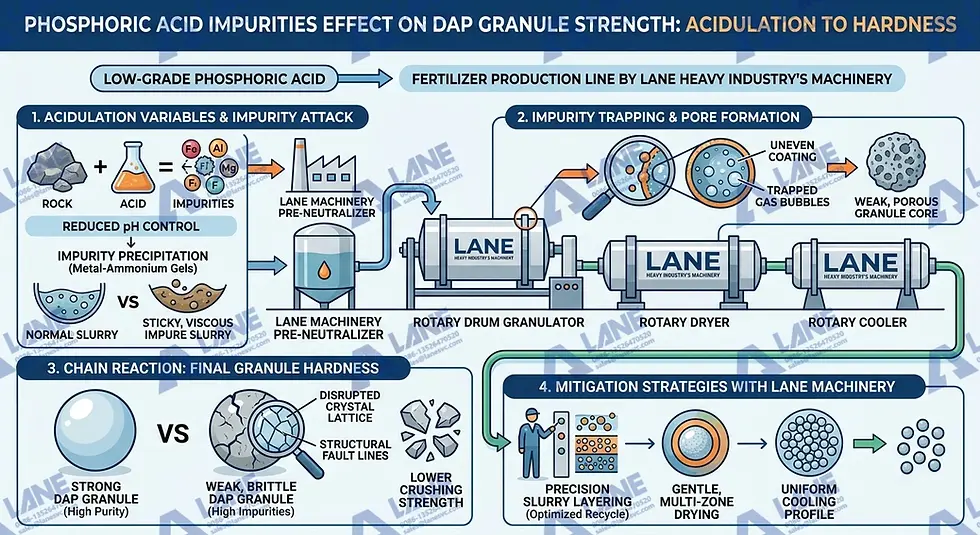
One of the biggest issues in MAP production begins before the process even starts: raw material quality. Producers sometimes choose lower-grade phosphoric acid because it is cheaper. But impurities such as iron, calcium, or magnesium disrupt the neutralization reaction, cause color changes, and reduce MAP purity.
How to Avoid It: Use industrial-grade or higher-purity phosphoric acid with stable P₂O₅ content. If you must use lower-grade acid, pre-filtration or impurity reduction steps should be added to prevent buildup inside pipelines and reactors.
Unbalanced Ammonia–Acid Reaction
MAP production depends on a precise chemical balance. Too much ammonia results in alkaline material that tends to cake. Too much acid leads to incomplete reactions and wet, sticky slurry. Both conditions make granulation difficult and reduce final nutrient stability.
How to Avoid It: Install flow-controlled ammonia lines and acid pumps so the reaction stays within the ideal NH₃/P₂O₅ ratio. Continuous monitoring ensures the slurry feeding the granulator is neither too wet nor too dry.
Poor Temperature Control During Slurry Preparation
Slurry temperature has a direct impact on granule quality. If it’s too low, the slurry becomes thick and resists mixing. If it’s too high, the material may over-react and dry prematurely, leading to dust generation or uneven granules.
How to Avoid It: Maintain a stable reaction temperature appropriate for MAP—typically controlled through steam injection systems, jacketed reactors, or automated temperature feedback loops.
Feeding a Slurry That Is Too Thin or Too Viscous
The slurry consistency defines how well it binds during granulation. Over-diluted slurry makes weak granules that break easily. Thick slurry forms large chunks and uneven particle sizes.
How to Avoid It: Adjust solid content and feed rate. The slurry should flow smoothly into the granulator but still contain enough viscosity to build strong granules during rolling or tumbling.
Improper Use of Granulation Equipment
Whether you use a pan granulator, rotary drum granulator, or double roller granulator, each machine has its own working principles. One of the most common mistakes is incorrect angle, rotational speed, or feeding position, which leads to an inconsistent size distribution.
How to Avoid It: Train operators to understand the behavior of MAP material inside the granulator. Keep equipment calibrated, and check that feeding, rotating, and layering match the optimal settings for MAP.
Insufficient Drying Capacity
MAP needs moisture reduction after granulation. If the dryer temperature is too low or retention time is too short, granules remain soft. If the temperature is excessively high, granules crack and create dust.
How to Avoid It: Use a rotary drum dryer with stable airflow and adjustable residence time. Moisture should reach a safe level suitable for storage and cooling, usually around 2% or slightly lower depending on your specification.
Skipping the Cooling Step
Some plants rely solely on natural cooling, which works for small batches but not for continuous production. Hot MAP granules become sticky, leading to caking in storage or during transportation.
How to Avoid It: A rotary cooler helps quickly stabilize MAP temperature and improve hardness. Cooling also reduces dust and prevents moisture migration inside bags.
Inaccurate Screening or Oversized Recycle Ratio
Poor screening results in too many oversized or undersized particles. Sending too much material back for re-granulation increases energy consumption, wear on equipment, and inconsistent output.
How to Avoid It: Use reliable screening machines with proper mesh size. Keep the recycle–product ratio balanced. This reduces cost, improves granule quality, and maintains smooth production flow.
Ignoring Anti-Caking Measures
Even perfectly manufactured MAP can cake if stored improperly. Warm granules, excess moisture, and long stacking times all contribute to this issue.
How to Avoid It: Cool thoroughly, use anti-caking agents if needed, and store the final MAP in a dry, ventilated warehouse. Packaging bags should be sealed to reduce humidity exposure.
Poor Quality Control and Lack of Real-Time Monitoring
Many MAP plants rely only on final-product testing, which means problems go unnoticed until the batch is finished. By then, losses are difficult to recover.
How to Avoid It: Adopt real-time monitoring strategies—temperature, slurry pH, moisture, ammonia flow, and granule strength. Early warnings prevent waste, downtime, and off-spec products.

Conclusion
Producing MAP fertilizer is not complicated, but doing it well requires attention to detail. Many producers fail not because they lack equipment, but because they overlook small variables that accumulate into major production inefficiencies. By avoiding the common mistakes discussed above—raw material issues, improper granulation control, poor drying or cooling, and weak quality management—you can build a more stable, profitable MAP fertilizer operation.
Email: sales@lanesvc.com
Contact number: +86 13526470520
Whatsapp: +86 13526470520


Comments