


How SOP Fertilizer Enhances Nutrient Use Efficiency in Salt Tolerant Soils

Table of Contents
Introduction
The Importance of SOP Fertilizer in Salt-Tolerant Soils
Benefits of SOP Fertilizer for Nutrient Use Efficiency
The SOP Fertilizer Production Process at LANE Heavy Industry
Environmental and Economic Benefits
Conclusion
Frequently Asked Questions (FAQs)
1. Introduction
Salt-tolerant soils present a unique challenge to agriculture. Soil salinity, exacerbated by irrigation and climatic conditions. It limits plants growth and reduces nutrient availability. Soil salinity affects over 1 billion hectares of land globally. In salt tolerant soils, fertilizers often fail to deliver optimal results due to ion antagonism and salt accumulation. (Sulfate of Potash) SOP Fertilizer in Salt-Tolerant Soils has emerged as a solution in this situation. This article explains the effectiveness of SOP Fertilizer in Salt-Tolerant Soils and how SOP fertilizer production line from LANE can help create high quality SOP fertilizer for Salt-Tolerant Soils.
2. The Importance of SOP Fertilizer in Salt-Tolerant Soils
Salt-tolerant soils are very common in arid and semi-arid regions. It contains high levels of soluble salts, including sodium chloride, which can impair the growth of most crops. These soils often present low capacity for holding nutrients. This makes it difficult for plants to absorb essential minerals like potassium, sulfur, and nitrogen.
SOP fertilizer provides a vital source of potassium and sulfur, both of which are crucial for plant health and development. The primary advantage of using SOP fertilizer in salt-tolerant soils lies in its chloride-free composition. Unlike Muriate of Potash (MOP), which contains chloride, SOP's sulfate form of potassium is non-toxic to crops that are sensitive to chloride, making it more suitable for these environments.

3. Benefits of SOP Fertilizer for Nutrient Use Efficiency
The use of SOP fertilizer in salt-tolerant soils improves nutrient use efficiency in several significant ways:
Improved Potassium Uptake
Potassium is essential for regulating water and nutrient transport within plant cells, especially under salinity stress. SOP fertilizer enhances potassium uptake, which helps plants maintain cellular function, regulate osmotic pressure, and improve overall drought and salinity tolerance.
Sulfate-Sulfur Benefits
Sulfate, the form of sulfur in SOP, is highly soluble and readily available to plants. Sulfur is crucial for enzyme activation, protein synthesis, and photosynthesis. In salt-affected soils, sulfur is often deficient, and the use of SOP fertilizer ensures an adequate sulfur supply to support plant metabolic functions.
Reduced Soil Salinity Impact
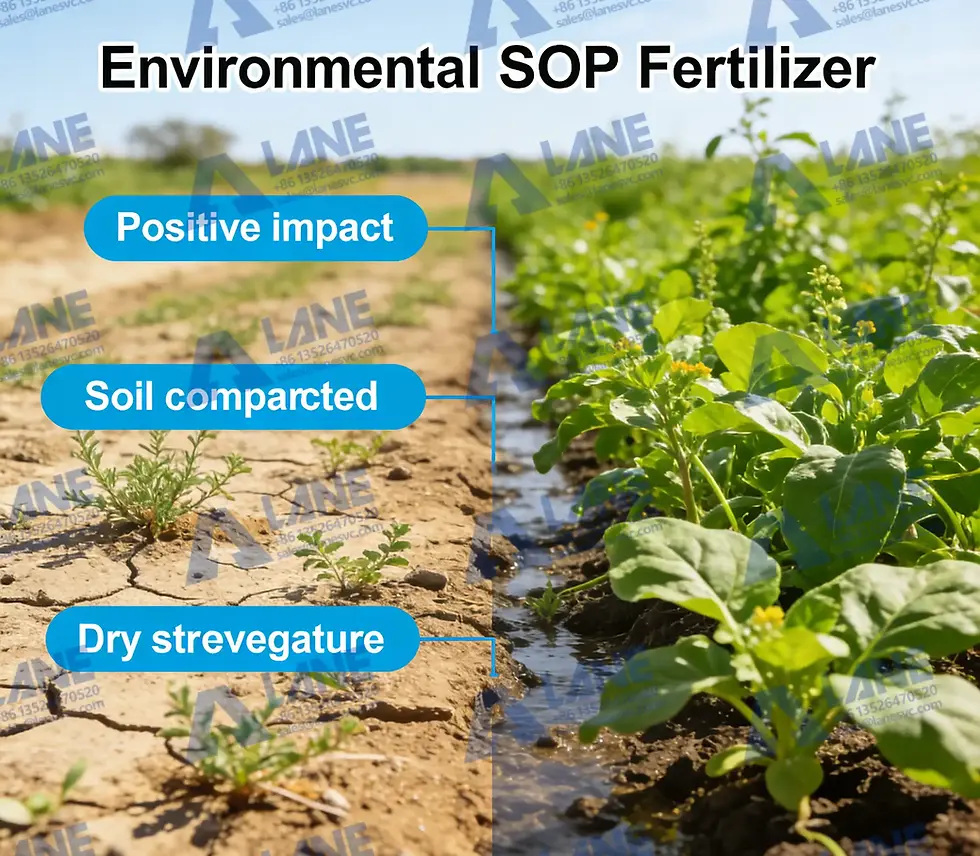
Potassium in SOP helps improve soil structure by encouraging the aggregation of soil particles. This process reduces soil compaction and improves water infiltration, allowing plants to better access the nutrients in the soil, even under high salinity conditions.
Better Crop Yield and Quality
SOP's balanced nutrient profile leads to stronger plant health, better disease resistance, and enhanced crop yield. The presence of potassium helps strengthen cell walls, reducing the susceptibility of crops to various pathogens, while sulfur enhances crop flavor and quality.
4. The SOP Fertilizer Production Process at LANE Heavy Industry
To meet the growing demand for high-quality SOP fertilizers, LANE Heavy Industry has developed a highly efficient SOP fertilizer production line. This state-of-the-art machinery ensures the production of high-purity SOP at large scales, using advanced technologies that improve both energy efficiency and cost-effectiveness.
Key Steps in the Production Process
Raw Material Preparation: The primary raw materials used in SOP production include potassium chloride (KCl) and sulfuric acid (H₂SO₄). These are carefully sourced and prepared for the chemical reaction that will yield potassium sulfate (SOP).
Reaction and Crystallization: The KCl and sulfuric acid are reacted under controlled conditions to produce potassium sulfate. The process also involves crystallization, where the potassium sulfate is formed into solid crystals.
Drying and Grading: The crystals are then dried to remove any residual moisture, ensuring the SOP fertilizer is in the ideal form for use. The final product is graded based on size and purity, with high-quality SOP being selected for agricultural applications.
Crushing and Mixing: The SOP crystals are sent to the LANE chain crusher for crushing into fine powder. This process helps even distribution of nutrients. Then the SOP powder is sent to the mixer to add nutrient to make custom formula.
Granulation: The dried SOP fertilizer is then sent to the double roller granulator for granulation. This machine uses two double opposing rollers to compact the powder into granules.
Screening and coating: After granulation, granules are conveyed to Rotary Screening machine. It separates on-size granules from the fine and oversized granules and sent them back to crusher to recycle into granules. On-size granules are sent to coating machine for extra shelf life.
Packaging and Distribution: Finally, the SOP fertilizer is packaged into various sizes and distributed to farmers and agricultural suppliers. LANE’s machinery guarantees that each batch meets stringent quality standards, ensuring farmers get the best possible product for their crops.

5. Environmental and Economic Benefits
Using SOP fertilizer in salt-tolerant soils offers both environmental and economic advantages:
Environmental Benefits
Chloride-Free: SOP’s chloride-free nature ensures it does not contribute to further salinity or soil degradation, making it an environmentally sustainable choice.
Reduced Leaching: SOP’s slow-release mechanism means that the nutrients are absorbed more effectively, reducing the risk of nutrient leaching into groundwater.
Improved Soil Health: By enhancing potassium availability, SOP helps maintain optimal soil structure, improving aeration and reducing the risk of soil erosion.
Economic Benefits
Increased Yields: The enhanced nutrient uptake from SOP results in higher crop yields, improving farmers' profitability.
Cost-Effective: Although SOP may be slightly more expensive than other fertilizers, its efficiency in salt-affected soils reduces the overall need for multiple applications, making it more cost-effective in the long run.
6. Conclusion
SOP fertilizer enhances nutrient use efficiency in salt tolerant soils through chloride-free nutrition, pH regulation, and synergistic nutrient effects. It provides essential potassium and sulfur to crops without exacerbating salinity issues. Its balanced composition and ability to enhance soil structure make it an ideal choice for farmers dealing with salt-affected soils. LANE Heavy Industry’s SOP fertilizer production produces fertilizer with high precision and efficiency, ensuring farmers have access to SOP Fertilizer in Salt-Tolerant Soils, which can enhance their yields and crop quality with
7. Frequently Asked Questions (FAQs)
Q1: What is SOP fertilizer?
SOP (Sulfate of Potash) is a premium fertilizer containing potassium and sulfur, both essential nutrients for plant growth. It is especially effective in environments with salt-tolerant soils, as it is free from chloride, unlike MOP (Muriate of Potash).
Q2: How does SOP fertilizer improve nutrient use efficiency in salt-tolerant soils?
SOP fertilizer improves nutrient uptake by supplying potassium and sulfur in forms that are readily available to plants. It also helps improve soil structure and reduces the negative impacts of salinity on crops.
Q3: Why is SOP fertilizer better for salt-tolerant soils than MOP?
SOP fertilizer is chloride-free, which prevents the toxic effects of chloride on crops. MOP, on the other hand, contains chloride, which can worsen salinity stress and negatively impact plant health in salt-affected soils.
Q4: What are the benefits of using LANE Heavy Industry's machinery for SOP production?
LANE Heavy Industry’s machinery ensures high-quality SOP production with optimized energy use and efficiency. Their advanced systems allow for large-scale production while maintaining product consistency and minimizing waste.
Q5: Can SOP fertilizer be used on all types of crops?
While SOP fertilizer is highly effective for salt-sensitive crops like fruits and vegetables, it can be used for a variety of crops, especially in soils with high salinity or chloride sensitivity.

Email: sales@lanesvc.com
Contact number: +86 13526470520
Whatsapp: +86 13526470520


Comments